
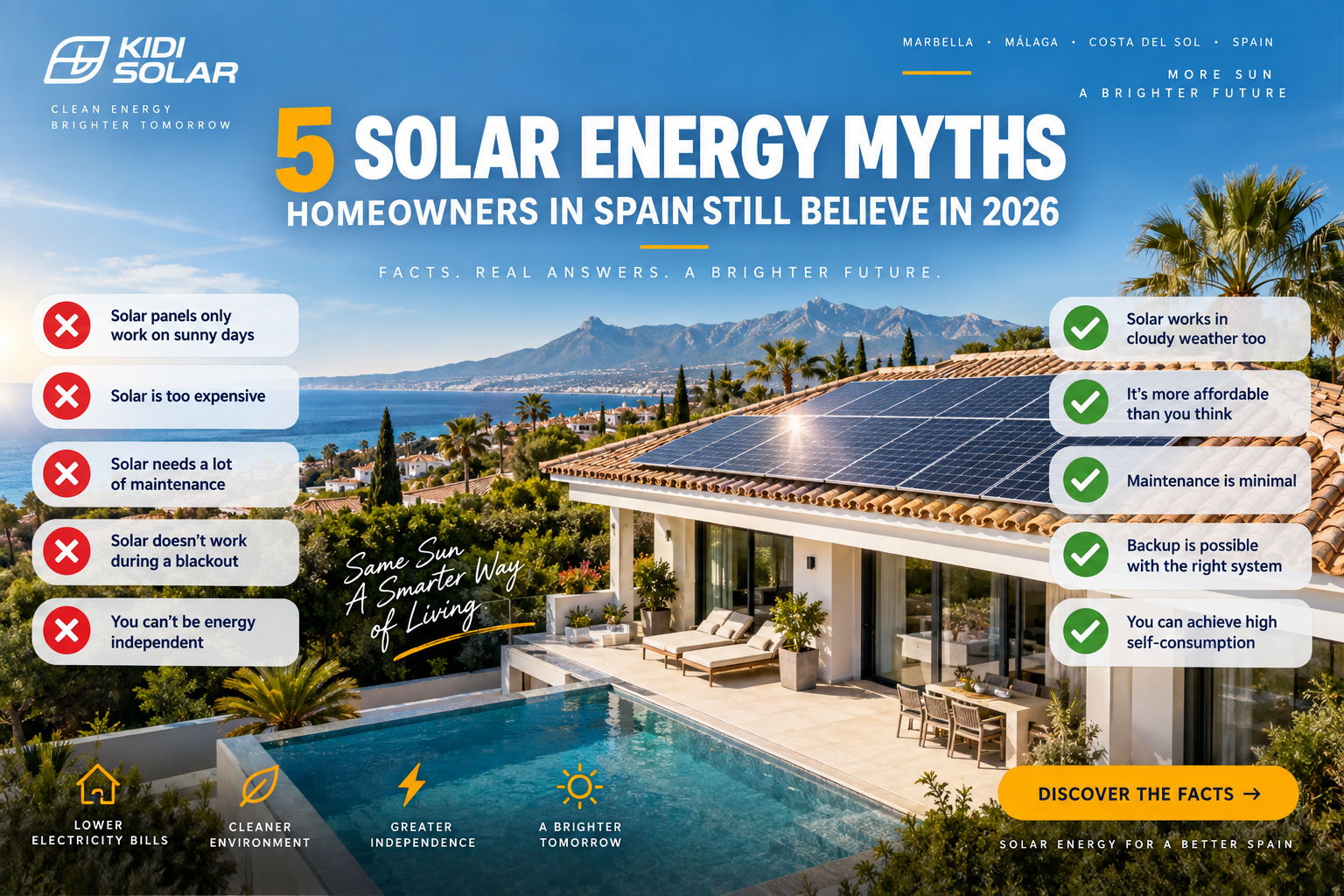
Solar energy has become mainstream across Spain, and the Costa del Sol in particular now has thousands of residential and commercial installations. Yet homeowners, villa owners and expats still repeat claims about cost, cloudy weather, batteries, maintenance, payback and blackout protection that were only ever partly true, or that reflect how the technology and the market worked several years ago rather than in 2026.
Some of these myths are simply wrong. Others come from oversimplified marketing — a kernel of truth stretched into a universal promise. This guide goes through the most persistent solar myths in Spain, explains what is accurate, what is exaggerated, and what genuinely depends on the property, so that homeowners on the Costa del Sol can evaluate solar on realistic terms rather than slogans.
Myth 1: Solar Panels Only Work on Hot, Sunny Days
Solar panels need light, not heat. A photovoltaic cell generates electricity whenever it receives sunlight, including direct sunlight on a clear day and the diffuse light that reaches the ground on an overcast one. Output on a cloudy day is lower than on a clear day — often substantially lower — because less total light energy is reaching the panel, but the system does not simply switch off.
Seasonal output also varies. Andalucía has strong annual solar resource compared to most of Europe, but shorter winter days and lower sun angles still mean less total generation per day in December than in July, even on a clear day. This is a function of daylight hours and irradiance, not of temperature.
There is also a separate, and often confused, effect worth understanding: the temperature coefficient. Photovoltaic cells can lose a small amount of instantaneous electrical efficiency as they get hotter, so a panel can, in principle, convert sunlight to electricity slightly more efficiently on a cold, bright day than on a very hot one. That does not mean cold weather always produces more energy overall — total daily generation still depends heavily on day length and cloud cover, both of which usually favour summer despite the heat. The practical takeaway is that orientation, shading and system design affect output far more than whether a given day feels hot or cold.
Myth 2: Solar Panels Are Too Expensive and Take Forever to Pay Back
Solar is a capital investment, and like any investment its return depends on the specific numbers involved rather than a fixed rule. Payback period is shaped by the property’s electricity tariff, the price paid for the system, how much of the generated electricity is actually self-consumed versus exported, the compensation received for any exported surplus, the available roof space, and how the system is sized relative to real consumption.
Because these variables differ from one home to the next, there is no single accurate payback figure that applies to every installation in Spain. A villa with high daytime consumption — a pool pump, air conditioning, an EV charger — can self-consume a large share of its solar generation and see a comparatively fast payback. A property that is empty during the day and consumes mainly in the evening will self-consume less of its solar output unless paired with a battery, which changes the economics again. For a detailed look at what actually drives installation costs in Spain, see solar panel installation cost in Spain; businesses evaluating solar for commercial premises can also review commercial solar ROI in Spain.
Myth 3: Solar Panels Require Constant Maintenance
Modern grid-connected PV systems generally need limited routine maintenance, but “maintenance-free” is also misleading. A well-designed system still benefits from periodic attention.
In practice, this usually means an occasional visual inspection of the panels and mounting structure, cleaning if dust, pollen or other residue has built up enough to noticeably affect output, and keeping an eye on the inverter’s monitoring data or alerts, since a sudden drop in generation is often the first sign something needs attention. Electrical connectors and roof penetrations should also be checked periodically as part of a normal system health check.
On the Costa del Sol specifically, the coastal environment adds a consideration that inland installations do not face to the same degree: salt-laden air and airborne dust can accumulate on panel surfaces and on exposed metal components faster than in drier inland locations, which is one reason periodic inspection matters more near the coast. For an overview of what upkeep a system on the Costa del Sol typically needs, see solar maintenance.
Myth 4: A Solar System Can Power Your Home During Any Blackout
This is one of the most important misconceptions to clear up, because it affects real expectations during a power cut. A standard grid-connected solar installation, without a battery and backup configuration, is designed to shut down automatically during a grid outage. This is a safety requirement: it prevents the system from feeding electricity back into lines that utility workers may be repairing.
Genuine backup power during a blackout requires specific equipment: a hybrid inverter with backup or EPS (emergency power supply) output, a battery to store energy, and correctly designed backup circuits that isolate the protected loads from the wider grid connection. Without this combination, solar panels alone — even a large array — will not power the home when the grid goes down. Homeowners who want blackout protection should discuss this explicitly with their installer rather than assuming any solar system provides it; see solar battery cost and payback in Spain for how battery-backed systems are typically evaluated.
Myth 5: Solar Panels Can Make Every Home 100% Energy Independent
Full energy independence is possible in some specially designed systems, but it is not an automatic outcome of installing solar panels. Achieving it usually requires a system deliberately oversized relative to typical daily consumption, enough battery capacity to cover overnight and low-generation periods, and — for genuinely off-grid properties — often a backup generator for extended periods of low sun, such as a run of cloudy winter days.
For a normal grid-connected home, it is more useful to think in terms of three separate concepts rather than one promise of “independence”: high self-consumption, which is a realistic and common goal where the household uses a large share of what it generates; backup capability, which covers specific circuits during an outage if the system is designed for it; and full off-grid independence, which is a much larger and more expensive undertaking. Seasonal variation, night-time consumption and the property’s actual load profile all affect which of these is realistic for a given home, and no responsible installer should promise guaranteed 100% independence without a system genuinely designed and sized for it.
Myth 6: Solar Batteries Are Always Necessary
A battery is optional for many grid-connected homes, not a mandatory component of a solar system. Whether one makes sense depends on the household’s consumption pattern and on the compensation available for exported surplus electricity.
A home with strong daytime consumption — for example, a villa where the pool pump, air conditioning and other major loads run mainly during daylight hours — may already self-consume most of its solar generation without a battery. A home where consumption is concentrated in the evening, after solar generation has dropped off, will self-consume a smaller share of its solar output unless it adds storage, though surplus compensation schemes can still make a battery-free system worthwhile depending on the numbers. Battery cost, expected cycle life and the value of backup power during outages all factor into whether storage pays for itself in a given case — it is not something that is always necessary and not something that is never worth it.
Myth 7: Solar Panels Become Useless After 20–25 Years
Solar panels degrade gradually rather than failing outright at a fixed age. It is worth separating three related but distinct concepts that get conflated in this myth: the product warranty, which typically covers manufacturing defects for a set number of years; the performance warranty, which guarantees the panel will still produce above a specified percentage of its original rated output after a set number of years, commonly in the 25–30 year range depending on the manufacturer; and the actual operational life of the panel, which can extend beyond either warranty period.
Not every panel degrades at exactly the same rate — this depends on the panel technology, build quality and installation conditions — so it is inaccurate to claim every system becomes “useless” at a specific age. In practice, many systems continue generating electricity, at a gradually reduced output, well beyond the end of their performance warranty period.
Myth 8: Solar Panels Are Worse for the Environment Than Grid Electricity
Manufacturing solar panels requires energy and raw materials, and every panel carries an embodied carbon footprint from its production, transport and installation. That is a real cost, not a myth to dismiss.
What this claim leaves out is the other side of the comparison: once installed, a solar panel generates low-carbon electricity for years, typically decades, offsetting the emissions associated with grid electricity that would otherwise have been consumed instead. Precise payback-time figures for the embodied carbon of a panel vary by study, manufacturing location and grid mix being displaced, so this article does not quote a single number; what matters for a homeowner is understanding that manufacturing impact and long-term operational benefit are two different parts of the picture, and the technology should be judged on both, not on manufacturing impact alone.
Can Solar Panels and Batteries Be Recycled?
Yes, though the two follow different regulatory frameworks in the EU. Solar panels are classified as electrical and electronic equipment and fall under the EU’s WEEE (Waste Electrical and Electronic Equipment) framework, which places take-back and recycling obligations on producers. Mechanically, a panel is made mostly of recoverable materials — glass, aluminium framing, and, depending on the technology, silicon and various metals from the cell and wiring — which established recycling processes can separate and recover.
Batteries, including the lithium-based batteries used in home solar storage, are covered separately under the EU Battery Regulation (Regulation (EU) 2023/1542), which sets collection and recycling-efficiency requirements that apply across battery types, including lithium-ion. This is a more recent and more structured framework than older, informal claims about battery recycling often suggest, so figures circulating from several years ago about how little of a lithium battery could be recycled should not be treated as current. For authoritative detail on obligations under either framework, official sources such as MITECO (Spain’s Ministry for Ecological Transition) and the European Commission are the appropriate reference points, since obligations and thresholds are periodically reviewed.
Do Solar Panels Stop Working When It Gets Too Hot?
No — panels keep generating electricity in hot weather, which is directly relevant to Andalucía’s summer climate. What does happen is a reduction in instantaneous efficiency as cell temperature rises above standard test conditions, due to the temperature coefficient referenced earlier. This means a panel can produce somewhat less power on a very hot afternoon than the same panel would under identical sunlight at a cooler temperature, but it does not stop functioning.
Good system design reduces the practical impact of this effect: adequate ventilation behind the panels (rather than mounting them flush against a hot roof surface with no airflow), and correctly sized inverters that are not pushed beyond their rated conditions in peak summer heat, both help keep real-world summer performance closer to expectations.
Do You Need a Perfect South-Facing Roof?
No, though south-facing orientation is often advantageous in the northern hemisphere because it tends to maximise total daily sunlight exposure. East- and west-facing roof sections can still perform well, particularly where they align with when the household actually consumes electricity — an east-facing array can suit a household with strong morning consumption, for instance, while a west-facing section can suit evening loads.
Roof angle, shading from nearby buildings, trees or chimneys, the total usable area, and the property’s consumption profile all interact with orientation to determine what a given roof can realistically deliver. A roof that is not perfectly south-facing is not automatically a poor candidate for solar — it needs a proper site assessment rather than a blanket rule.
Can Solar Panels Handle High-Consumption Homes?
Large villas with a swimming pool, air conditioning, an EV charger and possibly a heat pump can have significantly higher and more complex electricity consumption than an average home, and solar can still be designed around that — but system sizing has to be based on the property’s real consumption data, not a generic assumption.
A pool pump and air conditioning running through the day can actually work in solar’s favour, since they create daytime demand that lines up well with generation. An EV charger or heat pump adds substantial load that, depending on when it typically runs, may call for a larger array, added battery capacity, or specific load-management settings to get good self-consumption. For homes adding or planning an EV charger, see EV charger installation for how that load is typically integrated into a solar system’s design.
Solar Panel Myths on the Costa del Sol
Certain misconceptions come up repeatedly among homeowners in Marbella, Estepona, Mijas, Benahavís, Fuengirola, Benalmádena, Málaga, Torremolinos and Sotogrande specifically, often shaped by local conditions or assumptions about the coast.
One is the belief that solar is unnecessary here because electricity is cheap — a claim that does not hold up given typical Spanish electricity tariffs and the strong solar resource available across the region. Another is that coastal salt air destroys panels quickly; salt and airborne dust are a real maintenance consideration near the coast, as noted earlier, but they are a reason for periodic inspection and cleaning, not a reason panels fail. A third is the assumption that batteries are mandatory for every installation, which, as covered above, depends on the household’s consumption pattern rather than being a fixed rule. A fourth is the idea that panels “only work in summer” — output is lower in winter due to shorter days, but systems generate electricity year-round. This guide does not use invented local statistics to counter these claims; the underlying technical explanations above apply equally across the region. KiDi Solar installs across the Costa del Sol and regularly works through these questions with homeowners during a site assessment.
Solar Panels in Marbella: What Homeowners Should Actually Consider
For a Marbella property specifically, the factors that actually determine whether — and how — solar makes sense are the roof’s orientation, angle and available area; any shading from neighbouring buildings, trees or terrain; the household’s real electricity usage pattern, including pool, air conditioning and any EV charging; whether battery storage is worth adding given that consumption pattern; the applicable electricity tariff and export compensation; and the legalisation process required to register the self-consumption installation correctly.
These are property-specific questions that a generic online myth cannot answer. For homeowners in Marbella evaluating a project, solar panel installation in Marbella covers what the process typically involves locally.
Myth vs Reality
| Myth | Reality |
|---|---|
| Solar panels don’t work on cloudy days | They still generate electricity from diffuse light, but output is lower than on clear, sunny days |
| Solar panels need constant maintenance | Routine maintenance is limited, but periodic inspection, cleaning and monitoring are still needed, especially near the coast |
| A battery is always necessary | A battery is optional and depends on the home’s consumption pattern and the value it adds; it is not required for every system |
| Solar panels power your home during any blackout | Standard grid-tied systems shut down in an outage for safety; backup requires a hybrid inverter, battery and dedicated backup circuits |
| There’s a fixed solar payback period | Payback depends on tariff, system cost, self-consumption and export compensation, and varies by property |
| Solar makes every home 100% energy independent | High self-consumption is realistic for many homes; full independence needs a system specifically designed and sized for it |
| Panels become useless after 20–25 years | Panels degrade gradually; many keep generating, at reduced output, beyond their performance warranty period |
| Solar panels and batteries can’t be meaningfully recycled | Panels fall under the EU WEEE framework and batteries under the EU Battery Regulation, both of which set collection and recycling obligations |
How Should You Decide Whether Solar Is Right for Your Home?
A reliable answer comes from the property’s own data, not from general claims found online. A proper evaluation typically looks at around 12 months of electricity bills to capture seasonal variation, ideally with hourly or 15-minute consumption data if the utility or smart meter provides it, alongside the roof’s orientation, shading and usable area. It should also factor in any plans for an EV, a heat pump, or other major future loads, whether battery storage and backup are wanted, the applicable electricity tariff, and realistic expectations around backup power.
This is why generic myths — even accurate ones — are less useful on their own than a site-specific assessment: the same statement (“solar panels work on cloudy days,” for instance) is true everywhere, but how much that matters for a given home depends entirely on that property’s roof, consumption and goals.
5 Solar Sales Claims You Should Treat Carefully
- “You will never pay an electricity bill again.” Most grid-connected systems reduce, rather than eliminate, electricity costs, since consumption at night or during low-generation periods is still typically drawn from the grid unless the system includes enough storage and is specifically sized for full coverage.
- “A battery always pays for itself.” Whether a battery pays for itself depends on the household’s evening consumption, the applicable tariff, export compensation, and the battery’s cost and lifespan — it is a calculation, not a given.
- “Every roof produces the same amount.” Orientation, shading, tilt and local obstructions all affect generation; two similar-looking roofs on the same street can perform quite differently.
- “All solar panels are basically identical.” Panel technology, efficiency, degradation rate and warranty terms vary between manufacturers and product lines, and these differences affect long-term performance and value.
- “Solar automatically works during a blackout.” As covered above, backup power requires specific equipment — a hybrid inverter, battery and backup circuits — not just the presence of panels.
Frequently Asked Questions About Solar Energy Myths in Spain
Do solar panels work on cloudy days?
Yes. Panels still generate electricity from diffuse daylight on cloudy days, though output is lower than under direct sunlight.
Do solar panels work in winter?
Yes, panels generate electricity year-round. Winter output is typically lower than summer output mainly because of shorter days and lower sun angles, not because of the cold.
Do solar panels lose efficiency in hot weather?
Panels can lose some instantaneous electrical efficiency as their temperature rises, due to the temperature coefficient, but they continue operating in hot weather. Good ventilation and correctly sized inverters help minimise the practical impact.
Do I need a battery?
Not necessarily. Whether a battery is worth adding depends on your consumption pattern, especially how much electricity you use in the evening, and on the compensation available for exported solar surplus.
Can solar panels power my home during a blackout?
Only if the system is specifically designed for it, with a hybrid inverter, battery and backup circuits. A standard grid-tied system without these components shuts down automatically during an outage for safety.
Can solar panels cover 100% of my electricity?
It is possible for some properties with a system specifically sized and designed for it, including adequate battery storage, but it is not an automatic outcome of installing solar. Most grid-connected homes achieve high self-consumption rather than full independence.
How long do solar panels last?
Panels degrade gradually rather than failing at a fixed age. Performance warranties commonly cover 25–30 years at a guaranteed minimum output level, and many systems continue generating, at reduced output, beyond that period.
Do solar panels need cleaning?
Periodically, yes, particularly near the coast where salt air and dust can build up faster. Cleaning frequency depends on local conditions and how much it is actually affecting output.
Are solar panels expensive to maintain?
Routine maintenance needs are generally limited for a well-installed grid-connected system, but it is not accurate to call it maintenance-free. Periodic inspection and occasional cleaning are normal.
Can solar panels be recycled?
Yes. Solar panels fall under the EU’s WEEE framework for electrical and electronic equipment, which sets producer take-back and recycling obligations, and their main materials — glass, aluminium, silicon and various metals — are recoverable through established recycling processes.
Are solar panels worth it in Spain?
For many properties, yes, given Spain’s strong solar resource and electricity tariffs, but the actual value depends on the specific property’s consumption, roof and system design rather than a universal answer.
Do solar panels work near the coast?
Yes. Coastal conditions do not prevent panels from working, but salt-laden air and dust can mean more attention to inspection and cleaning compared with an inland installation.
Do I need a south-facing roof?
No. South-facing orientation is often advantageous, but east- and west-facing roof sections can still perform well, particularly when they match the household’s consumption pattern.
Can I add batteries later?
In many cases, yes, depending on the existing inverter and system configuration. Compatibility should be checked with an installer, since not every existing system can accommodate a battery retrofit without modification.
Get a Solar Assessment for Your Home on the Costa del Sol
Instead of relying on general claims, KiDi Solar can review your property directly — actual electricity usage, roof orientation and shading, appropriate system size, whether a battery makes sense for your consumption pattern, EV charging needs, realistic backup expectations, expected generation, and the legalisation process your installation will need. KiDi Solar provides professional solar panel installation across Marbella and the wider Costa del Sol.