
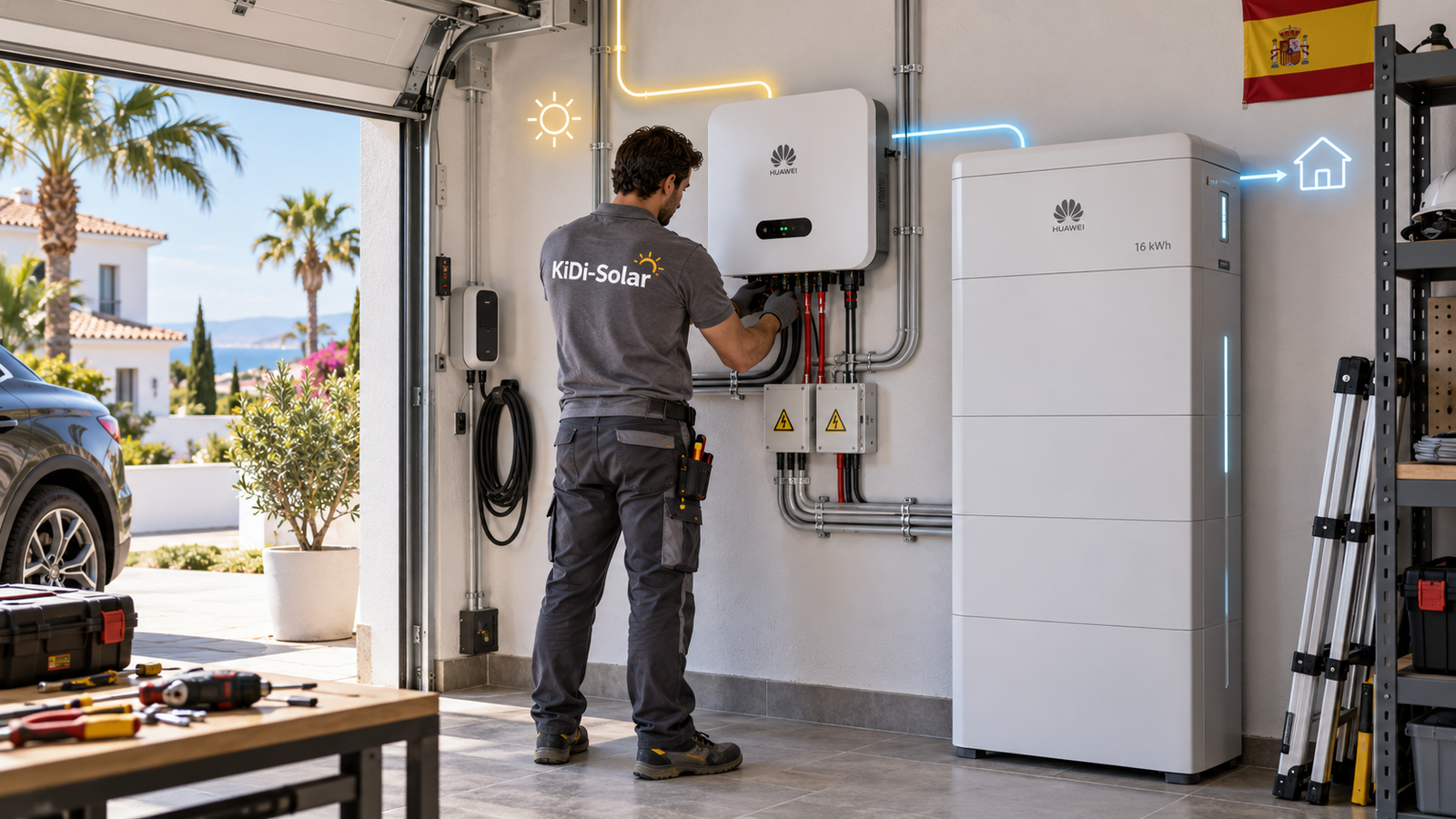
Adding a battery to a solar PV system is not automatically worthwhile, and it is not automatically a waste of money either — the right answer depends on your home’s specific consumption pattern. Homes in Spain, including across the Costa del Sol, often generate strong solar production during the day, while a large share of household electricity use happens in the evening, after the sun has gone down. A battery’s job is to bridge that gap.
Whether that bridge pays for itself depends on how much solar surplus your system would otherwise export, what you are paid or credited for that surplus, how much electricity you buy from the grid after sunset, and the cost of the battery itself. This guide walks through each of these variables so you can judge your own situation rather than relying on a generic yes or no answer.
Are Solar Batteries Worth It in Spain in 2026?
A solar battery is most financially useful when a home exports a meaningful amount of solar energy during the day and then buys electricity back from the grid later — typically in the evening. In that situation, the battery lets you store your own daytime surplus and use it yourself instead of selling it cheaply and buying it back at a higher price.
The financial case comes from increased self-consumption: using more of your own solar generation rather than exporting it. Backup power during outages is a separate value proposition — one some homeowners want regardless of the pure financial payback, and one that requires specific equipment beyond just adding a battery (covered later in this guide).
How Does a Solar Battery Save Money?
Without a battery, a typical grid-connected solar system works like this: during the day, solar generation that exceeds your immediate household consumption is exported to the grid. In the evening and overnight, when panels stop producing, electricity is bought back from the grid at the standard retail price.
With a battery, that same daytime surplus charges the battery instead of being exported immediately. That stored energy is then used later in the day or evening, displacing electricity that would otherwise have been purchased from the grid.
The key economic point is that avoided grid electricity and compensated exported energy are usually valued very differently. Avoiding a grid purchase saves you the full retail price of that electricity. Exporting the same energy for compensation typically earns a lower rate, set by your retailer under the applicable compensation mechanism. This gap — between what you save by not buying, and what you earn by exporting — is where a battery’s financial value comes from. There is no single compensation rate that applies to everyone; it depends on your retailer and contract.
Battery vs. No Battery: An Illustrative Example
Illustrative example — not a KiDi Solar customer case. The figures below are chosen for clarity, not as a forecast for any specific home.
Assume a home’s solar system produces 30 kWh on a given day, direct daytime consumption is 12 kWh, leaving 18 kWh of surplus, and the home separately consumes 10 kWh in the evening after generation has stopped.
Without a battery: 12 kWh is self-consumed directly, 18 kWh is exported to the grid, and the 10 kWh of evening consumption is bought from the grid at the full retail price.
With a battery (assuming it can store the full 10 kWh of evening demand from the surplus, allowing for some charge/discharge losses): 12 kWh is still self-consumed directly during the day, roughly 10–11 kWh of surplus charges the battery to cover the evening consumption, and the remaining surplus (around 7–8 kWh) is still exported, since the battery does not need to store more than the evening load requires.
The battery scenario converts what would have been a grid purchase (10 kWh at retail price) into self-consumption of stored solar energy, while only modestly reducing the exported surplus. This is the mechanism that creates savings — not the total capacity of the battery, but how much grid-purchased electricity it actually displaces on a typical day.
Who Benefits Most From a Solar Battery?
- Homeowners whose system generates substantial daytime surplus relative to daytime consumption
- Households with high evening or night-time electricity use
- Villas with pools, air conditioning or other loads that run outside peak solar hours
- Families who are out during the day but home — and consuming electricity — in the evening
- EV owners who charge mainly after returning home in the evening
- Homes with heat pumps used for heating, cooling or hot water
- Customers who specifically want backup power during outages, independent of pure ROI
- Homes on tariffs or in situations where grid electricity prices are relatively high
When Might a Solar Battery Not Be Worth It?
A battery is a weaker financial choice in several common situations:
- The home already self-consumes most of its solar generation during the day, leaving little surplus to store
- Evening and night-time electricity demand is low
- The PV system itself is small, generating limited surplus in the first place
- Overall household energy use is low, reducing the total value a battery can unlock
- Surplus compensation is comparatively strong relative to the local retail electricity price, narrowing the gap a battery would otherwise capture
- The ownership horizon is short — for example, a planned sale or relocation before the battery could pay for itself
- The existing inverter or intended battery are not well matched, adding cost or limiting functionality
- The battery is oversized relative to the home’s actual surplus and evening demand, adding cost without proportional benefit
In these cases, it can be more sensible to delay a battery purchase, choose a smaller unit, or focus on optimising the existing solar system before adding storage.
What Size Solar Battery Do I Need?
Battery size should not be chosen based on PV system size (kWp) alone. Two homes with an identical solar array can have very different battery needs depending on daily surplus generation, evening and night-time demand, whether backup for specific loads is required, the battery’s usable depth of discharge (not all rated capacity is usable long-term), the battery’s charge and discharge power rating, and how consumption changes across seasons.
5 kWh solar battery
A battery in this range is often considered for lighter evening electricity use, smaller households, or as partial backup for a limited set of essential circuits rather than the whole home. It is not automatically “too small” — it depends entirely on how much evening consumption there actually is to offset.
10 kWh solar battery
This is a commonly discussed size for villa or family-home profiles with meaningful evening consumption — covering things like evening lighting, appliances, and moderate air conditioning or pool pump use outside solar hours. Whether it is the right size still depends on the specific consumption profile.
15 kWh solar battery
Larger households, homes with higher overall consumption, or properties planning to add EV charging or a heat pump sometimes look at this range, particularly where a larger share of backup coverage is also wanted.
20 kWh solar battery
This size is generally considered for larger homes, higher year-round consumption, more extensive backup requirements, or properties combining solar, battery, EV charging and other significant loads. As with the smaller sizes, this is not a universal recommendation — it depends on the underlying load and generation data.
| Battery usable capacity | Typical suitable profile | Main use | Important consideration |
|---|---|---|---|
| 5 kWh | Lighter evening consumption, smaller household | Partial evening self-consumption, limited backup | May not cover a full evening’s demand in a larger home |
| 10 kWh | Family home or villa with moderate evening use | Meaningful evening self-consumption | Actual suitability depends on measured evening demand, not assumption |
| 15 kWh | Larger household, higher consumption, planned EV or heat pump | Extended evening coverage plus partial backup | Requires adequate PV surplus generation to charge fully |
| 20 kWh+ | Larger homes, high year-round consumption, extensive backup needs | Broad evening/night coverage and larger backup scope | Higher upfront cost — needs enough daily surplus to justify the size |
How Much Does a Solar Battery Cost in Spain in 2026?
Battery pricing depends on several factors and varies by project, so a single fixed national price would be misleading. The main cost drivers include:
- Battery capacity (kWh) and power rating (kW)
- Battery chemistry and brand
- Whether a hybrid inverter is required, or already installed
- The complexity of retrofitting into an existing solar system
- Backup equipment, if blackout functionality is required
- Electrical board modifications needed for backup circuits
- Installation and commissioning work
- Monitoring setup
- Applicable legalisation and documentation
As an indicative reference point, KiDi Solar’s starting price for a 16 kWh battery is from €2,000, though the final quoted price for any specific project depends on the inverter compatibility, whether backup functionality is included, and the electrical work required at the property. A precise quote requires reviewing your system and requirements directly rather than relying on a generic figure.
Which Battery Technology Is Best for Home Solar?
Modern residential solar storage is built almost exclusively around lithium iron phosphate (LiFePO4, or LFP) chemistry, and for good reason. LFP batteries generally offer a long cycle life relative to older battery chemistries, strong thermal stability (an important safety characteristic), a high usable depth of discharge — meaning more of the rated capacity can be used repeatedly without excessive degradation — relatively low maintenance requirements, and modular designs that allow capacity to be added in some systems.
Older lead-acid or gel battery technology, once common in off-grid setups, is largely not relevant to modern grid-connected residential solar storage — it has been superseded by LFP systems for nearly all current home installations, so it is not a meaningful comparison point for a 2026 buying decision.
How Long Do Solar Batteries Last?
Battery lifespan is typically expressed through a warranty that combines a number of years, a maximum number of charge/discharge cycles, and sometimes a guaranteed minimum remaining capacity at the end of the warranty period (for example, a guarantee that the battery will retain a certain percentage of its original capacity after a set number of years or cycles).
A “10-year warranty” does not mean every battery will perform identically for exactly ten years and then fail — it means the manufacturer guarantees a certain level of performance within defined usage limits during that period. All batteries degrade gradually over time and with use, meaning usable capacity slowly decreases; the warranty terms define how much degradation is considered acceptable and covered. It is worth reviewing the specific warranty document for any battery under consideration, since terms vary between manufacturers.
How Do You Calculate Solar Battery Payback?
A useful way to think about a battery’s annual financial value:
Annual battery value = avoided grid purchases − value of solar that would otherwise have been compensated − estimated battery losses − additional costs
And simple payback:
Battery payback period = net battery investment ÷ estimated annual battery-related savings
It’s worth noting explicitly that battery payback is often longer than solar-panel payback on its own. This is because the panels themselves generate value from the moment they produce electricity you use directly, while a battery only creates additional value on top of that — specifically the value of shifting surplus into avoided evening purchases, minus what that surplus would otherwise have earned through compensation. A battery is an optimisation layered on top of solar generation, not a separate revenue source, which is why its payback calculation should be treated on its own terms rather than blended into the panels’ payback figure.
Battery Payback: What Makes the Biggest Difference?
Several variables have an outsized effect on whether a battery’s payback is fast or slow:
| Factor | Improves battery economics when… | Weakens battery economics when… |
|---|---|---|
| Electricity purchase price | The retail price is relatively high, increasing the value of each avoided kWh | The retail price is low, reducing the savings per kWh displaced |
| Export compensation rate | Compensation is low, so storing surplus is clearly better than exporting it | Compensation is strong, narrowing the gap the battery is meant to capture |
| Amount of daily surplus | The system regularly generates more than the home uses during the day | Most solar generation is already self-consumed directly |
| Evening/night usage | A meaningful share of consumption happens after sunset | Evening consumption is minimal |
| Battery efficiency and losses | Round-trip efficiency is high, so less stored energy is lost | Efficiency is lower, reducing the effective value of stored energy |
| Battery cost | The unit is appropriately sized and competitively priced for the need | The battery is oversized or priced high relative to the value it can capture |
| Seasonal load and generation | Consumption and generation patterns stay reasonably consistent across seasons | There’s a strong seasonal mismatch, e.g. high winter evening use with lower generation |
| EV charging | Charging can be shifted to align with solar generation and stored surplus | Charging happens overnight regardless, adding demand the battery must cover |
| Tariff structure | The tariff has meaningful time-of-use price differences that a battery can exploit | A flat tariff removes most of the incentive to shift consumption timing |
How Does Surplus Compensation Affect Battery ROI?
If exported solar electricity already receives a reasonable compensation value, a battery has to work harder to be worthwhile — because instead of comparing “store it” to “get nothing,” you’re comparing “store it and use it later” to “sell it now for a known, if modest, credit.” The battery only creates additional value if avoiding a grid purchase is worth meaningfully more than the compensation the surplus would otherwise have earned.
It’s important to distinguish between three separate things: self-consumed energy (used directly as generated, the highest-value category), exported energy (surplus sent to the grid), and compensated surplus (exported energy that qualifies for and receives a credit under the applicable compensation mechanism — compensación simplificada in Spain, where eligible). There is no single, universal €/kWh compensation price — the rate depends on your electricity retailer and contract, and should be confirmed directly rather than assumed.
More detail on the regulatory framework behind self-consumption and surplus compensation is available in our guide to solar panel regulations and legalisation in Spain.
Will a Solar Battery Keep My Home Powered During a Blackout?
Not automatically. A standard grid-connected solar system — even one with a battery — is generally designed to disconnect during a grid failure, as a safety measure to prevent feeding electricity back into a network that utility workers may be repairing.
Achieving backup power during an outage requires specific equipment and design: a hybrid inverter capable of operating independently from the grid, a battery compatible with that inverter’s backup mode, an EPS (emergency power supply) or backup output on the inverter, either automatic or manual switching to isolate the home from the grid during the outage, dedicated backup circuits wired separately from the rest of the property’s electrical installation, and correct electrical protection throughout.
This distinction matters: battery storage (using stored solar energy to reduce grid purchases during normal operation) and battery backup (keeping selected loads powered during a grid outage) are related but separate capabilities. A battery installed purely for storage, without this backup architecture, will not power anything during a blackout — it will simply be offline along with the rest of the grid-tied system.
What Can a Solar Battery Power During a Blackout?
What a properly configured backup system can actually power during an outage depends on several factors: the battery’s stored energy (kWh), the inverter’s power output rating (kW) — which limits how many things can run simultaneously, the backup output capacity specifically, whether any connected loads have high surge/startup power draws (some motors and compressors need a brief power spike to start), and which circuits were selected during design to be part of the backup system.
Typical priority loads chosen for backup circuits include a refrigerator, lighting, internet and networking equipment, security systems, a selection of power sockets, water pumps, a selected air-conditioning unit (sized appropriately for the backup power available), a garage door, and other essential appliances the homeowner identifies as priorities. Whole-home backup is possible in some designs but should not be assumed without a specific design review confirming the inverter and battery can support the property’s full load, including surge demands.
Can I Add a Battery to an Existing Solar PV System?
In many cases, yes — but it depends on the existing setup. Key considerations include whether a hybrid inverter is already installed (which generally simplifies adding a battery), whether the intended battery is part of a compatible ecosystem with the existing inverter, whether an AC-coupled retrofit is suitable (adding a separate battery inverter alongside the existing solar inverter) versus a DC-coupled retrofit (which typically requires the battery to connect through a hybrid inverter on the same DC side as the panels), whether the existing inverter would need to be replaced to support the desired battery and backup functionality, current firmware compatibility, whether the existing meter or current transformer (CT) setup is compatible with the battery system’s monitoring and control requirements, and communication protocol compatibility between the battery’s BMS (battery management system) and the inverter.
Retrofitting is a common and often straightforward project, but the specific compatibility should be verified against your existing equipment before committing to a particular battery brand or model.
Do I Need a Hybrid Inverter for a Solar Battery?
Not always. There are two general approaches: a DC-coupled battery, which connects to the same DC circuit as the solar panels through a hybrid inverter that manages both solar generation and battery charging/discharging together, and an AC-coupled battery, which uses its own separate battery inverter connected on the AC side of the electrical system, working alongside (rather than replacing) an existing standard solar inverter.
DC-coupled systems are often more efficient, since energy moves through fewer conversion stages, and are commonly used for new installations. AC-coupled systems are frequently used for retrofits, since they allow a battery to be added without necessarily replacing an already-installed standard inverter. Which approach makes sense depends on the existing equipment and the goals for the system, including whether backup functionality is required.
Why Battery and Inverter Compatibility Matters
Modern batteries typically communicate with the inverter through their BMS (battery management system) using specific communication protocols. This communication affects several things: how the system manages charging (rate and timing), discharge limits (how much power can be drawn and under what conditions), state-of-charge (SOC) reporting accuracy, safety functions such as automatic disconnection under fault conditions, whether the manufacturer’s warranty remains valid (many warranties specify approved inverter pairings), firmware update compatibility over time, and whether backup/EPS functionality will actually work as intended.
Not every battery works with every inverter, even when both are technically compatible with standard grid-tied solar. Compatibility should be confirmed for the specific battery and inverter models under consideration — this is a technical detail worth getting right before purchase, not something to assume.
Solar Battery Storage on the Costa del Sol
Battery storage is increasingly common across Costa del Sol properties, including villas, holiday homes and permanent residences in Marbella, Estepona, Mijas, Benahavís, Fuengirola, Benalmádena, Málaga, Torremolinos and Sotogrande. Common local use cases include villas with pools and air conditioning that create significant evening and daytime cooling loads, holiday homes where owners want reliable systems that perform well even when the property is managed remotely, EV charging that owners want to align with solar generation and stored surplus, and backup capability for properties where a power interruption would be particularly disruptive — without exaggerating how frequently outages actually occur in the region.
KiDi Solar designs battery systems around each property’s specific consumption profile, roof and existing equipment rather than applying a standard configuration across every location on the coast.
Solar Battery Installation in Marbella
Marbella villas often have characteristics that make battery storage particularly relevant to evaluate: larger PV systems sized for substantial properties, pools and HVAC systems that add meaningful daytime and evening electricity demand, growing EV ownership among homeowners, evening-heavy occupancy patterns typical of residential villa use, and interest in backup capability given the value owners place on property reliability. Each of these factors should be assessed for the specific property rather than assumed from Marbella’s general profile. More detail on the local installation process is available on our page for solar panel installation in Marbella.
Solar Battery and EV Charging
Combining solar, a battery and an EV charger is a common setup, but it’s worth understanding the relationship between them: charging an EV directly during solar production hours is often more efficient than first storing that same energy in a home battery and later using the battery to charge the car — every stage of storage and conversion introduces some energy loss, so cutting out an unnecessary step (battery → EV) is generally preferable to routing power through it when direct daytime charging is possible.
Where this becomes more nuanced is timing: daytime EV charging aligned with solar production captures the most value directly, dynamic load management can help balance EV charging against other daytime household loads and available solar generation, and overnight EV charging (common for owners who arrive home in the evening) is where a battery has more of a role — since it can capture daytime surplus and discharge it in the evening, either to the home or, depending on system design, toward EV charging. This overnight-charging scenario is one factor that can influence how a battery should be sized. More detail is available on our page for EV charger installation.
Do Solar Batteries Need Maintenance?
Modern lithium (LFP) battery systems generally require relatively little routine physical maintenance compared to older battery technologies, but ongoing monitoring is still important to catch issues early and ensure the system continues performing as expected.
Useful things to keep an eye on include firmware update availability and status, error logs reported by the battery or inverter, state-of-charge patterns over time (unusual patterns can indicate an issue), inverter-battery communication status, thermal conditions at the installation location, the system’s monitoring portal or app for ongoing performance visibility, and periodic performance checks to confirm the system is behaving as designed. This monitoring is often included as part of ongoing solar maintenance services.
Are Solar Batteries Safe?
Modern, properly installed LFP battery systems are designed with multiple layers of protection: a battery management system (BMS) that monitors and manages charging and discharging, temperature monitoring to detect and respond to thermal issues, over-current protection to prevent electrical faults, electrical isolation features, and other manufacturer-specified safety mechanisms built into the product.
That said, safety in practice also depends on correct installation, following manufacturer installation and ventilation requirements, appropriate location selection, and correct electrical protection at the property. It would be inaccurate to describe any electrical storage system as “100% safe” in an absolute sense — the realistic and accurate statement is that modern LFP systems, correctly installed and maintained according to manufacturer specifications, are designed with substantial safety engineering appropriate for residential use.
Where Should a Solar Battery Be Installed?
Suitable locations vary by battery model and manufacturer specification, but commonly considered options include a garage, a dedicated technical or utility room, and — where the manufacturer explicitly approves it — a sheltered exterior location. Factors that matter regardless of location include ambient temperature range (batteries generally have manufacturer-specified operating temperature limits), moisture exposure, direct sunlight (which can affect internal temperature), access for maintenance and inspection, and required clearances around the unit as specified by the manufacturer and applicable electrical regulations.
There is no single universally correct location — the right choice depends on the specific battery’s manufacturer specifications and the property’s available spaces.
Solar Battery Storage vs Off-Grid Solar
Adding a battery to a normal grid-connected home does not make that home fully off-grid. It’s worth distinguishing three related but different concepts: grid-connected storage, where the home remains connected to and can draw from the grid, with the battery simply optimising self-consumption during normal operation; grid-connected with backup, where the home is normally grid-connected but can disconnect and run on battery power (for selected circuits, typically) during an outage; and true off-grid, where a property has no grid connection at all and relies entirely on solar, battery storage, and often a backup generator for periods of low solar production.
The vast majority of residential solar-plus-battery systems in Spain, including on the Costa del Sol, fall into the first two categories. True off-grid design is a substantially different undertaking with its own sizing requirements and typically requires a backup generator for extended low-production periods, since battery storage alone cannot reliably cover an entire year’s variation in solar output.
Can a Battery Make a Home Energy Independent?
A battery can significantly increase how much of a home’s own solar generation it uses, but it does not create full energy independence for a grid-connected home in a realistic, ongoing sense. Solar production varies seasonally — winter generation is typically much lower than summer generation — and cloudy periods can reduce output for days at a time regardless of season. A battery sized for a typical summer day’s surplus will not necessarily cover winter evening demand, when generation is lower and heating-related loads may be higher.
Achieving something closer to genuine energy independence generally requires a larger, carefully sized system, accepting some remaining reliance on the grid during low-production periods, or — for a true off-grid setup — including a backup generator. Marketing claims of “100% energy independence” from a standard grid-connected solar-plus-battery system should be treated with caution; a well-designed system substantially reduces grid reliance, which is a genuine and valuable outcome, but it is different from complete independence.
What Does KiDi Solar Need to Size a Solar Battery Correctly?
An accurate battery sizing analysis depends on real data about your home’s energy use and generation, not general assumptions. To size a battery correctly, we typically need:
- Electricity bills — ideally 12 months, to capture seasonal variation
- Hourly or 15-minute load data, if available from your distributor or smart meter, showing when electricity is actually consumed
- Solar production data from your existing system, if you already have panels
- Exported surplus figures, showing how much solar energy is currently being sent to the grid
- Your existing inverter model, to assess compatibility with battery options
- PV system size (kWp), for context alongside the consumption and generation data
- EV ownership or plans, current or future
- Heat pump presence, if applicable
- Pool equipment, since pool pumps and heating can be a significant, schedulable load
- Backup priorities — which circuits or appliances matter most during an outage, if backup is a goal
- Future energy needs, such as planned renovations, additional appliances, or lifestyle changes affecting consumption
Each of these inputs directly affects the correct battery size and configuration — sizing from PV capacity or bill amount alone, without this data, produces a much less reliable recommendation.
Common Solar Battery Sizing Mistakes
- Buying a battery that is larger than the home’s actual surplus and evening demand justify
- Sizing the battery based only on PV system size (kWp) rather than actual consumption data
- Ignoring evening and night-time load patterns when choosing capacity
- Overlooking the battery’s power rating (kW), which limits how much can be drawn at once, separate from total stored energy (kWh)
- Confusing kW and kWh when comparing battery specifications
- Assuming any battery automatically provides blackout backup, without the additional required equipment
- Ignoring inverter and battery compatibility before selecting a product
- Comparing batteries only on purchase price without considering usable capacity, efficiency, and warranty terms
- Overlooking the difference between rated and usable capacity
- Not carefully reviewing warranty conditions, including cycle limits and guaranteed remaining capacity
What Is the Difference Between Battery kW and kWh?
kWh (kilowatt-hours) measures energy stored — the total amount of electricity the battery can hold, similar to the size of a fuel tank. kW (kilowatts) measures power — the rate at which that stored energy can be delivered at any given moment, similar to how fast fuel can flow out of the tank.
A simple example: a battery rated at 10 kWh with a 5 kW power output can supply up to 5 kW of power at any instant, and could theoretically supply that full 5 kW for 2 hours before being depleted (10 kWh ÷ 5 kW = 2 hours), or supply a lower power draw for a longer period. A battery with more stored energy (kWh) but a lower power rating (kW) might not be able to run several high-power appliances simultaneously, even though it holds plenty of total energy — this is why both figures matter, particularly for backup applications where several loads may need to run at once.
Should I Add a Battery to My Solar System?
A battery is more likely to make financial and practical sense if you export a significant amount of solar surplus, buy a significant amount of electricity from the grid after sunset, want blackout backup regardless of pure financial payback, are planning to add an EV or heat pump that will increase evening or overnight demand, or place value on reducing grid dependence beyond what the numbers alone would justify.
It may be a less attractive addition, at least for now, if most of your solar generation is already self-consumed directly during the day, your evening electricity use is low, your current surplus compensation arrangement is comparatively strong, or you have a short expected ownership horizon for the property. This is a decision worth making with real consumption and generation data rather than general assumptions about your home.
Frequently Asked Questions About Solar Batteries in Spain
Are solar batteries worth it in Spain?
For many homes, yes — particularly those with significant daytime solar surplus and meaningful evening electricity consumption. The answer depends on your specific consumption and generation pattern, not a universal rule.
How much does a solar battery cost in Spain?
Costs vary based on capacity, chemistry, inverter compatibility and whether backup functionality is included. As an indicative reference, KiDi Solar’s starting price for a 16 kWh battery is from €2,000, with the final price depending on your specific system and requirements.
How long does a solar battery last?
Modern LFP batteries typically come with warranties combining a number of years and a maximum cycle count, with gradual capacity degradation over time. Specific terms vary by manufacturer and should be reviewed directly.
What size battery do I need?
The right size depends on your daily solar surplus, evening/night consumption, and any backup requirements — not on your PV system’s kWp alone. Common residential sizes range from around 5 kWh to 20 kWh or more.
Is 10 kWh enough for a house?
It can be, for many family homes with moderate evening consumption, but this depends entirely on your actual evening/night electricity use — it is not a universal figure that fits every household.
Can I add a battery to existing solar panels?
Often yes, through either an AC-coupled or DC-coupled retrofit, depending on your existing inverter and its compatibility with the intended battery system.
Can solar batteries work during a blackout?
Only if the system is specifically designed for backup, with a hybrid inverter, compatible battery, EPS/backup output, and dedicated backup circuits. A standard grid-tied battery system does not provide backup power on its own.
Do I need a hybrid inverter?
Not always. DC-coupled batteries typically require a hybrid inverter, while AC-coupled batteries use their own separate inverter alongside an existing standard solar inverter.
What is the difference between kW and kWh?
kWh measures how much energy the battery can store; kW measures how much power it can deliver at any given moment. Both matter for correctly sizing a system.
Does a battery reduce my electricity bill?
It can, by increasing how much solar electricity you use yourself instead of buying from the grid in the evening — though the size of the reduction depends on your specific consumption pattern and the battery’s cost.
Does surplus compensation make batteries less worthwhile?
Stronger surplus compensation narrows the financial gap a battery is designed to capture, since exporting surplus already earns some value. The battery still adds value if avoiding a grid purchase is worth more than the compensation received, but the case is less clear-cut than with low or no compensation.
Can a battery power air conditioning?
Potentially, if the inverter’s power rating and the battery’s backup circuit design specifically account for the air conditioning unit’s power draw, including its startup surge. This requires deliberate design rather than being assumed automatically.
Can I charge an EV from a solar battery?
Yes, depending on system design, though charging an EV directly from solar during the day is often more efficient than routing that energy through the battery first. A battery becomes more relevant for EV charging that happens after sunset.
Are solar batteries safe?
Modern LFP battery systems, correctly installed and maintained according to manufacturer specifications, include multiple built-in safety protections. No electrical storage system is absolutely without risk, but properly installed and maintained systems are designed with substantial safety engineering for residential use.
Do solar batteries need maintenance?
Modern lithium systems require relatively little routine physical maintenance, but ongoing monitoring of performance, firmware, and system communication is important to catch issues early.
Get a Solar Battery Assessment on the Costa del Sol
KiDi Solar can review your current PV system, check inverter compatibility for adding a battery, assess your consumption profile and exported surplus, evaluate evening and night-time electricity use, discuss backup priorities if blackout protection matters to you, factor in EV charging plans, and provide a battery size recommendation along with projected savings based on your actual data — not generic assumptions.
To get started, you can request a free solar battery assessment, and for further practical guidance, browse the KiDi Solar solar energy guides.