
How Much Does It Cost to Install Solar Panels in Spain in 2026?
At KiDi Solar, a straightforward residential solar installation starts at approximately €1,000 per installed kWp. That means a 5 kWp system typically starts around €5,000, an 8 kWp system around €8,000, and a 10 kWp system around €10,000. A 16 kWh battery adds approximately €2,200. These are indicative reference figures — your final solar panel installation cost in Spain is confirmed only after KiDi Solar analyses your electricity consumption and inspects the property.
If you own a villa or detached house in Marbella, Estepona, elsewhere on the Costa del Sol, or in Málaga province, this guide walks through exactly how KiDi Solar calculates a solar installation price — from your electricity bill to the final turnkey figure — so you know what to expect before requesting a quote.
Solar Panel Installation Cost by System Size
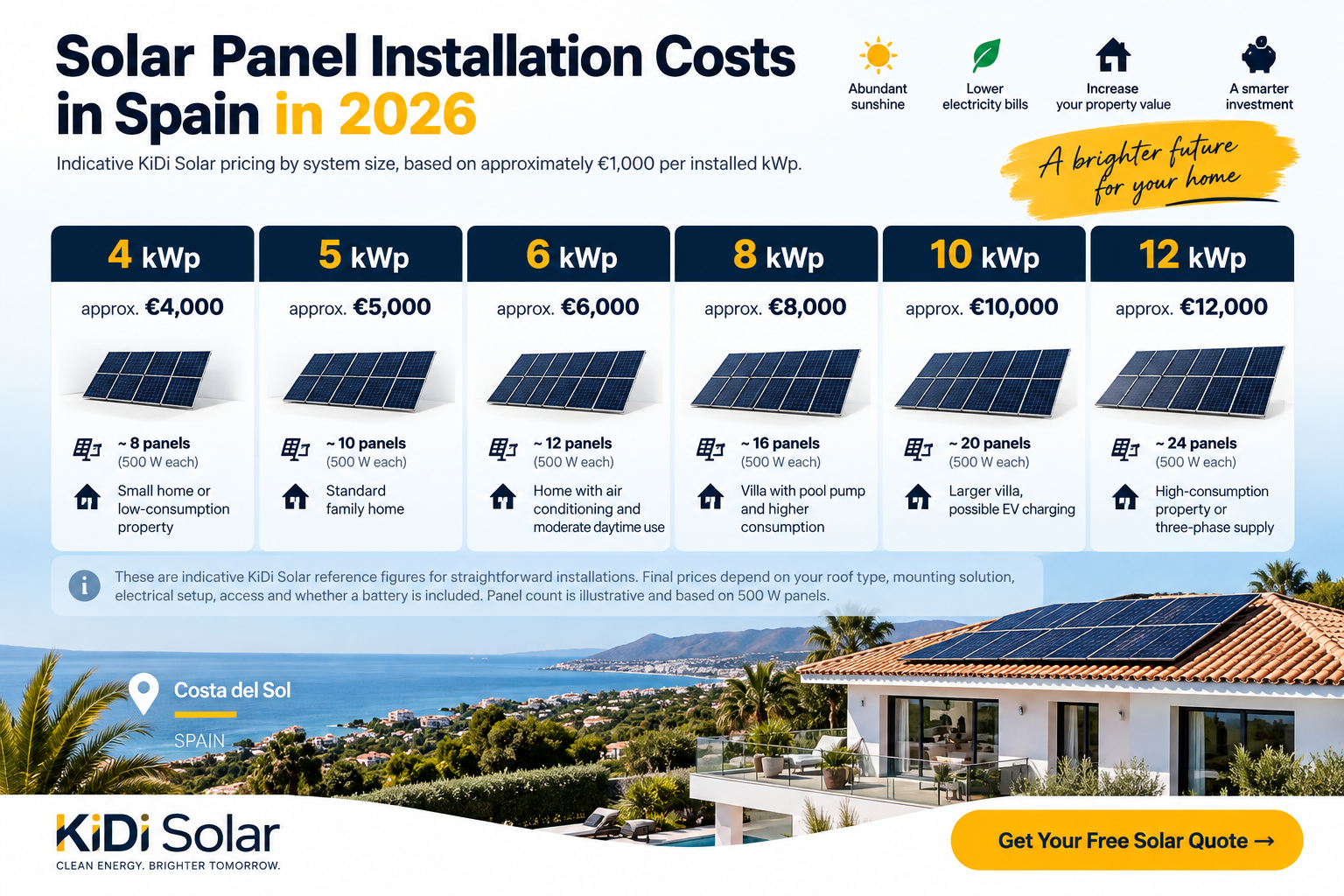
Here’s the pricing framework KiDi Solar uses as a starting reference for straightforward installations in Andalucía. These figures assume a standard pitched or conventional roof with good access and no unusual electrical work.
| System size | Example panel configuration (500 W panels) | Indicative installed price | Typical application |
|---|---|---|---|
| 4 kWp | approx. 8 panels | approx. €4,000 | Small home or low-consumption property |
| 5 kWp | approx. 10 panels | approx. €5,000 | Standard family home |
| 6 kWp | approx. 12 panels | approx. €6,000 | Home with air conditioning and moderate daytime use |
| 8 kWp | approx. 16 panels | approx. €8,000 | Villa with pool pump and higher consumption |
| 10 kWp | approx. 20 panels | approx. €10,000 | Larger villa, possible EV charging |
| 12 kWp | approx. 24 panels | approx. €12,000 | High-consumption property or three-phase supply |
Panel count is illustrative and depends on the actual panel wattage selected for your project. These are KiDi Solar reference figures for uncomplicated installations — not guaranteed quotations. Roof type, mounting solution, electrical modifications, access, and battery requirements can all change the final price.
Not sure which size applies to you? Send us your latest electricity bill and KiDi Solar can estimate the solar system size your property may need. Get a free estimate.
How KiDi Solar Calculates the Right Solar System for Your Home
A common mistake in solar quotes is sizing the system purely around how many panels fit on the roof. KiDi Solar does it the other way around: we start with your actual electricity consumption, then work out the system, the roof requirement, and finally the price.
Step 1: We Analyse Your Electricity Bill
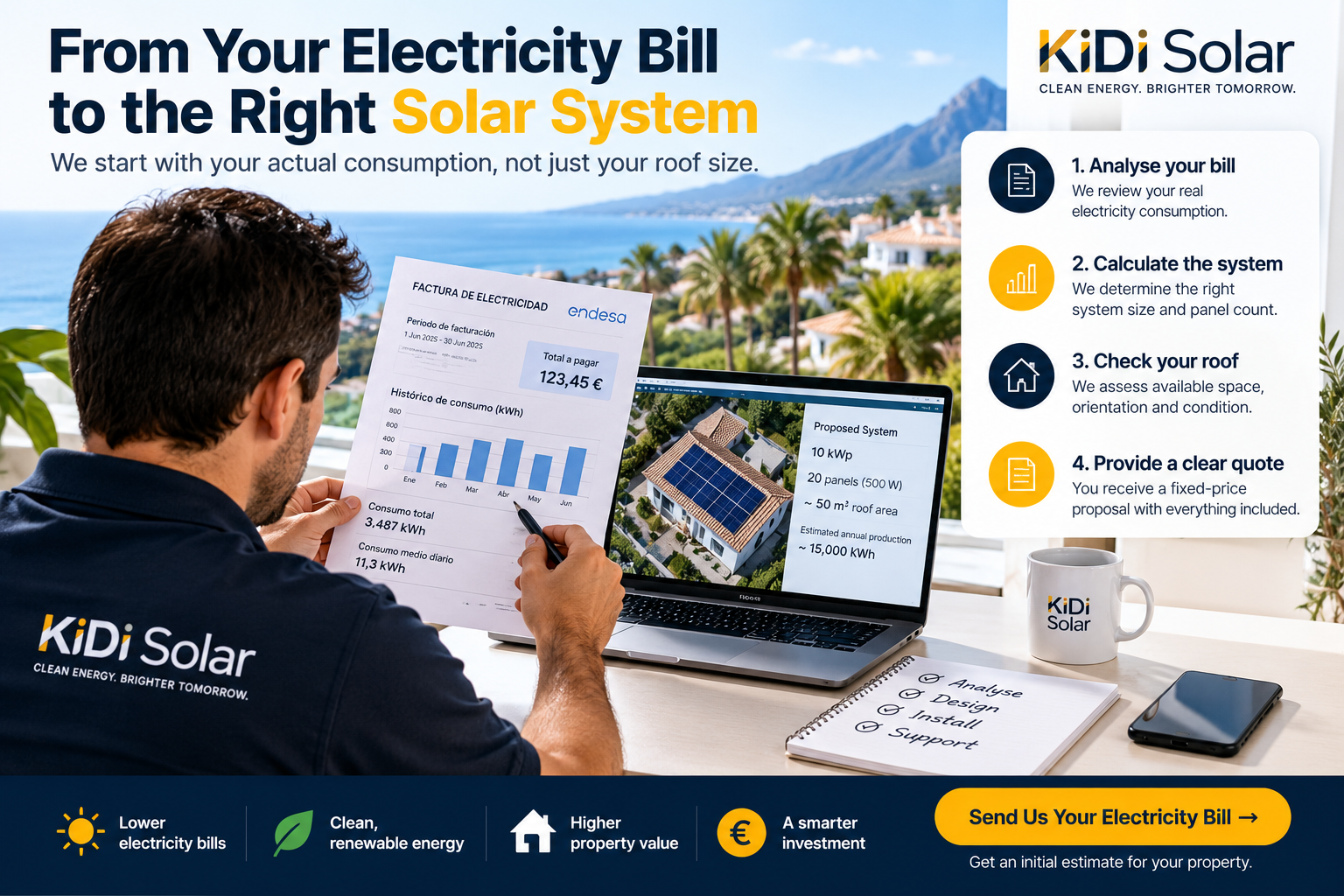
The process starts with your recent electricity bill and, where useful, consumption data covering previous months. This tells us your annual consumption pattern — how much electricity you use, and when. A villa with a pool pump running all day has a very different profile from an apartment used mainly in the evenings, even if both households use similar total kWh per year.
This matters because sizing based on consumption, rather than roof space alone, avoids two common problems: an undersized system that leaves you still paying high bills, or an oversized system where you pay for capacity you rarely use.
Step 2: We Calculate System Size, Panel Count and Roof Space
Once consumption is understood, we translate it into a recommended system size in kWp. For example, if your consumption pattern suggests a system in the region of 10 kWp, that might translate to approximately 20 panels of 500 W each — though the exact count depends on the panel wattage ultimately selected for your project.
For planning purposes, a 20-panel installation may require in the region of 50 m² of usable roof area once realistic layout requirements are factored in. This is a planning estimate only: the actual area required depends on panel dimensions, spacing, roof geometry, orientation, shading, setbacks, access routes, and any obstacles like chimneys or skylights.
Step 3: KiDi Solar Visits Your Property
A desk-based estimate can only go so far. Before issuing a final quotation, KiDi Solar arranges a site visit to check the details that determine both feasibility and price:
- Available roof area, condition and type
- Orientation and shading throughout the day
- Access for installation equipment
- Optimal panel positioning
- Existing electrical installation and main electrical board
- Cable routing from roof to inverter and board
- Proposed inverter and battery location
- Single-phase or three-phase electrical supply
- Possible EV charger integration
- Backup power requirements, if relevant
This is why a site visit makes the final quotation significantly more reliable than an online calculator: it catches the site-specific factors — an unusual roof pitch, a distant electrical board, limited access — that can change the price before you commit to anything.
Ready for the next step? Request a property assessment and KiDi Solar will visit your home to confirm exact feasibility and pricing. Request an assessment.
How Your Roof and Mounting System Affect the Price
Mounting method is one of the biggest — and most overlooked — factors in the final price. It depends heavily on your roof type.
Pitched and conventional roofs
For suitable pitched or conventional roofs, panels are typically fixed using aluminium mounting rails with roof-specific fixings. This is usually the more straightforward and cost-efficient approach when the roof structure and covering are suitable.
Flat roofs
Flat roofs, common on many Costa del Sol villas, need a different engineering approach. Depending on the specific project, two general solutions may apply:
- Anchored mounting structures — fixed directly to the roof structure. This can sometimes be less expensive, but requires the roof to be structurally suitable for the necessary attachments and waterproofing.
- Ballasted mounting systems — held in place by weight rather than penetrating the roof. This can reduce the need for roof penetrations in appropriate designs, but requires additional material, a wind and weight-loading assessment, and more engineering consideration — which can increase cost.
Neither solution is automatically correct for every flat roof. Roof loading capacity, wind exposure, waterproofing condition, and structural suitability all need to be assessed before a mounting method is chosen — which is exactly what the site visit is for.
| Factor | Why it affects cost | Potential impact |
|---|---|---|
| Roof type | Determines which mounting systems are even feasible | Can change mounting cost and labour time |
| Mounting solution | Ballasted systems need more material and engineering than rail-mounted systems | Can increase overall project price |
| Battery | Additional hardware, wiring and configuration | Adds a separate line item to the quote |
| Electrical work | Older boards or long cable runs may need upgrading | Can add labour and materials |
| Access | Difficult roof access increases installation time | Can affect labour cost |
| Cabling distance | Longer runs between roof, inverter and board need more cable and conduit | Can add material cost |
| Backup requirements | Backup circuits need additional switching equipment | Adds equipment cost |
| EV charger integration | May require dedicated circuits or load management | Typically quoted as a separate or add-on item |
| Three-phase supply | May require a different inverter configuration | Can affect equipment selection and price |
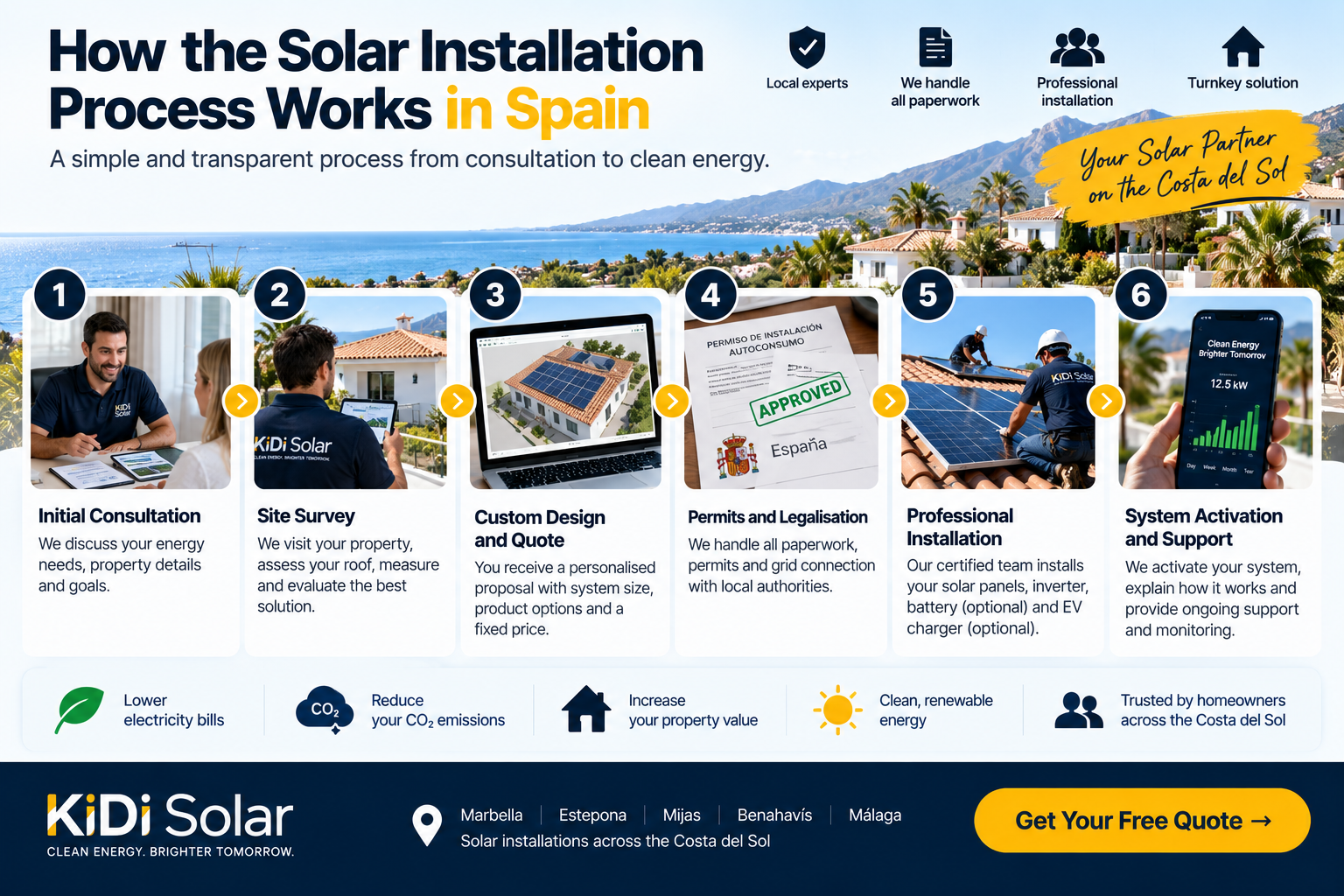
What Is Included in a Turnkey Solar Installation?
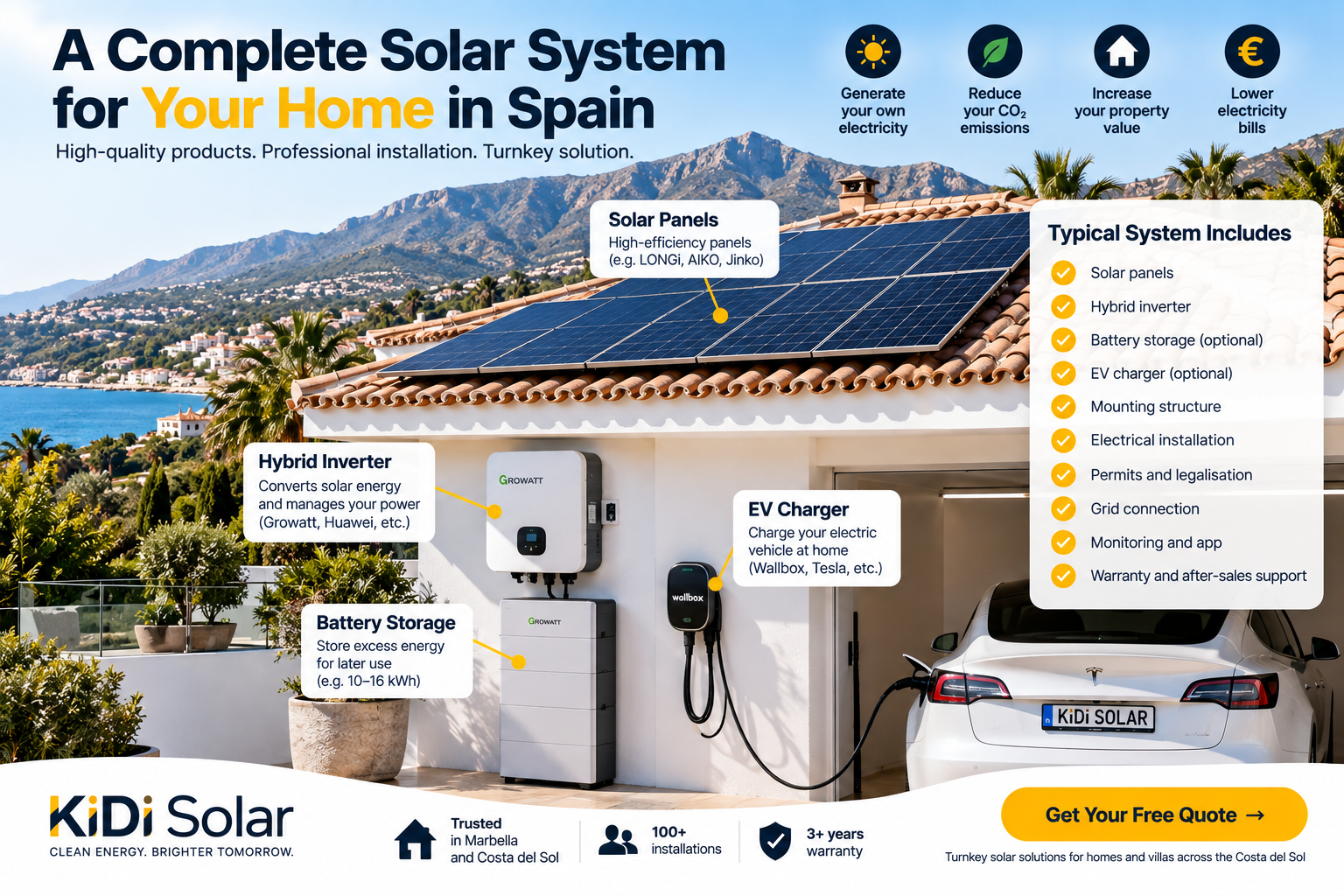
When you get a quote from KiDi Solar, you’re not just buying panels. A turnkey solar panel installation is priced to cover the full project, which can include, depending on scope:
- Solar panels and inverter
- Mounting structure and roof-specific fixings
- DC and AC electrical protections and equipment
- Cabling and connectors
- Installation labour and system design
- Electrical integration with your existing board
- Monitoring setup and configuration
- Testing and commissioning
- Certification and documentation
- Legalisation procedures with the relevant grid/distributor
- After-sales support
Understanding what’s bundled into the number is more useful than comparing headline prices between installers — a lower quote that excludes legalisation, commissioning, or certification isn’t actually a lower total cost.
How Much Does a Solar Battery Add to the Cost?
Solar panels generate electricity mainly during daylight hours. Solar battery storage keeps part of the solar energy you don’t use immediately, and makes it available later — for example in the evening, when a household’s consumption often peaks. This can increase the share of your own solar energy that you actually consume, rather than exporting it to the grid.
For larger residential systems — 8 kWp, 10 kWp, 12 kWp or above — KiDi Solar commonly considers a battery in the region of 16 kWh, depending on actual night-time consumption. As an indicative reference:
A 16 kWh battery adds approximately €2,200 as an indicative KiDi Solar reference on top of the base system price, depending on the final equipment specification and project requirements.
Whether a battery makes sense for you — and what size — depends on several factors:
- How much electricity you use at night
- Your desired level of self-consumption
- Whether you need backup power during outages
- Inverter compatibility
- Battery chemistry and usable capacity
- Power output requirements
- Future consumption changes, including EV charging plans
A battery does not automatically guarantee a specific saving — the actual benefit depends on your consumption pattern and how much surplus solar energy you’d otherwise export.

Solar Panels and EV Charging: Does It Change the System Size?
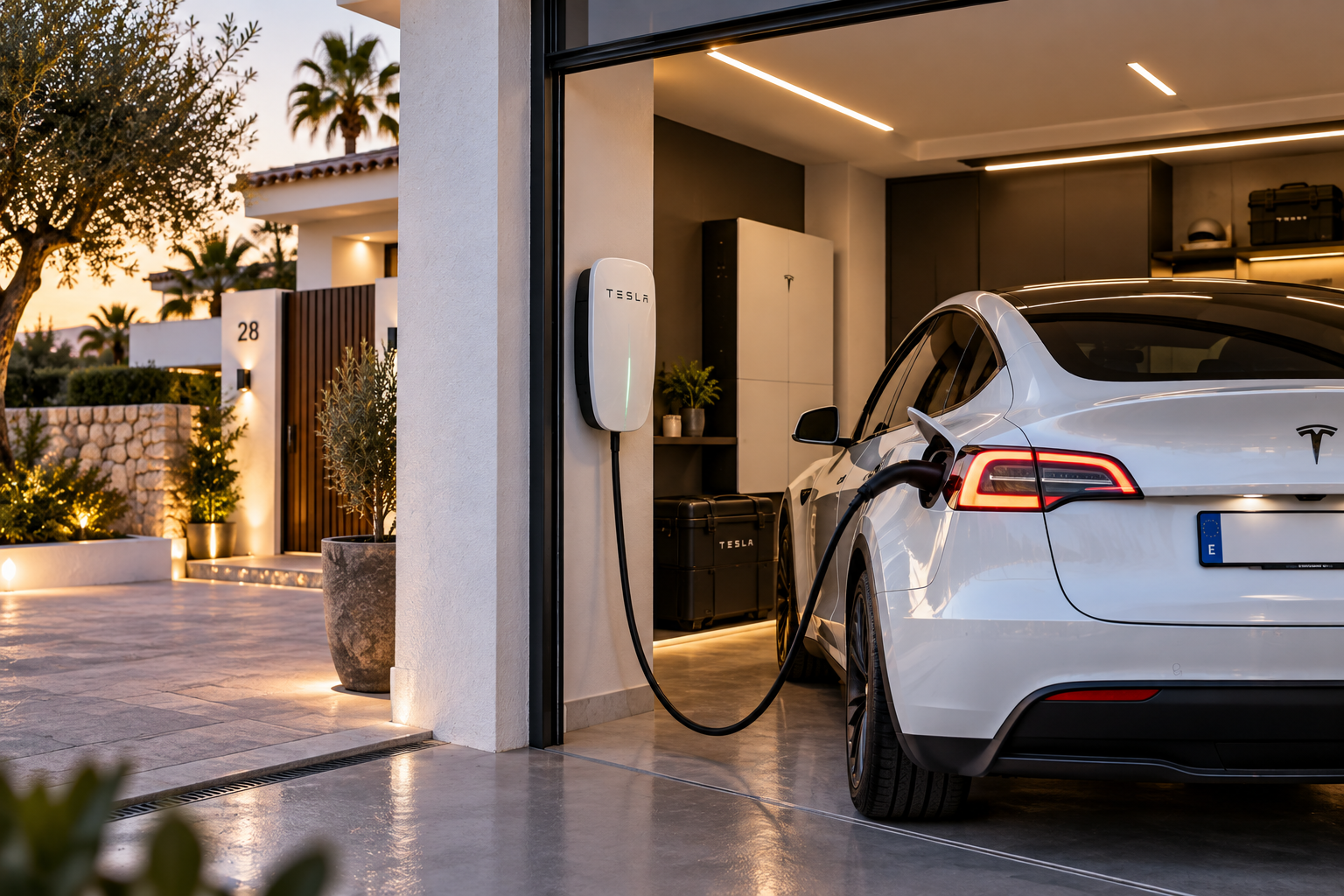
An electric vehicle can materially increase household electricity consumption, so if you already own an EV, plan to buy one, or want home charging installed, this should be considered before your final solar system is sized — not added as an afterthought.
Solar panels can generate electricity that’s used directly by a home EV charger. Charging during solar-production hours — typically the middle of the day — can increase how much of your own solar power you use directly, rather than relying on grid electricity in the evening. In some setups, dynamic load management may be appropriate to balance charging with the rest of the household’s consumption.
Available charging power depends on your property’s electrical installation and contracted capacity. Common residential charging powers include 7.4 kW, 11 kW and 22 kW, but not every property can support every option — a single-phase supply typically has different charging limits than a three-phase installation. This is assessed during the same site visit used for solar sizing.
If EV charging is relevant to you, mention it early — see EV charger installation for more detail.
10 kWp Solar Installation — A Practical Example
To make this concrete, here’s how a typical 10 kWp project moves through KiDi Solar’s process, from first contact to final price.
- Customer sends a recent electricity bill.
- KiDi Solar analyses annual consumption.
- Approximately 10 kWp is recommended based on that consumption.
- Example configuration: 20 panels of 500 W.
- Approximate usable roof requirement: around 50 m² for planning purposes, subject to actual panel dimensions and layout.
- KiDi Solar performs an on-site survey.
- Roof condition and mounting solution are assessed.
- Straightforward installation: approximately €10,000 indicative price.
- More complex or ballasted mounting: could increase the project price — for illustration only, approximately €12,000 for a more demanding flat-roof project, not a fixed figure.
- Optional 16 kWh battery: approximately +€2,200 indicative reference.
- Certification and legalisation: included according to the agreed turnkey scope.
- Surplus electricity arrangement: discussed with your electricity retailer once the relevant legalisation is complete.
- KiDi Solar estimates potential production, savings and payback based on your actual consumption and project specifics.
| Element | Indicative value |
|---|---|
| Base solar installation | 10 kWp |
| Approximate panel count | 20 panels (500 W each) |
| Approximate roof requirement | ~50 m² (planning estimate) |
| Mounting option — straightforward | Rail-mounted, approx. €10,000 |
| Mounting option — complex/ballasted | Illustrative example only, approx. €12,000 |
| Optional battery | 16 kWh, approx. +€2,200 |
| Legalisation/certification | Included in agreed turnkey scope |
All figures above are indicative examples for a typical 10 kWp project and not a guaranteed price for any specific property.
Considering something similar for your home? Request a personalised solar and battery quotation based on your own consumption and roof. Request a quotation.
Legalisation, Certification and Surplus Electricity
A solar installation in Spain needs to be legalised as a self-consumption installation to operate correctly and, where relevant, to access compensation for surplus energy. KiDi Solar installations can include the required certification and legalisation within the agreed turnkey project scope, so you’re not left to handle the paperwork separately.
On surplus electricity: it’s not accurate to say you can simply sell electricity back to the grid in every case. What’s more precise is this — depending on your legalised self-consumption configuration and your contractual arrangement with an electricity retailer, exported surplus electricity may qualify for applicable surplus compensation arrangements. The economic value of exported surplus depends on your specific contract and the regulatory framework in force, and KiDi Solar does not guarantee a fixed export price or a specific compensation amount.
Related reading: Solar Panel Installation FAQ.
How Long Does It Take for Solar Panels to Pay for Themselves?
KiDi Solar calculates estimated payback individually for each project, weighing:
- Installation cost
- Historical electricity consumption
- Estimated solar generation for your location and roof orientation
- Self-consumption rate (how much solar power you use directly versus export)
- Your electricity tariff
- Surplus compensation, where applicable
- Battery use
- Any applicable incentives
As a purely illustrative scenario: in a favourable consumption and production scenario, a €10,000 system may show an estimated payback in the region of 3–4 years. This is an illustrative calculation, not a guaranteed payback period — another property, with different consumption, orientation or roof requirements, may have a longer or shorter payback timeline. KiDi Solar works out an individual estimate once your actual consumption and site details are known.
Solar Incentives and Subsidies in Andalucía
Depending on your municipality, property type, the specific installation, your tax situation, and the programmes currently in force, you may potentially qualify for solar incentives, grants, tax deductions or municipal benefits. Eligibility criteria and available programmes change over time, so KiDi Solar can help you identify which current schemes may apply to your project and assist with the relevant documentation within the agreed service scope.
Solar Panel Maintenance and Cleaning Costs
Solar systems require relatively limited routine maintenance, but performance should still be monitored over time. Panels can gradually accumulate dust, pollen, bird deposits and general environmental dirt — something worth keeping in mind for properties in southern Spain. How often solar panel cleaning is actually needed depends on the property, roof, surrounding environment, panel angle and the level of contamination observed — there’s no single frequency that applies to every installation.
A professional inspection or cleaning visit can also help identify issues beyond dirt, such as visible panel damage, mounting problems, cabling issues, or abnormal production that might otherwise go unnoticed. In Spain this is sometimes searched for as “limpieza placas solares.” If you’d like more detail on what’s involved, see solar panel maintenance and cleaning.
Solar Installation Costs for Villas in Marbella and Costa del Sol
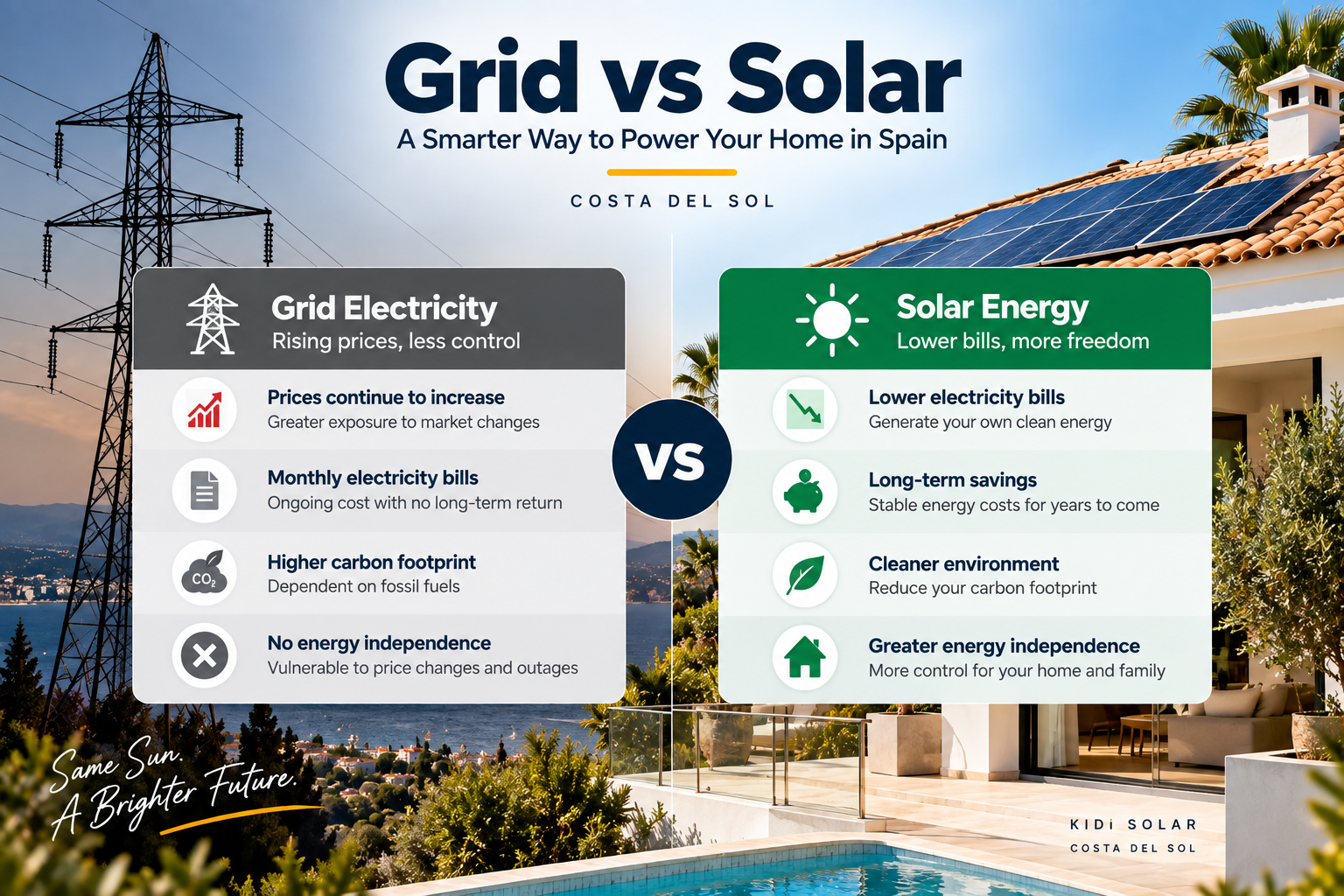
Villas across Marbella, Estepona, Mijas, Benahavís, Fuengirola, Benalmádena, Torremolinos and Sotogrande tend to share a few things that affect solar pricing: swimming pools, air conditioning, higher daytime consumption, and in many cases three-phase electrical supplies or EV charging needs. These factors typically push system sizing toward the 8–12 kWp range rather than the smaller residential end of the scale.
KiDi Solar has completed solar projects across the region.
Frequently Asked Questions About Solar Installation Costs
How much does it cost to install solar panels in Spain?
At KiDi Solar, a straightforward residential solar installation starts at approximately €1,000 per installed kWp. As an indicative example, a 5 kWp system may cost around €5,000, an 8 kWp system around €8,000, and a 10 kWp system around €10,000. The final price depends on the property, roof, mounting system, electrical installation and selected equipment.
How much does a 5 kWp solar system cost in Spain?
A straightforward 5 kWp solar installation with KiDi Solar starts at approximately €5,000 as an indicative reference. With 500 W solar panels, this would typically correspond to around 10 panels. The final quotation is confirmed after analysing your electricity consumption and assessing the property.
How much does a 6 kWp solar system cost in Spain?
A straightforward 6 kWp solar system starts at approximately €6,000 as an indicative KiDi Solar reference. Using 500 W panels, a 6 kWp system would require approximately 12 panels. Roof type, access, mounting requirements and electrical work can affect the final installation cost.
How much does an 8 kWp solar system cost in Spain?
An 8 kWp residential solar installation starts at approximately €8,000 for a straightforward project. With 500 W panels, this represents approximately 16 solar panels. An 8 kWp system can be suitable for larger homes and villas, but the correct system size should always be calculated from the property’s actual electricity consumption.
How much does a 10 kWp solar system cost in Spain?
A straightforward 10 kWp solar installation starts at approximately €10,000 as an indicative KiDi Solar reference. A typical example using 500 W panels would require approximately 20 panels. More complex roof structures, ballasted mounting systems, additional electrical work or other project requirements can increase the final price.
How many solar panels do I need for my home?
The number of solar panels you need depends primarily on your electricity consumption and the wattage of the selected panels. KiDi Solar starts by analysing your electricity bill and consumption history, then calculates the appropriate system size and panel count before assessing whether the required installation will fit correctly on your roof.
How much roof space do I need for solar panels?
As a planning example, a 10 kWp solar system using approximately 20 × 500 W panels may require around 50 m² of usable roof area. The actual requirement depends on panel dimensions, roof geometry, orientation, shading, spacing, access requirements and obstacles such as chimneys or skylights.
How much does a 16 kWh solar battery cost?
As an indicative KiDi Solar reference, adding a 16 kWh solar battery costs approximately €2,200. The final battery price depends on the selected equipment, inverter compatibility, installation requirements and system configuration. Battery sizing should be based on your consumption profile rather than solar system size alone.
Is a solar battery worth the extra cost?
A solar battery can be useful when a property produces surplus solar electricity during the day but consumes significant electricity in the evening or at night. It can increase solar self-consumption and reduce reliance on grid electricity. Whether a battery makes financial sense depends on your consumption profile, electricity tariff, solar production and desired backup capabilities.
Can I receive compensation for surplus solar electricity in Spain?
A legalised self-consumption solar installation with surplus generation may be eligible for an applicable surplus-energy compensation arrangement, depending on the installation and your electricity contract. The value and conditions of surplus compensation depend on the retailer, contract and regulations in force, so there is no single guaranteed export price.
Is certification and legalisation included in the solar installation price?
KiDi Solar turnkey installations can include the required certification, documentation and legalisation procedures within the agreed project scope. This means the administrative and technical process can be managed together with the physical solar installation rather than leaving the homeowner to organise these steps separately.
Are solar subsidies or incentives available in Andalucía?
Solar incentives, grants, tax deductions or municipal benefits may be available depending on the municipality, property, applicant, installation and programmes currently in force. Eligibility and conditions can change over time. KiDi Solar can help customers identify relevant current programmes and assist with applicable documentation within the agreed service scope.
Get Your Free Solar Installation Quote
Send us your electricity bill and get a free solar assessment and personalised quote.
Get Your Free Solar Quote →