
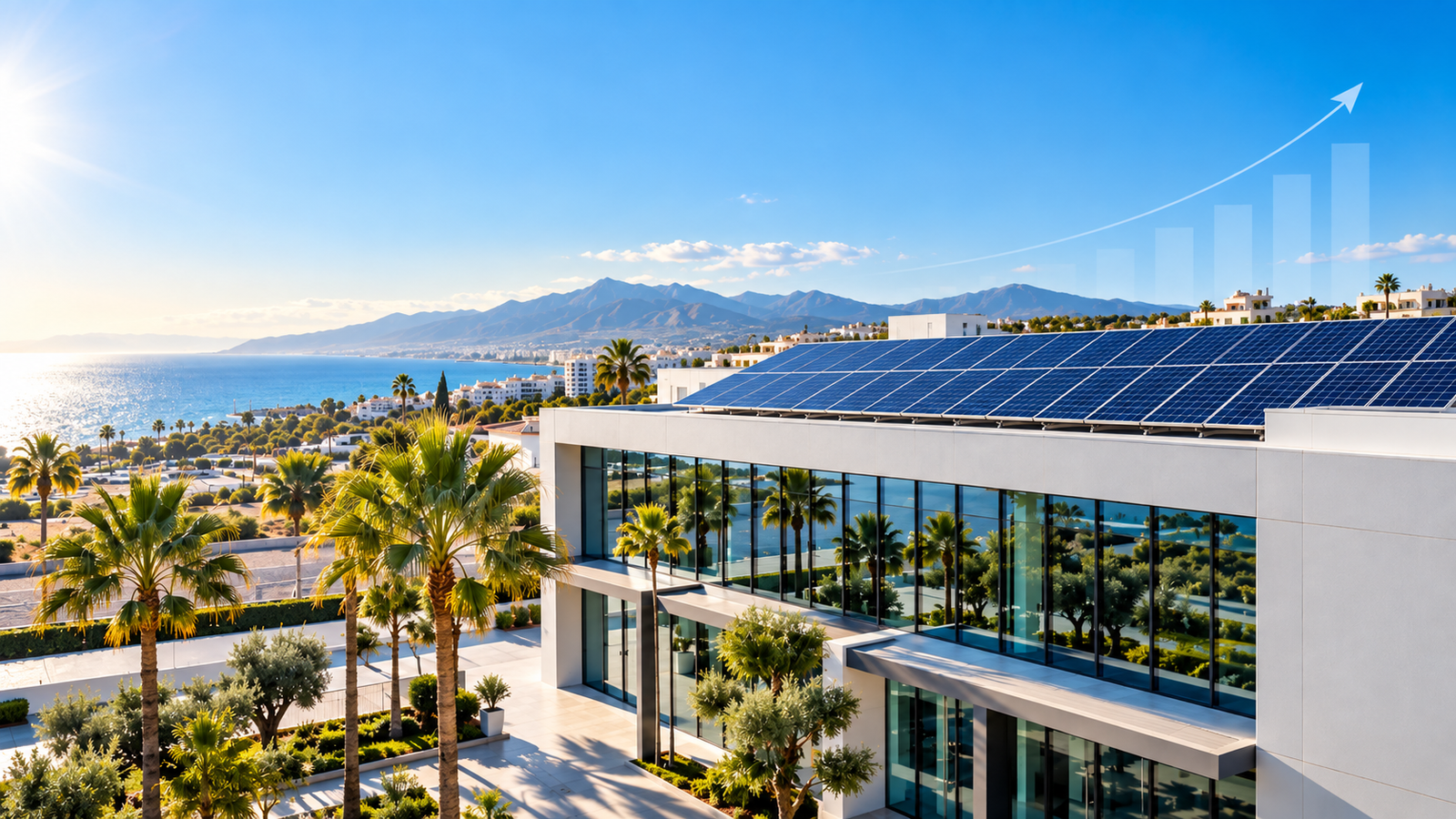
Are Solar Panels Worth It for a Business in Spain?
For many businesses in Spain, solar panels can be financially attractive — but the outcome depends on how much electricity the business consumes during daylight hours, not simply on how sunny the location is. Offices, warehouses, retail premises, hotels and workshops that operate mainly during the day can often achieve stronger economics than properties whose main electricity use happens in the evening or overnight.
There is no single payback period that applies to every business. The real answer depends on actual consumption data: how much electricity is used, when it is used, what tariff applies, and how the system is sized against the available roof. Businesses on the Costa del Sol — including hotels, restaurants, warehouses and offices in Marbella, Estepona, Mijas and neighbouring municipalities — should treat solar as a site-specific financial decision rather than a generic assumption based on climate alone.
Is Your Business a Good Candidate for Solar? A 30-Second Test
Before requesting a formal proposal, a business owner can get a rough first read on solar suitability by checking which of the following apply. This is a starting filter, not a financial guarantee — an accurate answer still requires consumption data and a site assessment.
Indicators that solar is more likely to make sense:
- High electricity consumption during daylight hours (roughly 9am–6pm)
- Operating five to seven days a week during the day
- Air conditioning running heavily during sunny hours
- Refrigeration or freezer loads that run continuously
- Pumps, motors or production machinery in regular daytime use
- Plans for EV charging for staff, customers or a fleet
- Pool filtration or heating systems (relevant for hotels and holiday rentals)
- A large usable roof area with limited shading
- A high monthly electricity bill relative to the business’s size
- Long-term ownership of the property, or a lease with several years remaining
Indicators that solar economics may be weaker or need closer analysis:
- Most electricity use happens after sunset (late-night restaurants, some retail, certain hospitality operations)
- A very low electricity bill relative to typical system costs
- A short remaining lease with no clarity on equipment transfer
- A heavily shaded roof, or a roof with limited usable area
- Structural limitations that would require significant reinforcement work
A business showing several strong indicators is generally a good candidate for a full consumption-based analysis. A business showing several weaker indicators can still benefit from solar, but usually needs more careful sizing, possibly combined with a battery, EV charging, or a smaller system than the roof could technically support.
How Much Could a Business Save With Solar?
Annual savings are driven by how much of a business’s own consumption solar can replace, not directly by the size of the electricity bill. Two businesses spending the same amount on electricity each month can have very different solar economics if their consumption patterns differ. The table below is a guide to the kind of questions worth investigating at each spending level — not a set of fixed outcomes.
| Monthly electricity bill | Approx. annual electricity spend | Likely importance of a detailed solar analysis | Typical questions to investigate |
|---|---|---|---|
| €500 | €6,000 | Worth checking, but system size and roof constraints matter more than at higher spend levels | Is most of this consumption during the day? Is the roof large enough for a system that makes sense at this scale? |
| €1,000 | €12,000 | Generally worth a full consumption-based analysis | What percentage of use falls during daylight hours? What is the contracted power and tariff structure? |
| €2,000 | €24,000 | Strong case for detailed modelling, especially for daytime-heavy operations | Does the business have three-phase supply? Would a battery meaningfully increase self-consumption? |
| €3,000 | €36,000 | Typically a strong candidate, subject to roof and load-profile confirmation | Is there capacity for future EV charging or added machinery? What is peak vs. base load? |
| €5,000+ | €60,000+ | Usually merits a full engineering-level analysis, including interval load data | Should the system be phased? Is a battery justified by evening load or backup needs? |
These figures are illustrative only and are not tied to a specific system size or guaranteed saving. Correct system sizing requires actual hourly or quarter-hourly consumption data, the usable roof area, the applicable tariff, and the business’s operating schedule — not the bill amount alone.
Why Daytime Self-Consumption Determines Commercial Solar ROI
Self-consumption means using solar electricity as it is generated, directly offsetting electricity that would otherwise be bought from the grid. Self-consumed electricity is generally worth more to the business than exported surplus, because it avoids the full retail price of grid electricity rather than earning a lower compensation rate for exported energy.
Consider two businesses with an identical roof and an identical system generating 100 kWh on a given day. If Business A uses 80 kWh of that directly during the day and exports only 20 kWh, most of the value comes from avoided grid purchases. If Business B uses only 30 kWh directly and exports 70 kWh, a much larger share of the generated electricity is exported at a lower compensation value rather than avoiding a full retail charge. Even with the same system and the same roof, Business A’s project will typically show a stronger return than Business B’s, because self-consumption — not gross generation — is what drives commercial solar ROI.
Which Businesses Benefit Most From Solar in Spain?
Different business types have different load profiles, and the profile — not the industry label — determines how well solar generation lines up with consumption.
| Business type | Typical load profile | Solar suitability | Battery relevance | Main electricity loads |
|---|---|---|---|---|
| Hotel | Mixed, with daytime and evening peaks | Mixed — depends on occupancy and season | Can be relevant for evening/common-area loads | Air conditioning, pools, kitchens, hot water, laundry |
| Restaurant (lunch-focused) | Strong daytime alignment | Strong daytime alignment | Usually limited economic need | Refrigeration, kitchen equipment, HVAC |
| Restaurant (dinner-focused) | Evening-heavy | Mixed to evening-heavy | Can materially increase self-consumption | Refrigeration, kitchen equipment, ventilation |
| Office | Strong daytime alignment (business hours) | Strong daytime alignment | Usually limited economic need | HVAC, computers, lighting, servers |
| Retail store | Daytime, extending into early evening | Strong daytime alignment | Depends on closing hours | Lighting, HVAC, refrigeration (food retail) |
| Warehouse | Weekday, often full daytime shifts | Strong daytime alignment | Depends on shift patterns | Machinery, HVAC, lighting, forklifts/charging |
| Workshop | Weekday, machinery-driven | Strong daytime alignment | Usually limited economic need | Machinery, compressors, tools, lighting |
| Clinic | Daytime, business-hours driven | Strong daytime alignment | Can matter for critical equipment backup | HVAC, medical equipment, lighting, sterilisation |
| Gym | Extended hours, morning and evening peaks | Mixed | Can increase self-consumption for evening peaks | HVAC, lighting, equipment, showers/hot water |
| Supermarket / food retail | Extended daily hours with continuous refrigeration | Strong daytime alignment, with a continuous base load | Can support refrigeration continuity | Refrigeration, freezers, HVAC, lighting |
| Holiday rental | Variable and seasonal | Mixed — depends on occupancy pattern | Depends on guest usage patterns | HVAC, pool, hot water, appliances |
Solar Panels for Hotels
Hotels on the Costa del Sol typically combine several load types: air conditioning across guest rooms and common areas, pool filtration and sometimes heating, kitchen equipment, laundry facilities, hot water systems, elevators, and increasingly EV charging for guests. Some of these loads — pools, air conditioning, common-area lighting — align well with daytime solar generation. Others, such as evening restaurant service or overnight lighting, do not.
Occupancy pattern matters as much as the building itself. A hotel with strong year-round occupancy has a more predictable consumption base to size a system against than one with sharp seasonal swings between high and low season, where system sizing needs to account for the lower-occupancy months rather than only peak summer demand.
Solar Panels for Restaurants
Restaurant economics vary significantly depending on service hours. A lunch-focused restaurant, common in many Costa del Sol beachfront and town-centre locations, has strong overlap between opening hours and solar generation, which tends to support stronger self-consumption. A dinner-focused restaurant generates most of its revenue and consumption after solar production has dropped off, which usually means either accepting a lower self-consumption share, sizing the system more conservatively, or evaluating a battery to shift some daytime generation into the evening.
Either way, restaurant loads are dominated by refrigeration and freezer units (which run continuously regardless of opening hours), kitchen equipment during service, and HVAC or ventilation — all of which should be reflected in the consumption profile used for sizing.
Solar Panels for Warehouses and Workshops
Warehouses and workshops often have two advantages: large uninterrupted roof areas well suited to solar, and predominantly weekday, daytime operating schedules. Loads typically include machinery, compressors, material-handling equipment, HVAC for staff areas, and increasingly EV charging for delivery or company vehicles. Many commercial and industrial premises of this size operate on a three-phase electricity supply, which affects how the solar system and inverter are configured (see the three-phase section below).
Solar Panels for Offices and Retail Businesses
Offices and retail premises generally show a natural overlap between business hours and solar generation: lighting, HVAC and equipment loads run during the same hours the sun is generating electricity. This tends to produce comparatively strong self-consumption without necessarily requiring a battery, though extended opening hours into the evening (common for some retail formats) can shift some of that alignment and make a battery worth evaluating.
How Much Does Commercial Solar Cost in Spain in 2026?
Commercial solar costs vary considerably between projects, and a single national price figure would be misleading. The main factors that drive cost include:
- System capacity (kWp)
- Choice of solar modules and their efficiency
- Inverter architecture (string, central or hybrid, and single- vs three-phase)
- Roof type — flat vs pitched, and whether ballasted (non-penetrating) mounting is used
- Roof structure and condition, including any reinforcement needed
- Site access — crane or scaffolding requirements for larger or harder-to-reach roofs
- Distance between the roof and the electrical switchboard (cable runs)
- Upgrades needed to existing electrical boards or protections
- Grid connection and distributor requirements
- Engineering and technical design work
- Legalisation, certification and registration costs
- Monitoring systems
- Battery storage and backup equipment, if included
Because these variables differ from one commercial property to another — even between two buildings of similar size — a realistic commercial solar quote should be based on an on-site survey and a consumption analysis, not a generic price-per-panel estimate. KiDi Solar does not publish a fixed commercial price list for this reason; costs are calculated per project once the roof, electrical supply and consumption profile are known.
Cost Per kWp: Why It Often Falls With Scale
The cost per kWp of installed capacity tends to decrease as system size increases, because certain costs are largely fixed regardless of system size — site mobilisation, engineering, scaffolding or crane hire, and administrative/legalisation work — while others scale roughly with capacity, such as the modules and inverters themselves. A larger system spreads the fixed costs over more installed kWp, which is one reason commercial projects can show a more favourable €/kWp figure than small residential systems, though this is not automatic and depends on the specific site conditions.
How Does Three-Phase Commercial Solar Work?
Many larger commercial and industrial properties in Spain are supplied with three-phase electricity rather than the single-phase supply typical of most homes. Three-phase power delivers electricity across three alternating current phases instead of one, which allows a property to draw more total power and run larger motors and equipment more efficiently.
A solar installation on a three-phase supply generally uses a three-phase inverter, which converts the DC electricity from the panels into AC power balanced across all three phases. Phase balance matters: if solar generation and self-consumption are not distributed evenly across the three phases, the system may underperform or trigger protective limits, even if the total generation and total consumption figures look adequate on paper. This is one reason commercial three-phase projects require proper electrical design — including contracted power, existing switchboard capacity and phase loading — rather than simply scaling up a residential-style design.
How Do You Calculate Commercial Solar ROI?
Commercial solar ROI calculations follow a consistent underlying logic, even though the specific inputs vary by project.
Simple annual saving:
Annual saving = (self-consumed solar electricity × avoided electricity price) + (value of compensated surplus) − (additional operating costs)
Simple payback period:
Payback period = net project investment ÷ estimated annual net saving
Annual return on investment (ROI):
Annual ROI = estimated annual net benefit ÷ net investment × 100
A realistic model should also account for factors that a simple first-year calculation can miss: panel output degradation over time (modules produce slightly less energy each year), ongoing maintenance costs, eventual inverter replacement (inverters typically have a shorter service life than panels), the cost of financing if the project is not paid in cash, assumptions about future electricity price movements, applicable taxes, and battery replacement costs where a battery is included, since batteries have a finite cycle life.
Illustrative ROI Example
Illustrative example — not a KiDi Solar customer case. The figures below use round numbers purely to demonstrate the calculation method described above; they are not a forecast for any specific business.
- Business annual electricity consumption: 60,000 kWh
- Estimated annual solar generation: 40,000 kWh
- Self-consumed electricity (assumed 70% of generation): 28,000 kWh
- Exported electricity (remaining 30% of generation): 12,000 kWh
- Avoided grid energy cost (28,000 kWh × an assumed €0.18/kWh): €5,040
- Surplus compensation value (12,000 kWh × an assumed €0.06/kWh): €720
- Total estimated annual saving: €5,760
- Assumed system cost (illustrative only, for a system of this scale): €32,000
- Simple payback: €32,000 ÷ €5,760 ≈ 5.6 years
Every figure in this example — the self-consumption share, the electricity price, the compensation rate and the system cost — is an assumption chosen for illustration. A real proposal replaces each of these with figures derived from the business’s actual bills, tariff, roof and consumption profile, which is why two businesses of a similar size can end up with meaningfully different payback periods.
Does a Business Need a Solar Battery?
A battery is not automatically necessary for a commercial solar system, and adding one does not automatically improve ROI. The right decision depends on the business’s load profile and, in some cases, on resilience needs rather than pure financial return.
- Strong daytime consumption: if the business already self-consumes most of its solar generation during the day, a battery may add only limited additional economic value, since there is little surplus left to store.
- Significant evening consumption: if a meaningful share of consumption happens after solar generation has dropped off, a battery can capture daytime surplus and shift it into the evening, increasing the overall self-consumption share and the associated savings.
- Backup requirement: for businesses where a power outage causes real operational or financial loss — refrigeration-dependent businesses, clinics, server rooms — the decision to add a battery is partly about resilience rather than payback alone, and should be evaluated on that basis alongside the financial case.
Battery sizing depends on usable capacity (not all of a battery’s rated capacity is usable long-term), power output, expected cycle count over its lifetime, whether backup functionality is required, and whether a hybrid inverter with EPS (emergency power supply) architecture is included to enable that backup function.
| Factor | Solar without battery | Solar with battery |
|---|---|---|
| Initial investment | Lower | Higher |
| Daytime self-consumption | Determined directly by simultaneous load and generation | Similar during the day; battery mainly affects surplus handling |
| Evening use | Relies on grid electricity once generation drops | Can draw on stored daytime surplus |
| Backup potential | None without additional backup equipment | Possible, if paired with a hybrid inverter and EPS/backup design |
| System complexity | Lower | Higher — additional design, protection and monitoring considerations |
| Payback sensitivity | Driven mainly by self-consumption share and tariff | Additionally sensitive to battery cost, cycle life and eventual replacement |
Will Commercial Solar Keep a Business Running During a Blackout?
Not automatically. A standard grid-tied commercial solar system is generally designed to disconnect during a grid outage as a safety measure, in the same way conventional grid-connected electrical installations do.
Keeping selected loads running during a power cut requires a system specifically designed for backup: a suitable hybrid inverter, a battery sized for the loads that need to stay powered, a backup interface or EPS architecture, and correct switching and protection design that separates backup circuits from the rest of the property’s electrical installation. This is particularly worth evaluating for businesses where an outage causes direct operational losses — for example, refrigeration-dependent food businesses or clinics — since the backup capability is a distinct design decision, not a default feature of a standard commercial solar system.
What Happens to Excess Solar Electricity From a Business?
Electricity generated beyond what a business consumes at that moment can either be self-consumed later (if paired with a battery) or exported to the grid. Real Decreto 244/2019 is the national framework that regulates self-consumption in Spain, including the categories of self-consumption with and without surplus, and the conditions under which exported surplus can be compensated.
Where an installation and consumer are eligible, exported surplus can be valued under the simplified compensation mechanism (compensación simplificada) and credited against the electricity bill by the retailer, subject to the applicable contract and eligibility conditions. Larger commercial installations, or those outside the scope of simplified compensation, may instead need other contractual arrangements with a retailer for their exported electricity — this should be confirmed for the specific installation rather than assumed, since eligibility depends on the installation’s classification and capacity.
What Tax Advantages Can Businesses Get for Solar in Spain in 2026?
Spain’s tax authority, the Agencia Tributaria, has confirmed that the “libertad de amortización” (free depreciation) regime for investments in installations using renewable energy sources has been extended to cover fiscal year 2026. Under this regime, eligible businesses can depreciate a qualifying solar self-consumption investment for corporate tax purposes on their own schedule, rather than being bound by the standard official depreciation tables — which can bring forward the tax deduction and improve short-term cash flow, without changing the total amount depreciated over the asset’s life.
This regime comes with specific conditions that a business should not assume it automatically meets, including that the installation must be used for an economic activity, that the investment must generally replace or avoid use of fossil-fuel-based installations, that buildings themselves are excluded from the qualifying investment, that there is a maximum qualifying investment amount, and that businesses are generally required to maintain their average workforce for a set period after the installation enters into service. These conditions have changed between successive Real Decreto-ley extensions of this measure, so the applicable rules for a specific fiscal year should be confirmed directly rather than assumed from a prior year.
Separately, standard IVA (VAT) treatment applies to commercial solar purchases in the normal way for business investments, and municipal incentives — such as reductions in ICIO (construction tax) or IBI (property tax) for renewable energy installations — vary by municipality and are set at the discretion of each town hall rather than nationally. This section is general information, not tax advice, and every business should confirm its specific eligibility and the current rules with its accountant or tax adviser before making investment decisions based on expected tax treatment.
Are There Grants for Commercial Solar in Spain in 2026?
Grant and incentive programmes for renewable energy and self-consumption investments periodically open and close, and their terms change between calls. Andalucía, through the Junta de Andalucía and the Agencia Andaluza de la Energía, has historically published regional incentive programmes supporting self-consumption investments for businesses and households, but whether a specific programme is currently open, which businesses qualify, and what percentage of investment it covers depends on the current call for applications at the time.
Because grant availability changes, a business should not build its core ROI calculation around an unconfirmed or future subsidy. A grant, if available and successfully obtained, improves the project’s return — but the underlying financial case should stand on its own using the business’s actual consumption and tariff data, with any grant treated as a potential upside rather than a baseline assumption.
What Permits and Legalisation Does a Commercial Solar Installation Need?
A compliant commercial solar installation in Spain generally involves several distinct elements: technical design and engineering appropriate to the system’s size and configuration, certified electrical installation work, applicable certificates, registration with the competent regional administration, municipal procedures specific to the property’s location, grid or distributor procedures where the system connects to or exports to the network, and — where relevant — the contractual arrangements for surplus compensation.
Exactly which of these apply, and in what form, depends on the installation’s power, its self-consumption category, and its location. A full explanation of the national, regional and municipal framework is available in our guide to solar panel regulations and legalisation in Spain.
Is Your Commercial Roof Suitable for Solar?
Roof size alone does not determine whether a commercial roof is suitable for solar. A proper assessment also considers usable area after accounting for obstructions, orientation and tilt relative to the sun’s path, shading from nearby buildings, equipment or vegetation, the structural condition of the roof and its ability to bear the additional load of panels and mounting hardware, the presence of existing HVAC units or skylights that reduce usable space, required fire-safety and maintenance access routes, the condition of the roof’s waterproofing, and whether the roof is due for replacement or major repair within the system’s expected lifespan.
A large roof with significant shading, structural limitations, or planned replacement work can be a weaker candidate than a smaller roof that is unobstructed, structurally sound and not due for near-term work — which is why an on-site technical assessment is a necessary step before finalising system design.
What If Your Business Rents the Building?
Businesses operating from a leased commercial property face additional considerations beyond the roof and consumption analysis. Landlord consent is typically required before installing equipment on a building the business does not own. The remaining length of the lease matters directly, since a short remaining term can make it difficult to recover the investment before the tenancy ends. Ownership of the equipment — whether it stays with the property or is removed and reinstalled elsewhere if the business relocates — should be clarified contractually, along with who benefits from the electricity savings during the tenancy. Aligning the investment and expected payback period with the remaining lease term, and agreeing these points with the landlord in writing, is a practical prerequisite before proceeding.
Can a Business Combine Solar With EV Charging?
Solar and EV charging are frequently combined for commercial properties, whether for employee charging, customer charging at retail or hospitality locations, or fleet charging for delivery or company vehicles. Combining the two allows a business to direct daytime solar generation into charging vehicles rather than exporting it, which can improve self-consumption when other daytime loads are relatively modest.
Dynamic load management — software or hardware that adjusts charging rates based on available solar generation and the building’s overall electrical demand — helps avoid overloading the electrical supply, particularly on three-phase infrastructure where charging load needs to be balanced against other equipment. More detail on this is available on our page for commercial EV charger installation.
Commercial Solar Panels on the Costa del Sol
The Costa del Sol has a wide range of commercial property types that can benefit from solar, including hotels, restaurants, villas used for commercial or holiday-rental purposes, offices, retail premises, warehouses, workshops and property-management businesses. Each has a different consumption profile, which is why the same general framework — daytime alignment, roof suitability, tariff and system sizing — applies regardless of business type.
Commercial solar design across municipalities including Marbella, Estepona, Mijas, Benahavís, Fuengirola, Benalmádena, Málaga, Torremolinos and Sotogrande needs to account for the specific electricity use pattern of the business, the available roof, operating hours, local installation conditions such as roof access and building type, and the applicable grid connection at that property. KiDi Solar designs commercial systems around these site-specific factors rather than applying a single standard configuration across the coast.
Commercial Solar Installation in Marbella
Marbella has a diverse commercial base that includes hotels, restaurants, offices, gyms, luxury property and hospitality businesses, retail premises and property-management companies. Each of these business types has a different load profile and a different roof and electrical configuration, so the applicable municipal procedure and the optimal system design need to be assessed per property rather than assumed from the town’s general profile. More detail on the local installation process is available on our page for solar panel installation in Marbella.
When Might Commercial Solar Not Be Worth It?
Commercial solar is not the right fit for every business or every property, and being transparent about this builds a more useful starting point than assuming solar is always worthwhile. Cases where the case is weaker include: a business whose electricity use happens mostly at night, with very little daytime consumption to offset; a business with extremely low overall electricity use, where system costs are hard to justify against the available savings; a short remaining lease with no agreement on equipment transfer; a roof that is heavily shaded, structurally unsuitable, or due for near-term replacement; a planned relocation within a timeframe shorter than the expected payback period; and a system that has been oversized relative to actual consumption, leading to a low self-consumption percentage and a large share of low-value exported surplus.
In several of these situations, solar can still make sense with adjustments: a smaller, more conservatively sized system; a battery to shift generation into higher-consumption hours; combining the system with new EV charging load; or shifting some operational loads (such as running machinery or refrigeration cycles) into daylight hours where practical. Not every scenario should be treated as a straightforward sale — in some cases, the honest recommendation is a smaller system, a delayed project, or no solar installation at all.
What Does KiDi Solar Need to Calculate Your Commercial Solar ROI?
An accurate commercial solar analysis depends on real data rather than assumptions. To produce a reliable proposal, we typically need:
- Electricity bills — ideally covering a full 12 months, to capture seasonal variation in consumption
- Interval or load-profile data, where available from the distributor or a smart meter, showing hourly or quarter-hourly consumption rather than just monthly totals
- Contracted power and the applicable electricity tariff
- Opening hours and operating schedule, including seasonal changes in occupancy or activity
- Roof information — dimensions, orientation, structural type, and any known shading or obstructions
- Property address, to assess site-specific solar yield and local grid conditions
- Planned future equipment, such as EV chargers, new machinery, or expansion plans that would change consumption
- Battery and backup requirements, if resilience during outages is a priority for the business
Each of these inputs directly changes the sizing, cost and projected saving of the system — which is why a credible commercial solar quote takes real data into account rather than being generated from a bill amount or roof size alone.
What Should a Business Ask Before Buying Solar?
A business owner evaluating proposals from any installer, including KiDi Solar, should expect clear answers to the following before signing a contract:
- How much annual generation is projected, and what method or software produced that forecast?
- What self-consumption percentage is the savings estimate based on, and how was it derived?
- What electricity tariff was used in the calculation?
- How much of the generated electricity is assumed to be exported, and at what compensation value?
- Is a battery included, and if so, what is its usable capacity and expected cycle life?
- Are legalisation, certification and registration costs included in the quoted price?
- Are any structural works (roof reinforcement, electrical board upgrades) included, or are they additional?
- What inverter brand and model is specified, and is it single-phase or three-phase?
- What warranties apply to the panels, inverter and installation workmanship?
- Is ongoing monitoring included, and what does it report?
- What maintenance is included, and at what frequency?
- Who manages the administrative paperwork and registration process?
- What specific assumptions — tariff, self-consumption share, electricity price inflation — were used to produce the quoted payback figure?
A transparent installer should be able to answer every one of these questions clearly and in writing.
Frequently Asked Questions About Commercial Solar Panels in Spain
Are solar panels worth it for businesses in Spain?
For many businesses, yes — particularly those with strong daytime electricity consumption. The outcome depends on the business’s actual consumption pattern, tariff and roof, not on climate alone.
How long does commercial solar take to pay back?
There is no fixed payback period. It depends on the self-consumption share, system cost, tariff and surplus compensation, calculated using the payback formula: net investment divided by estimated annual net saving.
How much does commercial solar cost in Spain?
Costs vary by system size, roof type, electrical requirements and site conditions. A reliable figure requires an on-site survey and consumption analysis rather than a generic price estimate.
Does a business need a battery?
Not automatically. A battery is more likely to add value where a significant share of consumption happens in the evening, or where backup power during outages is a priority.
Can solar power three-phase equipment?
Yes. Commercial installations on a three-phase supply typically use a three-phase inverter, with the electrical design balancing generation and consumption across all three phases.
Can businesses get paid for excess solar power?
Eligible installations can access simplified surplus compensation (compensación simplificada) under Real Decreto 244/2019, subject to the applicable contract and eligibility conditions. Larger or non-eligible installations may need alternative arrangements with a retailer.
Can solar reduce contracted power?
Solar reduces electricity drawn from the grid during generation hours, but changing contracted power depends on the business’s overall demand profile, including peaks outside solar hours, and should be assessed as part of the electrical design rather than assumed.
Can a restaurant benefit from solar?
It depends heavily on service hours. Lunch-focused restaurants typically show stronger daytime alignment than dinner-focused restaurants, which may need a battery or more conservative sizing.
Are solar panels worthwhile for hotels?
Often, particularly for loads like pools, air conditioning and common areas that run during the day. Seasonal occupancy patterns should be factored into system sizing.
Can a warehouse use solar panels?
Yes. Warehouses typically have large usable roof areas and daytime weekday operating schedules, which generally support strong self-consumption.
Can businesses reclaim IVA on solar?
Commercial solar investments are generally subject to standard VAT (IVA) treatment applicable to business investments. Specific eligibility and reclaim procedures should be confirmed with an accountant or tax adviser.
Are there commercial solar subsidies in Andalucía?
Regional incentive programmes have periodically been available through the Junta de Andalucía and the Agencia Andaluza de la Energía, but availability and terms change between calls. Confirm current programme status before including a grant in your financial planning.
Does solar work during a blackout?
Only if the system is specifically designed for backup, with a hybrid inverter, compatible battery and EPS/backup architecture. A standard grid-tied system disconnects during an outage for safety.
How many solar panels does my business need?
This depends on your actual consumption data, roof area, tariff and operating schedule. There is no fixed number that applies across businesses of similar size — a proper calculation requires the inputs listed in the “What Does KiDi Solar Need” section above.
Get a Commercial Solar ROI Assessment on the Costa del Sol
KiDi Solar can review your business’s electricity use — ideally 12 months of bills and tariff information — alongside your daytime load pattern, roof, existing electrical supply, and any battery, backup or EV charging requirements. From this, we produce a projected generation estimate, an expected self-consumption share, an estimated annual saving, and an indicative payback period specific to your property.
Actual performance and savings depend on site-specific factors and the assumptions used in the calculation, which is why every commercial proposal is based on your real consumption data rather than a generic estimate. To start the process, you can request a free commercial solar assessment, and further practical guides are available on the KiDi Solar solar energy guides page, alongside more detail on commercial solar maintenance and professional solar panel installation.