
An air-source heat pump (aerotermia) delivers about three to five units of heat for every unit of electricity it uses. Powered by solar panels on a roof in Marbella, that electricity can come largely from the sun. For domestic hot water the extra solar capacity needed is small: in a 3-bedroom home, about 0.4 kWp, one or two panels, covers a year of hot water at a COP of 3.
Heat pumps have become the default for new villas on the Costa del Sol because one machine can heat water, warm the house in winter, cool it in summer and heat the pool. They also turn the biggest loads in the house, air conditioning, hot water and pool, into electricity loads, which is exactly what solar panels produce.
This guide explains how the pairing works, with worked arithmetic for hot water and for a pool, what changes between summer and winter, how scheduling and thermal storage increase the share of solar you use, and what to check when sizing the inverter, contracted power and battery.
Quick Answer
Do solar panels and a heat pump work well together in Spain? Yes. A heat pump converts one kWh of electricity into roughly three to five kWh of heat, and Costa del Sol sunshine produces that electricity at about 1,700 kWh per installed kWp per year. Hot water is a small load, a pool is moderate, and space heating and cooling are the large ones. Pairing them lets you run these loads from your own panels during the day, store heat in a hot-water tank or the pool, and add a battery for the evening. The system should be designed around the heat pump from the start, because it changes the inverter size, the contracted power and the number of phases you need.
- 3–5Units of heat per unit of electricity (COP, typical range)
- 0.4 kWpSolar for a 3-bedroom home’s hot water, per year
- ≈ 1,700kWh per kWp per year in Marbella (PVGIS)
- 10.5 kWhHeat stored in a 200 L tank warmed by 45 °C
What Aerotermia Is and How Efficiency Is Measured
A heat pump does not make heat from electricity; it moves heat from the outside air using electricity. That is why it can deliver more heat than the electricity it consumes.
- COP (coefficient of performance): heat delivered divided by electricity used at a given moment. COP 4 means 4 kWh of heat for 1 kWh of electricity.
- SCOP / seasonal efficiency: the same idea averaged over a season. It is the number that matters for running costs.
- Domestic hot water (ACS): usually the lowest COP, because water is heated to a high temperature such as 55–60 °C.
- Space heating and cooling: usually higher efficiency at lower water or air temperatures; underfloor heating and fan coils suit heat pumps best.
- Pool heating: often the highest COP, as the target is only about 26–30 °C. Our pool heating cost comparison quotes 3–7 for pool heat pumps.
Manufacturers publish COP at specific test conditions, so a figure on a data sheet is not what you will see on a cold January morning. In our examples we use round, conservative values and label them as assumptions.
Why Heat Pumps and Solar Panels Fit Together
- Both are electric. Replacing gas, LPG or electric resistance heating with a heat pump moves the load onto the grid or onto your panels.
- The load follows the sun. Air conditioning and pool heat pumps run hardest on hot, sunny days, when panels produce the most.
- Heat is easy to store. A hot-water tank or a pool holds energy far more cheaply than a battery, so you can run the heat pump at midday and use the heat in the evening.
- Surplus is worth less than self-consumption. As explained in our guide to surplus compensation in Spain, an exported kWh is credited below the price of an imported kWh. Turning surplus into heat usually beats exporting it.
- It strengthens the battery case. A heat pump adds evening load that a battery can serve; see our battery storage page.
Domestic Hot Water: How Much Solar Does It Take?
The Spanish building code (CTE DB-HE) gives design figures for hot water demand: 28 litres per person per day at 60 °C, and a standard number of occupants per bedroom. Using those figures:
Domestic hot water: electricity needed per day and year
| Item | 3-bedroom home | 5-bedroom home |
|---|---|---|
| Design occupancy (CTE table) | 4 people | 6 people |
| Hot water at 28 L per person per day, 60 °C | 112 L/day | 168 L/day |
| Heat to warm it from about 15 °C to 60 °C | 5.86 kWh/day | 8.79 kWh/day |
| Electricity at an assumed COP of 3 | 1.95 kWh/day | 2.93 kWh/day |
| Electricity per year | ≈ 710 kWh | ≈ 1,070 kWh |
| Solar capacity to cover that, at about 1,700 kWh per kWp per year | ≈ 0.4 kWp (1–2 panels of 500 W) | ≈ 0.6 kWp (about 1–2 panels of 500 W) |
Heat = litres × 4.186 kJ/kg·K × temperature rise ÷ 3,600. Real systems add tank and pipe losses, legionella cycles and cold-water temperature swings, so treat these as a floor rather than an exact bill. The COP of 3 is an assumption; units vary.
What this means in practice
A year of hot water in an average villa needs a few hundred to about a thousand kWh of electricity, the same order as the output of one or two panels. Hot water on its own is rarely the reason to buy solar, but it is a cheap load to add to a system you are installing anyway, and it is the easiest one to shift to midday.
For a dedicated look at solar thermal and electric hot-water options, see solar water heating.
Pool Heating Example
Take a 4 × 8 m pool with a 1.5 m average depth, which holds 48,000 litres. Raising its temperature by 8 °C needs:
- Heat: 48,000 kg × 4.186 kJ/kg·K × 8 K ÷ 3,600 ≈ 447 kWh
- Electricity at an assumed COP of 5: ≈ 90 kWh
- That is about one day of output from a 10 kWp system in summer, or a few days of a smaller array
This is only the energy to warm the water once. Real pools lose heat continuously through the surface by evaporation, wind and radiation, which is why a cover matters so much and why running costs are dominated by losses rather than by the initial lift. Use our pool heating cost comparison for annual figures by method.
Cooling and Heating Through the Year
Solar output and heat-pump demand do not move together all year, and knowing where they match is how you size the system.
- Summer (June–August): the highest solar output and the highest cooling demand coincide. A 10 kWp system produces around 1,760 kWh in July in the PVGIS model, and cooling loads are served directly from the roof. See our solar air conditioning cost guide.
- Spring and autumn: modest heating and cooling needs and good output, so a large share of solar is exported or stored unless you add loads.
- Winter (December–February): heating demand peaks, but output is about 60% of July, roughly 1,050 kWh for 10 kWp in December. Daytime heating is covered well, while evenings lean on the grid or a battery.
Mild Costa del Sol winters keep heat-pump efficiency high compared with colder climates. For month-by-month figures for 5 kW and 10 kW systems, see how much solar panels produce on the Costa del Sol.
Thermal Storage and Scheduling
Heat is the cheapest energy to store. A 200-litre hot-water tank warmed by 45 °C holds 200 × 4.186 × 45 ÷ 3,600 ≈ 10.5 kWh of heat, comparable to a small home battery, at a fraction of the cost.
- Run the heat pump at midday using a timer, schedule or solar-aware control so that the tank is hot by the afternoon.
- Use the tank as a buffer. Hot water drawn in the evening comes from solar heat made earlier.
- Let the pool do the same. Pool pumps and pool heat pumps can be scheduled to the sunniest hours.
- Use smart inputs where the equipment supports them. Some heat pumps accept an external signal to raise setpoints when surplus power is available (often called SG Ready or similar). Support varies by brand, so confirm it before you buy.
Scheduling costs almost nothing and can raise your self-consumption noticeably. It is the first thing we configure, before talking about batteries.
Where a Battery Fits
- Daytime loadsHot water, pool and daytime cooling are served directly by the panels and the tank. A battery adds little here.
- Evening and night loadsEvening cooling, night heating and general household use are where a battery earns its cost.
- Backup powerA battery plus a hybrid inverter can keep the heat pump and essentials running in an outage, depending on the design.
Heat pumps draw high start-up and running power, so a battery and inverter must be sized for peak power as well as for kWh. We design the system around your actual loads; see backup power and the battery cost-effectiveness guide.
Sizing, Contracted Power and Phases
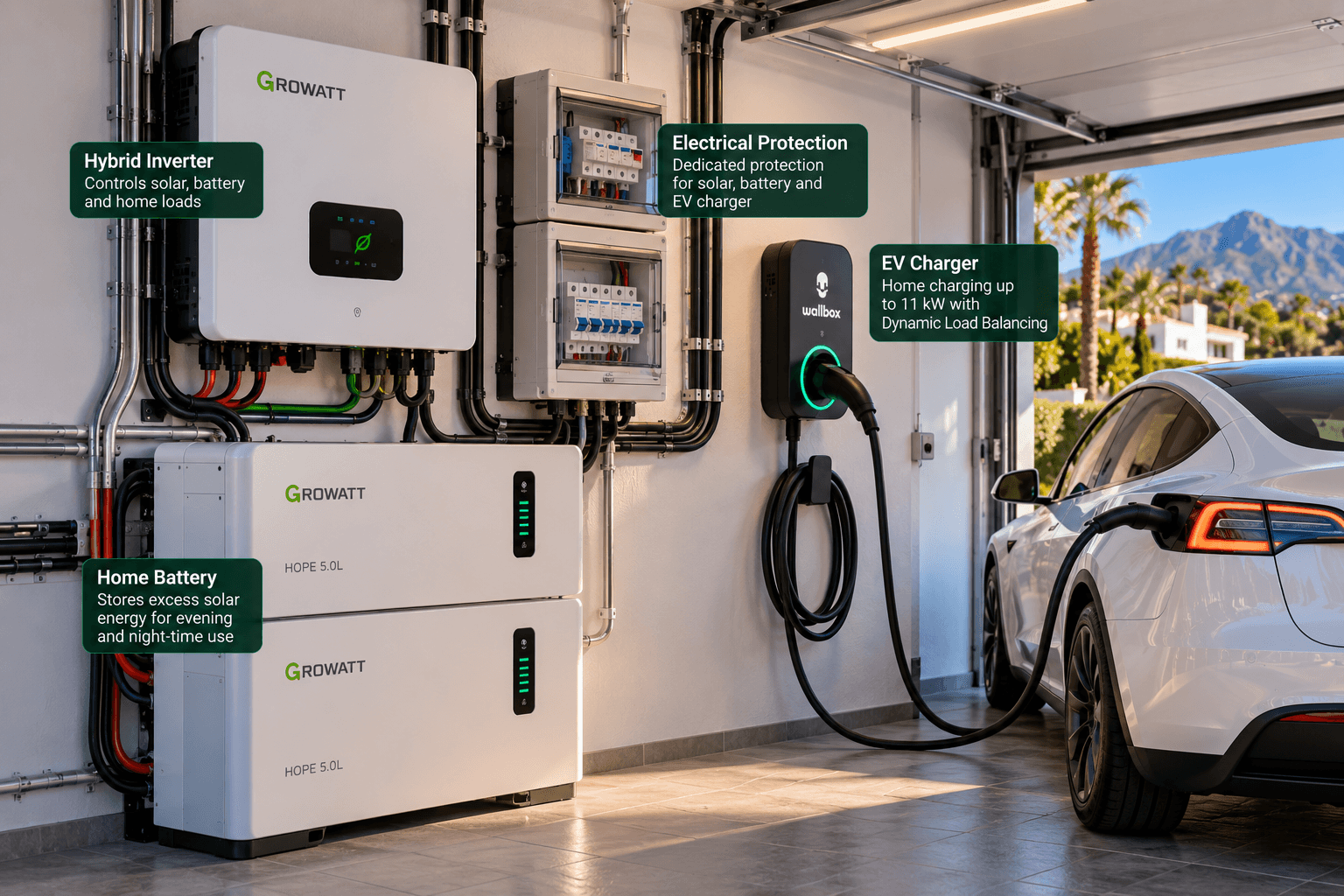
- Inverter capacity: must handle the heat pump’s compressor start-up and running load alongside the rest of the house.
- Contracted power (potencia contratada): adding a heat pump, an EV charger and a pool can exceed the power in your current contract. You pay for contracted power every month, so it is worth sizing deliberately.
- Single or three-phase: large heat pumps and fast EV chargers often need three-phase supply. Check yours before choosing equipment.
- Panel count: determined by total annual consumption, including the new heat-pump load, and by roof space and orientation.
- Control: the energy meter, inverter and heat pump should be able to coordinate. Compatibility is a purchasing criterion.
If you are also planning an electric vehicle, include it in the same design: see solar EV charging on the Costa del Sol. For cost guidance on the solar side, read the installation cost guide, and check subsidies in Andalucía.
Common Mistakes When Combining Heat Pumps and Solar
- Sizing solar before choosing the heat pump. Decide the heat-pump load first, then size the array and inverter.
- Ignoring contracted power and phases. A bigger load can trip a small main fuse or force an upgrade later.
- Letting the heat pump run at night by default. A schedule that follows the sun is the cheapest improvement available.
- Oversizing the battery. Heat can be stored in water, so keep the battery for the loads that cannot.
- Trusting data-sheet COP. Ask for seasonal efficiency figures and assume less in your own calculations.
- Forgetting the pool cover. Surface losses can dwarf the energy used to heat the water.
Key Takeaways
- A heat pump delivers roughly 3–5 kWh of heat per kWh of electricity, so solar goes a long way.
- Hot water for a 3-bedroom home is about 710 kWh per year at COP 3, around 0.4 kWp of panels.
- Warming a 48,000-litre pool by 8 °C takes about 90 kWh of electricity at COP 5, before surface losses.
- Heat is cheaper to store than electricity: a 200-litre tank holds about 10.5 kWh.
- Schedule loads to the sun first; add a battery for evenings and backup.
- Check inverter size, contracted power and phases before buying a heat pump.
- Design the solar and battery system around the heat pump from day one.
Frequently Asked Questions
What is aerotermia?
Aerotermia is the Spanish term for an air-source heat pump. It moves heat from outside air into your home, hot water tank or pool instead of generating heat by burning fuel or running a resistor. It can usually also run in reverse to cool the house.
How much electricity does a heat pump use for hot water?
As an illustration, a 3-bedroom home needs about 5.9 kWh of heat per day for hot water by the Spanish building code’s design figures. At a coefficient of performance (COP) of 3 that is roughly 2 kWh of electricity a day, around 710 kWh a year. Your real figure depends on occupancy, tank losses and the unit.
How many solar panels do I need to run a heat pump?
For domestic hot water alone, very few: the 3-bedroom example needs about 0.4 kWp, roughly one or two panels, on an annual basis. Space heating and cooling load are larger and depend heavily on insulation and usage, so we size them from your bills and the heat-pump specification.
Can I run a heat pump entirely on solar power?
Not entirely, because sunshine does not match every hour. Solar can cover a large share of daytime demand, a battery can extend that into the evening, and the grid fills the rest. We design for a high self-consumption share rather than promising zero grid use.
Is a heat pump cheaper to run than gas or electric resistance?
Per kWh of heat, a heat pump uses roughly a third to a quarter of the electricity of a resistance heater at COP 3–4, so it is far cheaper than direct electric heating. Compared with gas or LPG the answer depends on current fuel and electricity prices, which is why we run the numbers on your own tariffs.
Do heat pumps work in a Costa del Sol winter?
Yes. Winters are mild, so air-source units operate at good efficiency most of the year. Solar output is lower in December than in July, but on the Costa del Sol it is still roughly 60% of July in the PVGIS model (see our month-by-month production guide).
Does KiDi Solar install heat pumps?
Yes. KiDi Solar installs heat pumps, including pool heat pumps, together with the solar panels, hybrid inverter and battery that power them, so one team designs the whole system and plans the electrical side, including contracted power and phases.
Are there subsidies for heat pumps and solar?
Programmes and tax deductions exist at national, regional and municipal level and change often, with eligibility rules that vary. See our guide to subsidies for solar panels in Andalucía and ask us what applies to your property before you buy.
Should I get a heat pump or solar panels first?
If you are replacing a boiler, plan both together: the solar system and inverter should be sized for the heat pump load from day one. If you already have panels, adding a heat pump raises your self-consumption and often improves the case for a battery.
Why villa owners choose KiDi Solar
- Local technical team based in Marbella
- 330+ completed projects across the Costa del Sol
- Solar panels, home batteries and EV chargers designed and installed by one company
- Solar, battery and EV charger design that accounts for heat-pump loads
- Legalisation and certification handled where applicable
Plan the Solar System Around Your Heat Pump
Tell us what you have or plan to install and we will size the solar, inverter and battery around it:
- Heat pump model and size, or the plan
- Your electricity bills and contracted power
- Pool size and whether you want it heated
- Roof photos and property location
With this, KiDi Solar can determine:
- solar and battery sized for the heat-pump load
- a view on contracted power and phases
- which loads to schedule and which to store
- a clear quote with no pressure
Prefer to start with a conversation? Request a free on-site survey.
KiDi Solar installs and services systems across the Costa del Sol. For local prices, completed projects and a free survey, see our page on solar panels in Marbella.
Sources and notes: hot-water demand figures follow the design values in the Spanish building code, Código Técnico de la Edificación DB-HE (28 litres per person per day at 60 °C; occupancy by bedroom count). Solar yield figures are from PVGIS (European Commission JRC) for Marbella. The pool COP range is quoted from our pool heating cost comparison. COP values in the examples are assumptions for illustration, not manufacturer data. This guide is general information; equipment performance varies by model and installation.