
Yes, you can charge an electric car with a home solar installation on the Costa del Sol. For many drivers, the additional solar capacity required for an EV is smaller than expected. An efficient Tesla or similar electric car covering 10,000–15,000 km a year may require roughly 2–5 additional 500 W panels to offset its annual charging energy under typical Marbella-area solar conditions. The deciding factors are annual mileage, the car’s efficiency and when the car is parked at home, not the size of the EV battery.
That last point matters. A villa in Nueva Andalucía where the car sits on the drive most weekdays can charge directly from the sun far more often than a household where the car leaves at 8:00 and returns after dark. Both can benefit from solar, but the system design is different.
This guide explains the calculation step by step: how much electricity an EV such as a Tesla actually uses, how many panels that equates to on the Costa del Sol, which charger power suits your villa, and how Dynamic Load Balancing and solar surplus charging make the whole system work safely alongside air conditioning, pool equipment and everyday household loads.
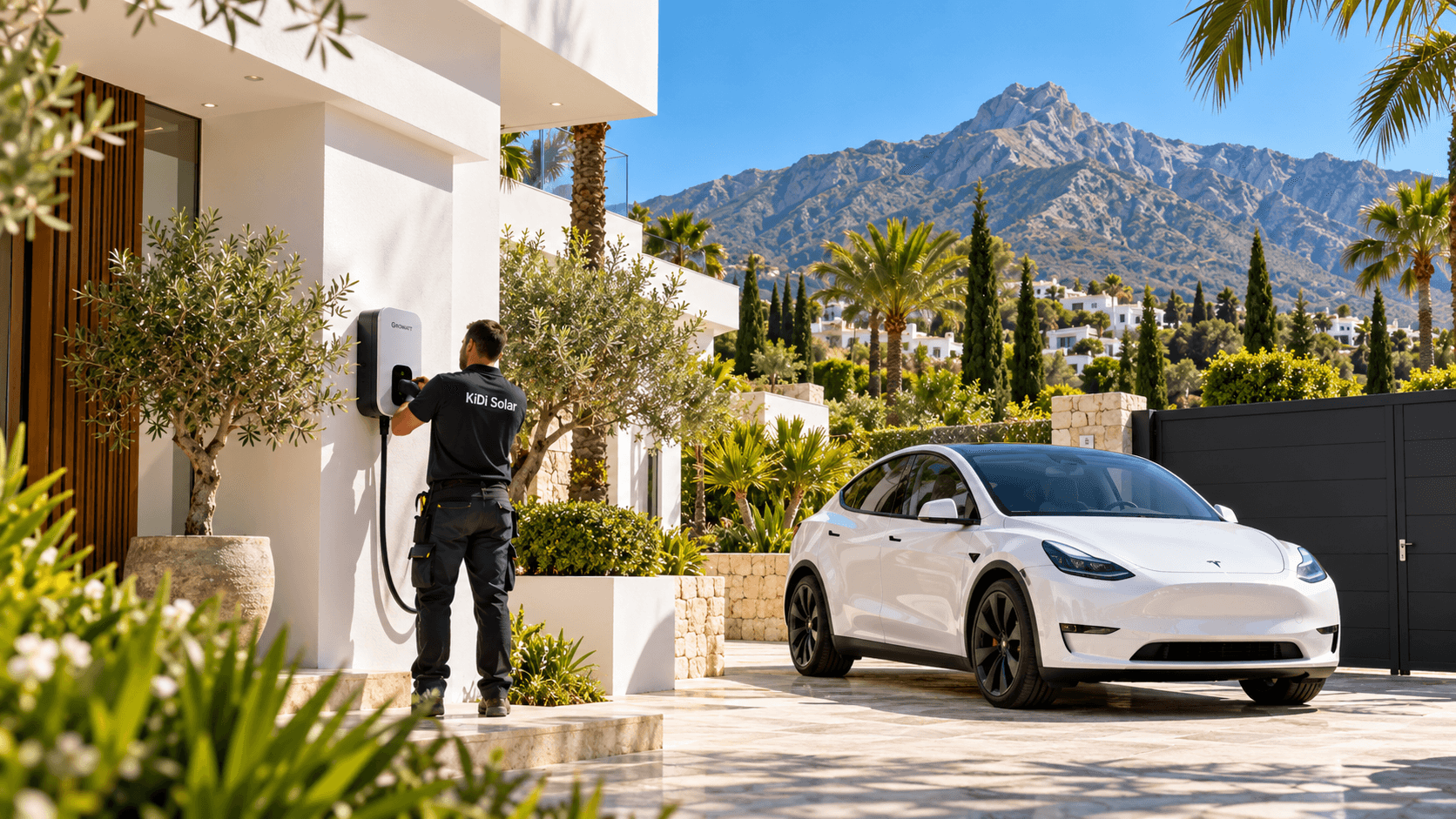
Quick Answer
How many solar panels do you need for EV charging on the Costa del Sol? Base the calculation on annual mileage, which matters more than EV battery size. An efficient Tesla or similar EV uses roughly 16–20 kWh per 100 km once charging losses are included. At around 15,000 km a year, that is about 2,400–3,000 kWh. Using Marbella-area production assumptions, each kWp of well-designed solar typically produces in the region of 1,450–1,650 kWh a year, so you would need roughly 1.5–2.1 kWp extra, or approximately 3–5 modern 500 W panels to offset the annual charging energy. Your exact figure depends on your roof, shading and charging habits.
- 50–60 km/dayTypical daily driving example
- 8–12 kWhTypical daily EV charging energy
- 3–5 panelsApprox. additional 500 W panels for 15,000 km/year
- 7.4 / 11 / 22 kWCommon home EV charger ratings
Can You Charge an Electric Car Directly from Solar Panels in Marbella?
Yes. Solar panels produce DC electricity, which an inverter converts into AC for the villa. That AC electricity powers household loads first, and any available energy can flow to a home EV charger and into the car. When solar production is not enough, for example on a cloudy day or at night, the grid supplies the difference automatically.
The energy flow in a typical Marbella installation looks like this:
- Solar panels on the roof generate DC electricity during daylight hours.
- The inverter converts it into AC electricity at the voltage your property uses.
- The villa’s loads (lighting, appliances, air conditioning, pool pump) consume what they need.
- The EV charger draws power for the car, either from solar, from the grid, or from a mix of both.
- The vehicle’s onboard charger converts AC back into DC to charge the battery.
The key component for smart charging is an energy meter installed at the main supply. It measures in real time how much electricity the property is importing from or exporting to the grid. With that information, a compatible smart charger can increase charging when solar is abundant and reduce it when the house needs more power.
Without a meter and a smart charger, the system still works: the car simply charges at its set power, and whatever the solar array does not cover is drawn from the grid. The difference is how much of the car’s energy actually comes from your roof.
How Much Electricity Does a Tesla Use?
A modern EV can use roughly 14–24 kWh per 100 km depending on the vehicle and conditions. For an efficient Tesla or similar EV, a practical planning range including typical home-charging losses is around 16–20 kWh per 100 km. That means roughly 8–12 kWh of charging energy for 50–60 km of daily driving. That is the figure your solar system needs to support, not the full battery capacity.
The table below shows illustrative ranges. They are planning figures, not official manufacturer data. For your own car, check the consumption history in the vehicle’s app or trip computer, which reflects your real driving on Costa del Sol roads.
Indicative EV energy consumption
| Vehicle type | Typical energy consumption (estimate) | Energy for 50 km | Energy for 60 km |
|---|---|---|---|
| Efficient saloon (e.g. Tesla Model 3, BMW i4) | approx. 14–17 kWh/100 km | approx. 7–8.5 kWh | approx. 8.4–10.2 kWh |
| Mid-size SUV (e.g. Tesla Model Y) | approx. 15–18 kWh/100 km | approx. 7.5–9 kWh | approx. 9–10.8 kWh |
| Large luxury EV (e.g. Tesla Model S, Porsche Taycan, Mercedes EQ) | approx. 17–21 kWh/100 km | approx. 8.5–10.5 kWh | approx. 10.2–12.6 kWh |
| Large SUV (e.g. Tesla Model X, BMW iX, Audi Q8 e-tron) | approx. 19–24 kWh/100 km | approx. 9.5–12 kWh | approx. 11.4–14.4 kWh |
Figures are indicative ranges at the battery, before charging losses. Fast motorway driving on the AP-7, hilly routes up to Benahavís and heavy use of air conditioning in summer will push consumption towards the upper end.
Charging losses
Not every kWh that leaves the wall arrives in the battery. Some energy is lost as heat in the onboard charger, cabling and battery, and the car may also use energy to condition the battery during charging. For home AC charging, a planning allowance of around 10% is reasonable, although the real figure varies with charging power, temperature and vehicle.
The formula
Daily EV energy (kWh) = Daily kilometres × vehicle consumption per kilometre (kWh/km) × charging-loss factor
Worked example: a Tesla Model Y driven 55 km a day between Sierra Blanca, Puerto Banús and San Pedro de Alcántara, averaging 16.5 kWh/100 km.
Worked example
Over a year: 55 km × 365 days ≈ 20,000 km, or roughly 3,650 kWh of charging energy.
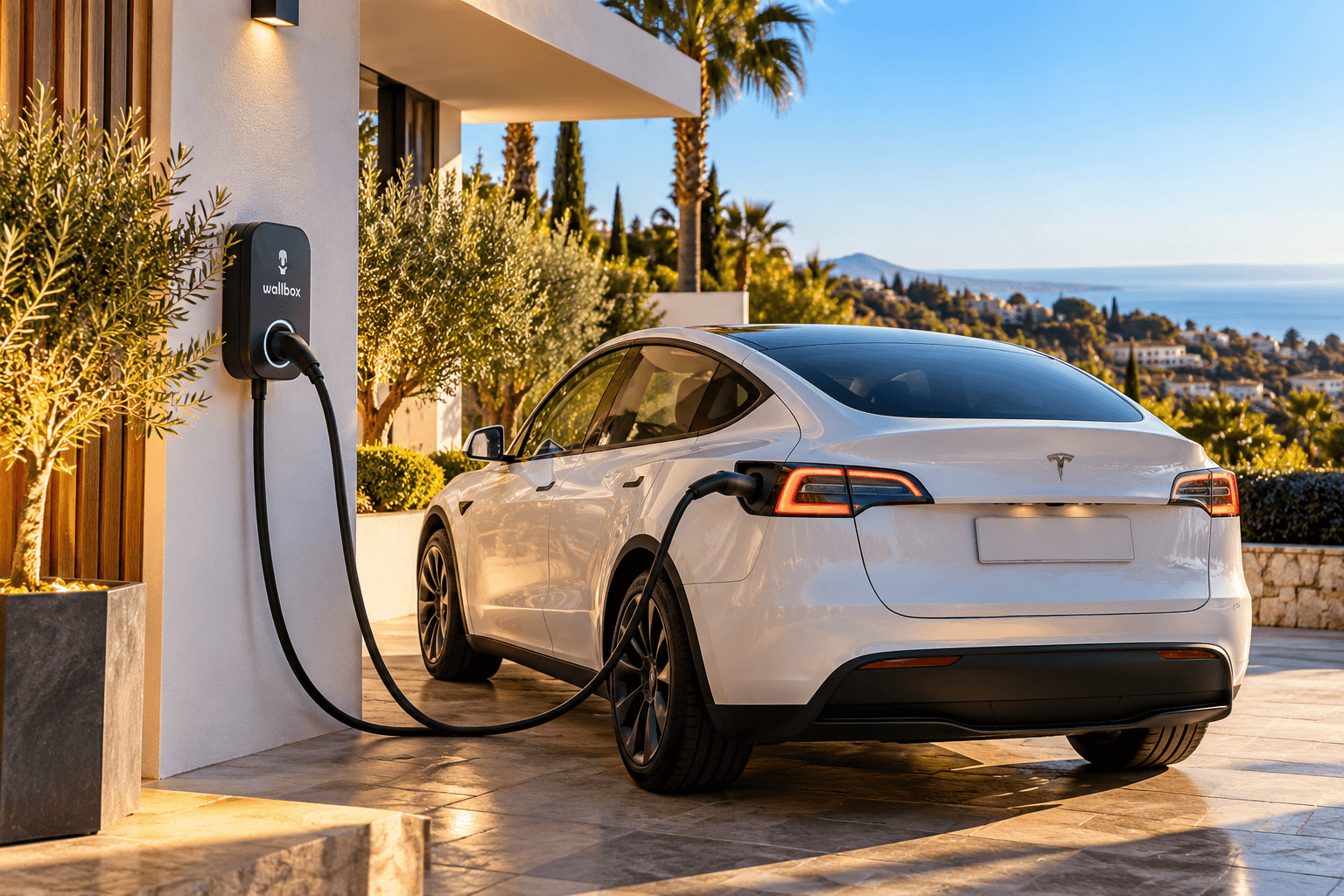
How Many Solar Panels Do You Need for EV Charging on the Costa del Sol?
For most drivers, between 2 and 7 modern 500 W panels may be enough to offset a year of EV charging under Marbella-area solar conditions, depending on mileage. At 15,000 km a year, the typical range is 3–5 panels (about 1.5–2.1 kWp). This is annual energy equivalence: the panels produce as much energy over a year as the car consumes, but not necessarily at the exact moment the car is charging.
Approximate calculation · 15,000 km a year
- 15,000 kmannual mileage
- 2,400–3,000 kWhannual EV energy
- 1.5–2.1 kWpextra solar capacity (Marbella reference)
- 3–5 panelsmodern 500 W modules
Estimates based on 16–20 kWh/100 km including charging losses and 1,450–1,650 kWh/kWp/year. Actual production must be calculated for each property.
To size this properly, three separate questions need answering:
- How much solar capacity offsets the car’s annual consumption? This is an annual energy calculation in kWh.
- How much solar power is available while the car is actually plugged in? This is about timing and instantaneous power in kW.
- How large should the total villa system be? The EV is only one load among many, alongside air conditioning, pool filtration, a heat pump and normal household use.
Step 1: Marbella solar production per kWp
The European Commission’s JRC PVGIS tool provides satellite-based solar irradiation and PV production estimates for any location in Europe. For the Marbella area, a well-oriented, unshaded system typically falls in the region of 1,450–1,650 kWh per kWp per year as a conservative planning range. Ideal south-facing roofs at the optimum tilt can exceed this, while east/west roofs, flat installations at low tilt or partial shading will produce less.
This is a planning estimate based on PVGIS-type modelling, not a guaranteed production figure. Marbella is used here as the reference point for the calculation; actual production varies slightly across the Costa del Sol and must be calculated for the individual property.
Real output for your villa depends on:
- roof orientation and inclination
- shading from trees, terraces, neighbouring buildings or the mountains behind properties in areas such as La Zagaleta and Benahavís
- panel temperature (output falls as panels get hotter in July and August)
- inverter efficiency and cable losses
- season and weather
- overall system design
Step 2: The calculation table
The table assumes a planning consumption of 16–20 kWh/100 km including charging losses, a production range of 1,450–1,650 kWh/kWp/year, and modern panels of around 500 W (4 × 500 W ≈ 2 kWp).
Estimated annual EV energy and solar capacity
| Annual mileage | Estimated EV consumption (incl. losses) | Approx. annual EV energy | Approx. additional PV capacity in Marbella | Approx. number of 500 W panels |
|---|---|---|---|---|
| 10,000 km | 16–20 kWh/100 km | 1,600–2,000 kWh | 1.0–1.4 kWp | 2–3 panels |
| 15,000 km | 16–20 kWh/100 km | 2,400–3,000 kWh | 1.5–2.1 kWp | 3–5 panels |
| 20,000 km | 16–20 kWh/100 km | 3,200–4,000 kWh | 1.9–2.8 kWp | 4–6 panels |
| 25,000 km | 16–20 kWh/100 km | 4,000–5,000 kWh | 2.4–3.5 kWp | 5–7 panels |
All figures are estimates for orientation only. Actual production must be calculated for the individual property using orientation, shading, roof geometry and local irradiation data.
Step 3: Why timing changes the answer
Four 500 W panels (about 2 kWp) do not charge the car at a steady 2 kW. Their output rises from zero at sunrise to a midday peak and falls again towards sunset, and the peak is usually below the panels’ rated power because of heat and system losses. Averaged over a year in Marbella, 2 kWp might produce somewhere around 8–9 kWh per day, more in summer and less in winter.
If your car is at home during the day, a large share of that energy can go straight into the battery. If the car is usually away from home during daylight, the panels still produce the energy, but it is used by the villa or exported to the grid, and the car charges later from grid electricity. Under Spain’s self-consumption framework (Real Decreto 244/2019), surplus energy can be compensated on your bill depending on your contract, but the value of exported energy is usually lower than the cost of imported electricity. That is why, in practice, we often recommend some extra margin above the pure annual-equivalence figure for owners who charge mostly in the evening.
One system, not a separate EV array
These panels do not need to be installed as a separate EV array. In most villas, KiDi Solar sizes one complete photovoltaic system around household consumption, air conditioning, pool equipment, EV charging and future energy requirements. A villa in Guadalmina with a pool, aerothermal heating and two EVs has a very different consumption profile from a townhouse in central Marbella, and the system should reflect that.
Already have solar panels? Your existing system may already cover part of the car’s energy, particularly if you currently export a lot of surplus in the middle of the day. Reviewing your inverter app data is the quickest way to find out whether you need more panels, a smarter charger, or both.
Already have an EV, or planning to buy one?
KiDi Solar can calculate how much additional solar capacity your car would require based on your annual mileage, electricity bill and property.
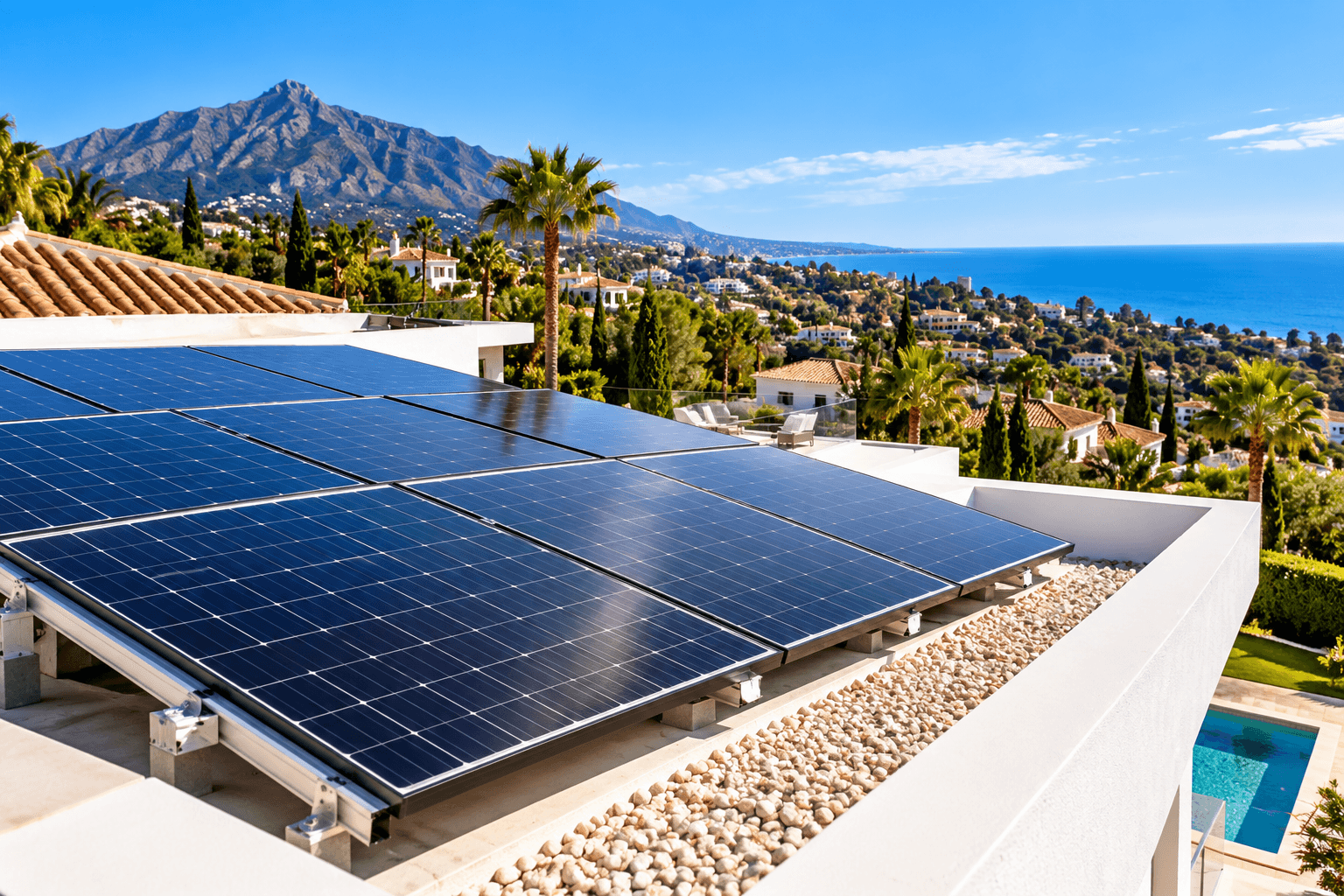
Can Solar Panels Fully Charge a Tesla in One Day?
Sometimes, but that is the wrong way to size a system. Many modern EVs have large traction batteries, but you rarely need to recharge the entire battery from empty. If you drive 50 km in a day, you may only need to replace around 8–10 kWh. Solar EV charging works because it replaces what you used, day after day.
Think of the EV battery like a fuel tank you top up regularly rather than a tank you empty and refill. Most owners plug in at home every evening or whenever the car is parked, so the daily requirement stays modest.
Sizing a solar system to fully charge a large battery in one day would mean installing far more capacity than the household actually needs most of the year. It would also ignore the fact that on most days the car is already partially charged.
Summer versus winter in Marbella
The Costa del Sol has excellent solar resource, but production still varies through the year:
- Summer: long days and high sun mean strong production. A properly sized system often has surplus available after covering the villa, even with air conditioning and pool pumps running.
- Winter: shorter days and a lower sun angle mean considerably less daily production per kWp. PVGIS monthly data for your exact location shows the size of this seasonal difference.
- Cloudy periods: output can drop substantially for a day or more. The grid, or a home battery if installed, covers the gap automatically.
Annual sizing balances these seasons. Depending on the system size and driving pattern, some winter charging may come from the grid, while higher summer solar production can cover a much larger share of the vehicle’s charging demand.
7.4 kW vs 11 kW vs 22 kW EV Chargers for Villas in Marbella
A 7.4 kW charger usually runs on a single-phase supply, while 11 kW and 22 kW chargers need a three-phase supply. For most villa owners, 7.4 kW or 11 kW is sufficient for overnight and daytime charging. A 22 kW charger only makes sense if the vehicle accepts 22 kW AC charging and the property’s electrical infrastructure supports it.
- 7.4 kWSingle-phaseGood for many homes
- 11 kWThree-phaseExcellent villa option where three-phase supply is available
- 22 kWThree-phaseOnly useful when the car and electrical supply support it
| Charger | Electrical supply | Typical use | Important considerations |
|---|---|---|---|
| 7.4 kW | Single-phase, 230 V, 32 A | Overnight charging for typical daily mileage; homes without three-phase supply | Adds roughly 35–50 km of range per hour depending on the car. Uses a large share of a single-phase contract, so load balancing is often advisable. |
| 11 kW | Three-phase, 400 V, 16 A per phase | The most common choice for villas with three-phase supply; flexible daytime solar and night charging | Many current EVs sold in Europe accept up to 11 kW AC. Load is spread across three phases. Check the vehicle’s onboard charger specification. |
| 22 kW | Three-phase, 400 V, 32 A per phase | Properties with high contracted power and vehicles that support 22 kW AC | Many EVs are limited to 11 kW AC, so a 22 kW charger may give no benefit. Requires heavier cabling, appropriate protection and sufficient contracted power. |
The charger’s rating is its maximum available power. The car’s onboard AC charger sets its own limit: if your vehicle accepts 11 kW, a 22 kW wallbox will still charge it at 11 kW. Before choosing a 22 kW unit, check your car’s specification in the manufacturer’s documentation or on the Tesla charging support pages.
The right charger for your villa depends on:
- Contracted power (potencia contratada) with your electricity supplier
- Main breaker rating and existing protection in the consumer unit
- Cable size required for the charging current
- Distance from the electrical panel to the parking position, which affects cable section and cost
- Phases available: single-phase or three-phase
- Other household loads running at the same time
Three-phase supplies are common in many larger villas around Marbella, Benahavís and La Zagaleta, but not universal. Older properties and apartments in central Marbella or Estepona are often single-phase. In Spain, EV charging installations fall under the low-voltage electrical regulations, including instruction ITC-BT-52 of the Real Decreto 1053/2014, which is why the installation should be designed and certified by a qualified installer.
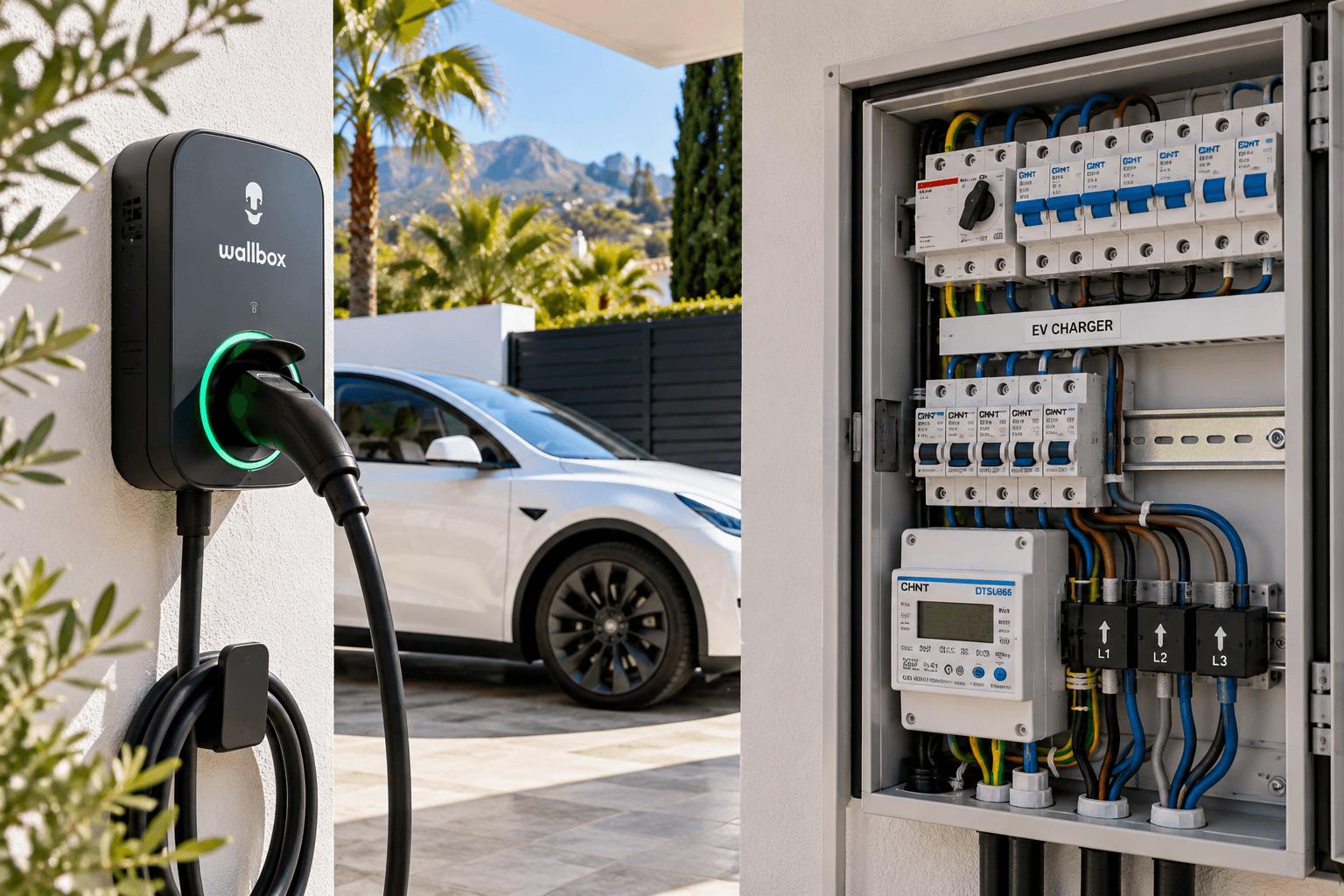
Why Dynamic Load Balancing Matters in a Marbella Villa
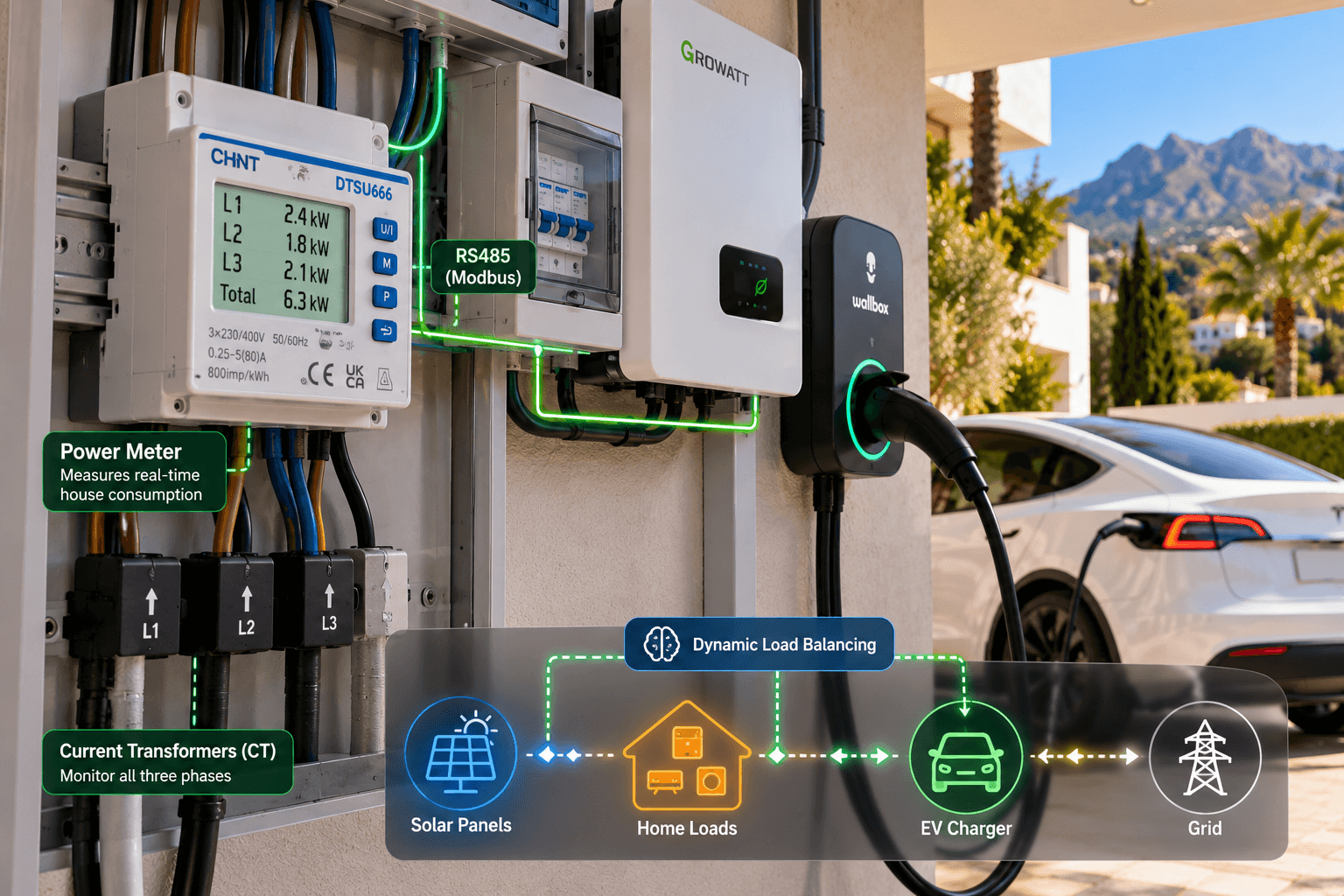
Dynamic Load Balancing is a control system that adjusts EV charging power based on the electricity the property is using at that moment. A Power Meter installed at the main supply measures total demand. When household consumption rises, the charger reduces power; when it falls, charging speeds up again. This protects the main breaker and makes better use of your existing contracted power.
Consider a typical summer afternoon in a villa in Sierra Blanca or Nueva Andalucía:
- Several air conditioning units running
- Pool filtration pump on its daily cycle
- Oven, induction hob and dishwasher in use
- An EV plugged into an 11 kW charger
Without load balancing, simultaneous high-power loads can exceed the property’s available electrical capacity. This may trigger the main breaker or the meter’s power-control function and interrupt the supply.
With Dynamic Load Balancing, the Power Meter continuously reports total property consumption to the charger:
- House demand rises when the air conditioning and oven switch on.
- The charger automatically reduces its charging power to keep total demand within the safe limit.
- When the oven switches off and demand drops, the charger increases power again.
The car still charges, just more slowly during peak household demand. For overnight charging, the difference in final charge level is usually small.
Benefits for villa owners
- Reduces the risk of main breaker trips when several large loads run at once
- Maximises existing electrical capacity instead of oversizing the supply
- Can reduce the need to increase contracted power, which affects the fixed part of your electricity bill
- Makes high-power charging safer and smarter, especially with 11 kW and 22 kW chargers
KiDi Solar installs chargers with a Power Meter and Dynamic Load Balancing where the property requires it. Several manufacturers offer this function; Wallbox chargers with a Power Meter are one common example. The right choice depends on your inverter, supply type and how you want to control charging from your phone.
What Is Solar Surplus EV Charging?
Solar surplus charging directs the solar energy your villa is not using into the EV instead of exporting it to the grid. An energy meter measures the surplus in real time, and a compatible smart charger adjusts its charging power to match. This maximises the share of the car’s energy that comes from your own roof.
A simple example on a sunny day:
Illustrative example
Instead of sending those 5 kW to the grid, a compatible smart charging system can direct some or all of it into the car.
Common charging modes
- Solar-only charging: the car charges only when there is enough surplus. No grid energy is used for the car.
- Solar-priority charging: solar surplus is used first, and the grid tops up to maintain a minimum charging rate.
- Minimum charging current: AC charging generally cannot run below a minimum current, which for many chargers and vehicles is around 6 A. At that current, single-phase charging draws roughly 1.4 kW and three-phase charging roughly 4.1 kW. In those cases, a three-phase charger needs a larger surplus before solar-only charging can start, unless the system can switch between one and three phases. Exact minimums depend on the charger and vehicle.
- Grid supplementation: when solar falls below the minimum, for example when a cloud passes over, the system either pauses charging or draws the difference from the grid, depending on your settings.
Capabilities vary by charger, inverter and energy-meter ecosystem. Some systems offer all of these modes, others only some, and the settings are usually managed in the manufacturer’s app. Matching compatible components is part of the system design, not something to check after installation.
Not sure whether your villa supports 7.4 kW, 11 kW or 22 kW charging?
KiDi Solar can check:
- your electrical supply and contracted power
- single-phase or three-phase availability
- the cable route from panel to parking
- main protection and consumer unit
- integration with existing or new solar
- whether Dynamic Load Balancing is needed
Do You Need a Home Battery to Charge an Electric Car with Solar?
Not necessarily. The most efficient path is direct: solar panels power the EV while the sun is shining. Routing energy through a home battery first adds conversion losses and battery cycles. A home battery is most useful for covering the villa’s evening and night consumption, rather than for charging the car.
Direct solar
Highest direct efficiency when the car is home during the day.
With home battery
Useful in some consumption profiles, but includes an additional storage cycle.
When the car is at home during the day, sending solar straight to the EV avoids storing energy twice. Residential batteries are also much smaller than EV batteries: typical home systems hold around 5–16 kWh, while many EVs carry 60–100 kWh. A full home battery can supply one day of moderate driving, but then the villa has nothing left for the evening.
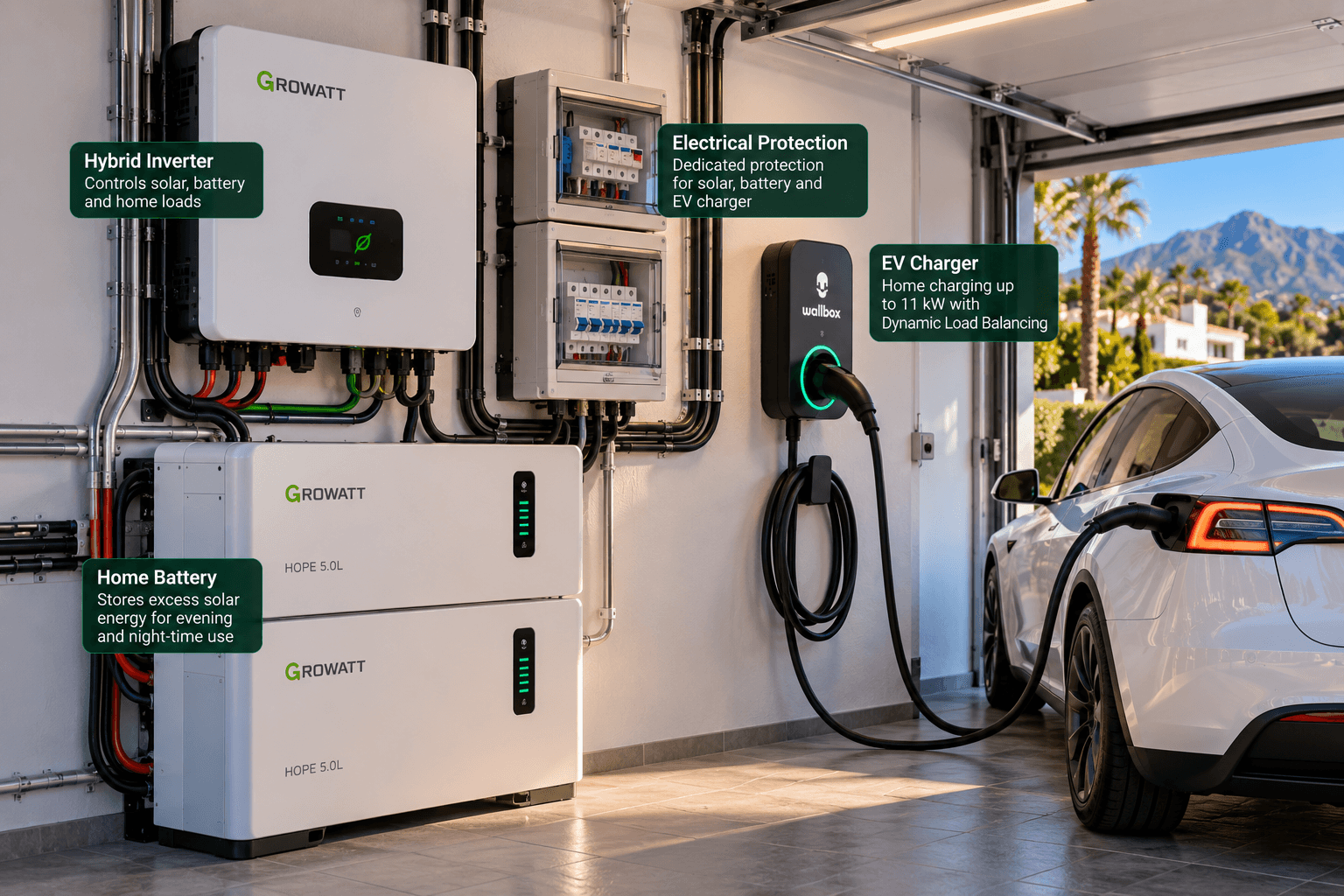
A home battery storage system is better used for:
- evening villa consumption: lighting, cooking, air conditioning
- night-time base loads
- avoiding peak-rate periods on time-of-use tariffs
- backup power, where the inverter and battery support it
- increasing overall solar self-consumption
Direct solar charging vs solar + home battery
| Direct solar charging | Solar + home battery | |
|---|---|---|
| Best for | Cars parked at home during daylight | Villas with high evening use or cars that charge at night |
| Efficiency | Highest: one conversion path | Lower for EV charging: extra storage losses |
| Upfront cost | Lower | Higher |
| Evening and night coverage | Grid supplies the villa and the car | Battery covers part of the villa’s evening use |
| Backup during outages | Not normally — requires dedicated backup/islanding functionality | Possible, if the inverter, battery and backup circuits are designed for it |
Whether a battery makes economic sense depends on your consumption profile, tariff and when the car is usually at home. We do not recommend one to every client.
Example: Solar + EV Charging for a Marbella Villa
Example configuration — not a quotation.
The scenario below is illustrative and does not describe a specific KiDi Solar client. It shows how the components work together in a typical Costa del Sol villa with a pool, air conditioning and one EV driven around 15,000–20,000 km a year.
Example system
- 10 kWp photovoltaic system (20 × 500 W panels)
- Hybrid inverter
- Smart energy meter at the main supply
- Optional 10–16 kWh home battery
- 11 kW three-phase EV charger
- Dynamic Load Balancing
Using the planning range above, a 10 kWp system in Marbella might produce in the region of 14,500–16,500 kWh a year on a well-oriented roof. Of that, roughly 2,400–4,000 kWh would cover the car, and the rest would support the villa’s own consumption, including air conditioning and pool equipment.
How energy might be prioritised on a sunny day
- Villa consumption: in this example, normal household consumption is prioritised first.
- EV charging: surplus solar flows into the car while it is plugged in.
- Home battery: once the car is charged or unplugged, surplus charges the battery for the evening.
- Grid export: anything left over is exported and compensated according to your self-consumption contract.
In the evening, the battery supplies the villa, and if the car needs more charge, it charges overnight from the grid, ideally during cheaper tariff periods, with load balancing keeping the total within the contracted power.
Priorities can be configured differently according to the client’s requirements and equipment. Some owners prefer to fill the home battery before the car; others want the car fully charged for an early start. Your system should follow your routine, not the other way round.
Designing Around the Whole Property, Not Just the Car
The best EV and solar system is not designed by looking at the car alone. It is designed around the whole property: how much the roof can produce, how much the villa uses, and how the car fits into that picture now and in future.
In our experience designing solar and EV charging systems for villas on the Costa del Sol, the most expensive mistakes come from treating each component separately: a charger chosen without checking the supply, or panels added without considering the second EV the family plans to buy next year. A complete design looks at:
- solar production for the specific roof
- household base consumption
- air conditioning and pool pumps
- aerothermal or heat pump loads, if present
- battery storage, if justified
- EV mileage and charging times
- charger power
- contracted electrical power
- single-phase or three-phase supply
- future demand, such as a second EV or extended living spaces
This is why KiDi Solar approaches each project as an energy system rather than a panel installation. Our work covers residential solar panel installation on the Costa del Sol, battery systems, EV chargers, electrical protection, smart meters and Dynamic Load Balancing, through to commissioning, mobile-app configuration and legalisation where required.
Key Takeaways
- Size solar for EV charging by annual mileage and energy use (kWh), not by EV battery capacity or charger power (kW).
- An efficient EV typically needs around 8–12 kWh per day for 50–60 km of driving, including charging losses.
- Using Marbella as the reference, offsetting 15,000 km a year usually requires roughly 1.5–2.1 kWp of extra solar, about 3–5 panels of 500 W.
- Panels offset the car’s energy over a year; how much goes directly into the car depends on when it is parked at home.
- Most villas need a 7.4 kW single-phase or 11 kW three-phase charger; 22 kW only helps if the car and supply support it.
- Dynamic Load Balancing protects the main breaker and can avoid the need to increase contracted power.
- A home battery is optional and usually better suited to evening villa loads than to charging the car.
Solar EV Charger Installation Across Marbella & Costa del Sol
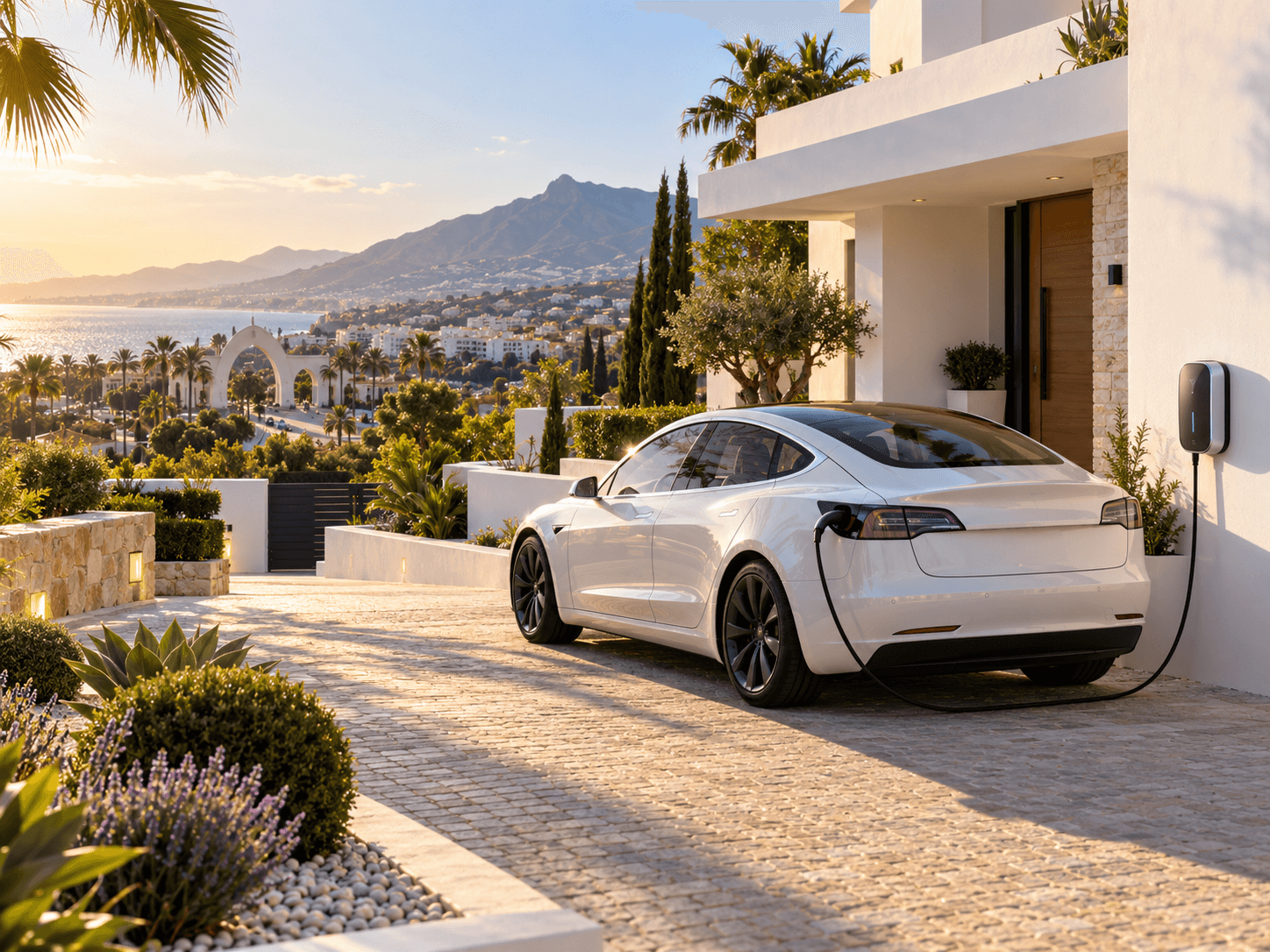
KiDi Solar designs and installs solar systems, home batteries and EV chargers for villas and residential properties across the Costa del Sol. From our office in Marbella, we work throughout Nueva Andalucía, Puerto Banús, the Golden Mile, Sierra Blanca, San Pedro de Alcántara and Guadalmina, as well as Benahavís, Estepona, Mijas, Sotogrande and the wider Málaga Province.
In our site surveys, villas in hillside urbanisations can require longer cable routes between the main electrical board and the parking area, while other properties may have the electrical panel much closer to the garage or carport. Supply type must always be checked individually, as both single-phase and three-phase properties are found across Marbella, Benahavís, Estepona and the wider Costa del Sol. If you are planning solar panels in Marbella or a new charger for an existing system, the first step is the same: understanding your property.
For charger-only projects, see our page on EV charger installation in Marbella and Costa del Sol.
Frequently Asked Questions
How many solar panels does it take to charge a Tesla in Spain?
It depends on mileage and location. In southern Spain, including Marbella, a Tesla or similar EV driven 15,000 km a year typically uses around 2,400–3,000 kWh of charging energy, which roughly equates to 1.5–2.1 kWp of extra solar, or about 3–5 panels of 500 W. Northern Spain receives less sunshine, so more panels would be needed for the same mileage. A site-specific calculation using PVGIS data gives the accurate figure.
Can I charge my Tesla directly from solar panels?
Yes, through a home EV charger connected to your solar installation. The inverter converts solar energy to AC, the villa uses what it needs, and the charger can draw the rest. With an energy meter and a compatible smart charger, charging power can follow solar production. When the sun is not enough, the grid makes up the difference automatically. The same principle applies to other electric cars, including BMW, Audi, Mercedes and Porsche models.
Can an 11 kW charger run only on solar energy?
Only when the solar surplus is large enough. With a typical 6 A minimum current, an 11 kW three-phase charger needs at least around 4.1 kW of surplus to start charging (exact minimums depend on the charger and vehicle), and reaching the full 11 kW requires substantial surplus after the villa’s own consumption. In practice, most solar-only charging runs below the charger’s maximum, with power varying through the day. Some systems can switch to single-phase charging to use smaller surpluses.
Is a 7.4 kW or 11 kW charger better for a villa in Marbella?
If the villa has a three-phase supply and the car accepts 11 kW AC, an 11 kW charger usually offers the most flexibility and spreads load across phases. On a single-phase supply, 7.4 kW is the practical maximum. For typical daily mileage, both comfortably recharge the car overnight. The decision depends on supply type, contracted power and other loads.
Do I need a battery to charge an EV with solar?
No. Charging the car directly from solar during the day is the most efficient option. A home battery, typically 5–16 kWh, is much smaller than an EV battery and is usually better used for evening and night villa consumption. A battery can make sense if your car is rarely home during daylight and your evening consumption is high, but it is not a requirement.
Can solar panels charge an EV at night?
Not directly, since panels produce no energy at night. Night charging uses grid electricity or energy stored in a home battery. Many owners charge at night on a cheaper tariff period and let daytime solar cover the villa, with surplus credited under Spain’s self-consumption compensation scheme, depending on the electricity contract.
What is Dynamic Load Balancing?
Dynamic Load Balancing is a control system that adjusts EV charging power based on the property’s real-time electricity consumption. A Power Meter at the main supply measures total demand. When household loads rise, the charger slows down; when they fall, it speeds up. This helps prevent main breaker trips and can avoid the need to increase contracted power.
Can I use solar surplus to charge my Tesla?
Yes, with a smart charger and energy meter that support surplus charging. The system measures how much solar energy would otherwise be exported and directs it into the car. Available modes, such as solar-only or solar-priority, depend on the charger, inverter and meter used, so compatibility should be checked during system design.
How much electricity does an EV use for 50 km?
Most modern EVs use roughly 7–10 kWh for 50 km at the battery, based on typical consumption of 14–20 kWh per 100 km. Including charging losses, expect around 8–11 kWh from the charger. Large SUVs, fast motorway driving, steep routes and heavy air conditioning use push this towards or above the upper end.
Why villa owners choose KiDi Solar
- Local technical team based in Marbella
- 330+ completed projects across the Costa del Sol
- Solar panels, home batteries and EV chargers designed and installed by one company
- Electrical protection, Dynamic Load Balancing and app configuration included where required
- Legalisation and certification handled where applicable
Drive on Marbella Sunshine
Send us four details and we will design a solar and EV charging system around your property and your driving:
- Your EV model (or the model you plan to buy)
- Approximate daily or annual mileage
- Your latest electricity bill
- Property location
With this, KiDi Solar can determine:
- the recommended PV capacity
- suitable EV charger power
- whether Dynamic Load Balancing is recommended
- whether battery storage makes economic sense for you
Prefer to start with a conversation? Request a free solar and EV assessment.
Sources: solar production ranges are planning estimates informed by European Commission JRC PVGIS data and must be calculated individually for each property. For general information on self-consumption and efficient energy use in Spain, see IDAE.