
Most guides to solar tariffs in Spain compare one number: the price paid for surplus. It matters, but it is rarely the biggest part of your bill. The energy price in each time period, the power term and the way surplus is credited usually decide what you pay.
This guide shows how a Spanish electricity bill is built, which tariff features matter when you have solar panels or plan to add a battery or an EV charger, and what the published comparisons say in November 2026. Prices change often, so check the retailer before you sign.
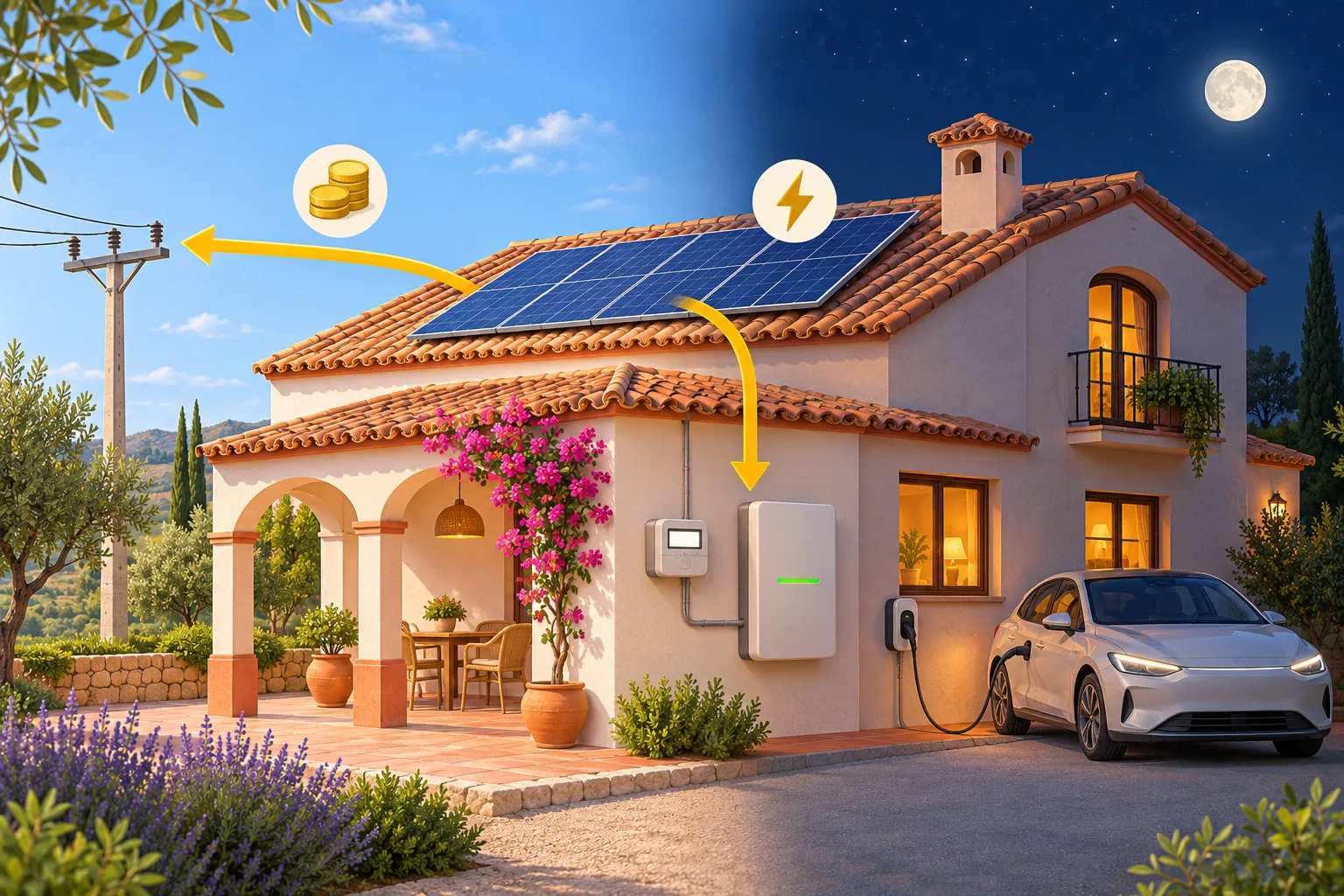
Which electricity tariff is best for solar owners in Spain?
There is no single best tariff. What matters is the energy price in each period, the power term, the surplus price and whether you get a virtual battery. In a Selectra comparison updated on 5 November 2026, surplus prices were €0.035 to €0.07 per kWh, and virtual batteries were offered by Repsol, Naturgy, Endesa and Octopus tariffs.
Compare the whole bill for your own consumption, not only the surplus price. A kWh used at home is worth about two to three times a kWh exported, as our own retailer comparison found.
- €0.035–0.07Surplus price per kWh across the tariffs in Selectra’s 5 November 2026 table
- 2 periodsPower term: punta (weekdays 08:00–00:00) and valle
- 00:00–08:00Cheapest energy period (valle) on weekdays, plus all day at weekends
- ≤ 100 kWInstallation size for simplified surplus compensation
The three parts of a solar owner’s bill
Compare each of these, not just one.
- Energy term. Priced per kWh and split into three periods. On the 2.0TD tariff, on weekdays, punta is 10:00–14:00 and 18:00–22:00, llano is 08:00–10:00, 14:00–18:00 and 22:00–00:00, and valle is 00:00–08:00. Weekends and national holidays are billed entirely at the valle price (Repsol).
- Power term. Priced per kW of contracted power per day, with two periods: punta, weekdays 08:00–00:00, and valle, the rest of the time including weekends and national holidays.
- Surplus price. A separate €/kWh credit for the energy you export. In the simplified compensation scheme it is deducted from the energy you buy and cannot exceed the cost of that energy in the month. It does not cancel the fixed term (the power charge) or taxes, which OCU notes are outside standard surplus compensation under RD 244/2019, so even a month with a large surplus still leaves a bill to pay.
For a retailer-by-retailer view of surplus prices, see our comparison of ten Spanish retailers and the guide to solar surplus compensation.
What a published comparison shows
Selectra’s table, updated on 5 November 2026.
| Retailer | Tariff | Surplus (€/kWh) | Virtual battery |
|---|---|---|---|
| TotalEnergies | A tu Aire Programa tu Ahorro Solar | 0.07 | No |
| TotalEnergies | A Tu Aire Siempre Solar | 0.07 | No |
| Naturgy | Tarifa Noche con Batería Virtual | 0.06 | Yes |
| Naturgy | Tarifa Por Uso con Batería Virtual | 0.06 | Yes |
| Repsol | Solar Tarifa Batería Virtual | 0.06 | Yes |
| Repsol | Solar Tarifa Solar | 0.06 | No |
| Endesa | Solar Plus | 0.06 | No |
| Endesa | Solar Plus & Batería Virtual | 0.06 | Yes |
| Endesa | Asesor Solar | 0.06 | Yes |
| Octopus | Octopus Solar | 0.035 | Yes |
| Endesa | Solar Basic | 0 | No |
Source: Selectra, page updated 5 November 2026. Offers change, so confirm the current price in the contract. For more retailers, see our surplus price comparison.
The surplus price is only one line. Here is what Selectra lists for energy and power on two tariffs, which shows how much the other lines matter:
| Tariff | Energy (€/kWh) | Power (€/kW/day) |
|---|---|---|
| TotalEnergies, A Tu Aire Siempre Solar | 0.1199 flat | 0.0945, punta and valle |
| Naturgy, Tarifa Noche con Batería Virtual | Punta 0.2180, llano 0.1450, valle 0.1100 | Punta 0.1230, valle 0.0616 |
Selectra’s worked example (270 kWh a month, 4 kW contracted, 650 kWh a month generated) gives an estimated bill of €47.89 on the TotalEnergies tariff and €59.65 on the Naturgy tariff. That is a small flat, so a villa with air conditioning or a pool heat pump will see different results, and the energy price will matter even more.
Why the night price matters for batteries and EVs
If you charge in the cheap hours, the valle price is part of your savings.
The valle period runs from midnight to 08:00 on weekdays and all day at weekends. Some tariffs make it much cheaper. In Selectra’s table, Naturgy’s Tarifa Noche lists €0.1100 per kWh in valle against €0.2180 in punta.
That gap matters if you charge an electric car or, with a system that lets you schedule it, a battery from the grid at night. Our guides cover the other side: charging an EV with solar panels and whether a battery is worth it. If you use a lot of power in the evening or at night, compare the punta and valle prices before the surplus price.
Virtual battery: what to check
It stores the value of your surplus as credit, instead of paying it out.
- What it covers. OCU says that with most companies the credit can reduce the total bill, taxes included, while some tariffs apply it only to energy. It names Octopus and Met Energía as exceptions that allow the credit against other items. Ask which lines your contract allows.
- Monthly fee. OCU lists Repsol and Endesa among companies charging €2 to €5 a month for the virtual battery. Selectra lists Naturgy’s at €0.00 a month.
- Credit expiry. OCU reports that Naturgy, Som and Goiener keep unused credit for up to 5 years and Iberdrola for 2 years. Ask before you sign.
- It is not a physical battery. See virtual battery versus physical battery and our virtual battery page.
On the Costa del Sol: who connects you and how long it takes
Your retailer pays the surplus, but another company connects you to the grid.
In Málaga province the electricity distributor is e-distribución, the network company of the Endesa group. You cannot choose your distributor, only your retailer. After the installer files the paperwork, the steps are:
- The installer obtains the CIE certificate from the Junta de Andalucía and the self-consumption code (CAU).
- The autonomous community sends the documents to the distributor. The IDAE guide gives 10 days for this step.
- The distributor notifies the retailer and updates the access contract, in 5 days according to the same guide.
- Your retailer then updates your supply contract and starts crediting your surplus.
Those are the guide’s stated periods. In practice the whole chain can take longer, so ask your installer for the date by which compensation will start, and compare tariffs knowing that the fixed monthly fees continue meanwhile.
Conditions for simplified surplus compensation
Without these, there is no credit for your surplus.
- Installation of up to 100 kW.
- Exclusively renewable energy.
- No direct economic gain from the compensation.
- A signed surplus compensation contract.
- A legalised installation, with the CAU code and the CIE certificate.
A simple way to choose
Our own rule of thumb, not a ranking.
- Estimate your split. How much you use during the day, how much at night, how much you export.
- Price the energy first. A kWh you use at home is worth more than a kWh you export, so the energy price usually matters more than the surplus price.
- Then the surplus. If you export a lot, a virtual battery can keep the value you would otherwise lose above the cap.
- Check the contract. Prices can be reviewed monthly or fixed for a period. Confirm both and the monthly fee.
Frequently asked questions about tariffs for solar owners in Spain
What is the best tariff for solar panels in Spain?
It depends on your consumption pattern. Compare the energy price in each period, the power term, the surplus price and whether a virtual battery is included, using your own consumption. A published comparison from November 2026 showed surplus prices from €0.035 to €0.07 per kWh.
Can my bill go negative if I export a lot?
No. Under simplified compensation the credit cannot exceed the cost of the energy you buy that month, and it covers the energy part of the bill, not the fixed power term. A virtual battery can carry the extra value forward, and OCU notes that with most companies its credit can reduce the whole bill, taxes included. Check your contract.
When is energy cheapest in Spain?
On the 2.0TD tariff the valle period is 00:00 to 08:00 on weekdays, and weekends and fixed national holidays are billed entirely at valle prices.
Do I need a virtual battery?
It is useful if you export a lot more than the cap allows you to deduct. Compare the energy price too, and ask whether credit expires and whether there is a monthly fee.
What do I need to get paid for surplus?
A system of up to 100 kW using renewable energy only, a surplus compensation contract, and a legalised installation with its CAU code and CIE certificate.
Want a solar system sized for your tariff?
Take our 2-minute quiz and we will come back to you with a quote, within 2 hours in working hours. We size the system for your consumption, so you do not export more than you need to.
- Your town and property type
- Your yearly electricity use or recent bills
- Whether you have or plan an EV or a battery
With this, KiDi Solar can determine:
- the system size that suits your consumption
- how much surplus to expect
- the price, quoted individually
Start the 2-minute quiz Message us on WhatsApp
Prefer to talk first? Request a free site visit or call +34 677 307 907.
Sources and notes: Selectra, mejor tarifa de excedentes de autoconsumo (updated 5 November 2026) for the tariff table, the worked example, virtual battery and the compensation conditions; Repsol, diferencias entre horas punta, llana y valle for the periods under 2.0TD. OCU, ventajas de la batería virtual for what the credit covers, monthly fees and expiry; IDAE guide for the activation steps and periods; Papernest for e-distribución in Málaga. Prices and conditions change, so confirm them with the retailer before you sign. This guide is general information, not financial advice.