
When the grid goes down, most solar homes go dark too. Panels alone do not keep the lights on in a blackout: you need a hybrid inverter with a backup output, a battery, and a backup circuit that decides what stays powered.
This guide explains why grid-tied solar switches off, what a backup system needs, the two ways to wire it (the whole house or only the circuits that matter), how long a battery lasts and what to check before you buy. It draws on the 28 April 2025 blackout in Spain and on industry and manufacturer sources.
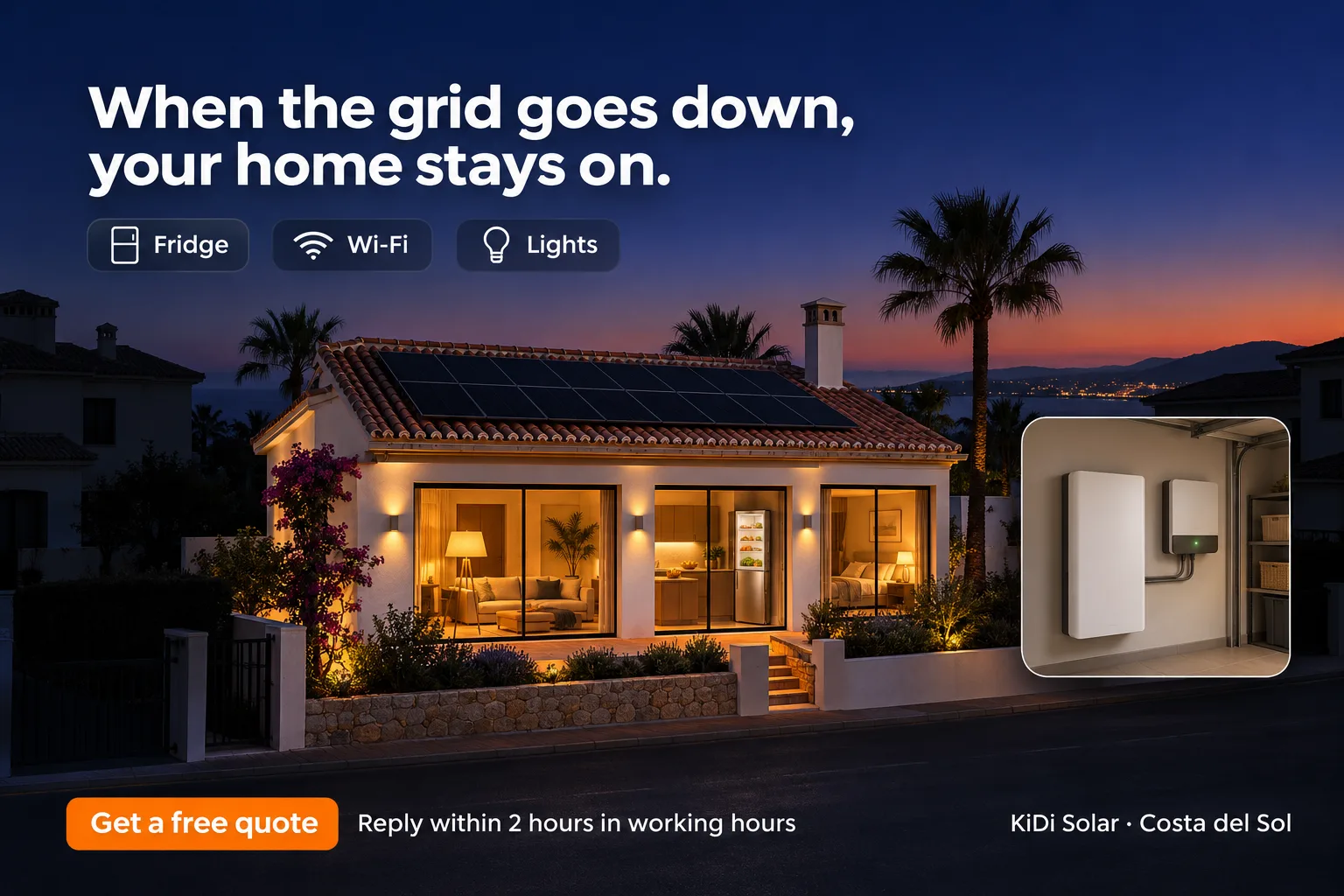
Will solar panels keep my home powered in a blackout?
Not by themselves. A standard grid-tied system disconnects automatically when the grid fails. To keep the home powered you need a hybrid inverter with a backup (island-mode) output, a physical battery and a backup panel that decides which circuits stay on (Selectra, Energías Renovables). After the 28 April 2025 blackout it took 16 hours to restore power in Spain, and almost 484,000 homes had solar, most without the setup needed to run in island mode.
Backup design depends on your house and on what you want to keep running, so treat every figure here as a guide and ask for a written proposal.
- 16 hTime to restore power in Spain after the 28 April 2025 blackout (Portugal: 12 h), per PV Europe
- ~484,000Spanish homes with solar self-consumption in April 2025, most without island mode, per Energías Renovables
- 10 msOn/off-grid transfer time listed in Growatt’s WIT 4–15K-HU datasheet
- 3 partsHybrid inverter with backup output, battery and a backup circuit
Why solar panels switch off in a blackout
It is a safety rule, not a fault.
- Grid-tied inverters disconnect. Most systems are designed to stay connected to the grid. When the grid fails, the inverter disconnects as a safety measure, mainly to protect workers repairing the network (Energías Renovables). Anti-islanding protection is required under Royal Decree 244/2019.
- A battery alone is not enough. Some batteries also shut down in an outage if they are not set up for island mode (Selectra).
- A virtual battery does not help. It is a billing credit for surplus energy, not stored power (Selectra). See virtual battery versus physical battery.
The expert panel’s final ENTSO-E report, covered by PV Europe in April 2026, describes the 2025 blackout as a chain of voltage oscillations followed by cascading overvoltage shutdowns of generation. Whatever the cause, a home without backup stays dark until the grid returns.
What a backup system needs
Three parts work together.
| Part | What it does | Source |
|---|---|---|
| Hybrid inverter with backup output | Detects the grid failure, switches to island mode, isolates the home and powers it from the battery and/or the panels | Selectra |
| Physical battery | Stores solar energy for use when the grid is down | Selectra |
| Backup (critical-load) panel | Decides which circuits stay powered | Selectra, Energías Renovables |
The Growatt hybrid inverters we install have a built-in backup output for this. Some installations also add a bypass or switching device that isolates the home from the grid (Energías Renovables). For how a battery pays back in normal days, see is a battery worth it.
Whole house or only the circuits that matter
Two ways to use the backup output.
| Option | How it works | Watch out for |
|---|---|---|
| Whole house on the backup output | The backup output feeds the entire home. You decide what to switch on during an outage and keep an eye on consumption. | Heavy loads such as air conditioning, an oven or a pool heat pump drain the battery quickly and can exceed what the backup output delivers. |
| Essential circuits (a mini-project) | We agree with you which circuits must always work and wire only those to the backup output. | Circuits left out stay off during an outage, so the list has to be right. |
On the essential-circuits route we draw up a short mini-project with you: the sockets and lights that must always work, for example the fridge in the kitchen, the Wi-Fi router and the lights in the bedroom and living room. Energías Renovables suggests the same kind of list (lights, sockets, fridge, Wi-Fi) and advises against putting heat pumps on the backup panel.
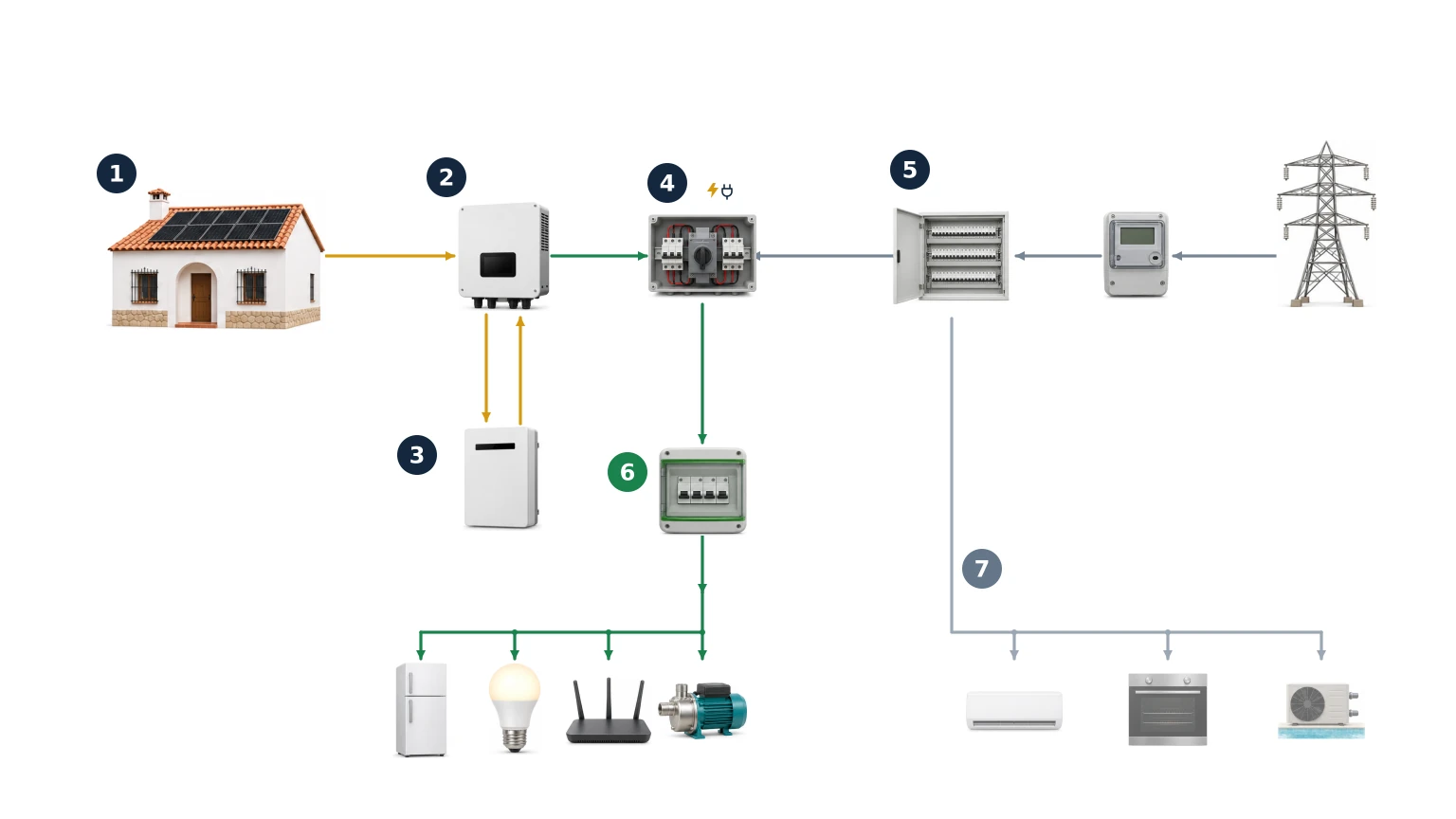
- Solar panels on the roof
- Hybrid inverter
- Battery: charges and discharges through the inverter
- Automatic transfer switch: disconnects the house from the grid in a blackout (often built into the inverter)
- Main panel, meter and grid connection
- Backup panel: the fridge, lights, Wi-Fi router and water pump keep working
- Regular appliances without backup (air conditioning, oven, pool heating): off during a blackout
How long will the battery last in a blackout?
It is simple arithmetic: usable battery energy divided by what you are running.
Hours of backup ≈ usable battery kWh ÷ average load in kW. This ignores recharging from the panels during the day, which extends the runtime.
| Example | Load | Runtime on 10 kWh usable |
|---|---|---|
| Essential circuits: fridge, router, a few lights | about 0.5 kW | about 20 hours |
| Whole home, moderate use | about 3 kW | about 3 hours |
This is our illustrative calculation, not a measurement or a promise. The battery must also be able to deliver the power you ask for at once, which is why air conditioning and other heavy loads need checking. We size the battery from your bills and your list of circuits.
Try it yourself: our Backup Power Calculator shows how long a battery could run your own list of appliances.
A blackout by day versus a blackout at night
The 20-hour figure above ignores the sun. In real life it matters a lot.
- By day: with a hybrid system, the panels can run the essential circuits and recharge the battery at the same time, so the battery is not drained while the sun is up.
- At night: the house runs on the battery alone, so the runtime follows the arithmetic above.
- A multi-day outage: a generator depends on fuel you must have in stock. A hybrid system refills itself on sunny days, but how much it recovers depends on the weather and on what you run. We do not promise unlimited autonomy.
What actually stops in a villa without power
Fridge, Wi-Fi and lights are only the start. On a villa, check these too.
- Security: the alarm, the cameras and the electric entrance gate. A gate without backup may not open, so nobody can drive in or out.
- Water: the booster pump that supplies the house and any drainage or sewage pump in a basement.
- Connectivity and remote work: the router, fibre equipment or satellite internet kit that your work depends on.
- Three-phase supply: many larger villas have a three-phase connection (trifásica). Some backup setups supply only one phase during an outage, so a circuit on another phase, such as the gate or the router, could stay off. We check the phase distribution when we design the backup.
Tell us which of these you have, and we include them in the list of essential circuits.
I already have solar panels. How do I add blackout protection?
You do not need to remove your panels. There are usually two routes.
- Replace the inverter with a hybrid one, add a battery and a backup circuit board for the essential circuits.
- Add an AC-coupled battery system next to the existing inverter, with its own backup circuit.
Which route fits depends on your current inverter, its age and your installation, so we check it before quoting. A system built only for self-consumption and a virtual battery (batería virtual) does not give backup on its own.
What happens when the grid fails
With a correctly installed backup system.
- The inverter detects that the grid has failed and isolates your home from it. Growatt’s WIT 4–15K-HU datasheet lists a 10 ms on/off-grid transfer time; check the datasheet of the exact model you are offered.
- The circuits on the backup output keep running from the battery and/or the panels.
- You keep an eye on consumption if the whole house is on backup, or simply carry on if only the essential circuits are.
- When the grid is back and stable, the system returns to normal operation.
What to check before you buy
Questions that separate a real backup from a marketing claim.
- Does the inverter have a backup output, and is it actually wired to the circuits you care about?
- Does the battery support island mode? (Selectra notes that some do not.)
- Which circuits are on backup, and what is the maximum load the backup output can supply?
- What are the rated backup power and the transfer time in the datasheet of the exact model?
- Does the backup cover every phase of your supply?
- If you already have panels, can the current inverter be used or does it need replacing?
- Do you get a written proposal with exact models?
KiDi Solar designs backup systems for homes and villas across the Costa del Sol, from Marbella and Estepona to Mijas and Benalmádena. See solar panel installation in Marbella.
Frequently asked questions about solar backup in a blackout
Will my solar panels work during a power cut in Spain?
Not without a backup system. A grid-tied inverter disconnects when the grid fails, mainly to protect workers repairing the network. With a hybrid inverter that has a backup output, plus a battery and a backup circuit, the chosen circuits stay powered.
Do I need a battery to have electricity in a blackout?
In the setups described by Selectra and Energías Renovables, yes: a hybrid inverter with backup and a physical battery. Some batteries also shut down in an outage if they are not set up for island mode.
Does a virtual battery keep the lights on?
No. A virtual battery is a billing credit for surplus energy, not stored power, so it does nothing during an outage.
How fast does the switchover happen?
Growatt’s WIT 4–15K-HU datasheet lists a 10 ms on/off-grid transfer time. Check the datasheet of the exact inverter you are offered.
Should I back up the whole house or only some circuits?
Both work. Whole house means everything runs but you manage consumption, since heavy loads drain the battery fast. Essential circuits give a longer runtime for the fridge, Wi-Fi and lights you choose. We agree the list with you in a short mini-project.
How long will the battery last?
Roughly usable battery kWh divided by the load in kW. As an illustration, 10 kWh usable at 0.5 kW is about 20 hours, and at 3 kW about 3 hours, before any solar recharging.
Free check of your current system or a backup plan
Send us your town, what must stay on and whether you already have panels. We will tell you which appliances could run in a blackout and what it would take, with a reply within 2 hours in working hours.
- Your town and property type
- What must stay on: fridge, Wi-Fi, lights, anything else
- Whether you already have panels or an inverter, and the brand if you know it
With this, KiDi Solar can determine:
- whether the whole house or only essential circuits suits you
- the battery size for the hours you need
- the price, quoted individually
Start the 2-minute quiz Message us on WhatsApp
Prefer to talk first? Request a free site visit or call +34 677 307 907.
Sources and notes: PV Europe, expert report on the Iberian blackout (April 2026) for the 16 and 12 hours and the cause; Selectra, sistema backup (30 April 2025) for how backup works, island mode and virtual batteries; Energías Renovables, autoconsumo en modo apagón (3 July 2025) for the number of installations, anti-islanding and the backup panel; Growatt WIT 4–15K-HU datasheet for the 10 ms transfer time. The runtime figures are our own illustration. This guide is general information, not an engineering design.