
Many homeowners ask the same question before buying panels: how much will my electricity company pay for the energy I do not use? There is no universal price. Each retailer sets its own, and it is written in your contract.
To give you a realistic idea, we checked the published surplus prices of ten retailers in November 2026. Below you will find the range, a comparison table with links to each company’s own page, and how to read the numbers.
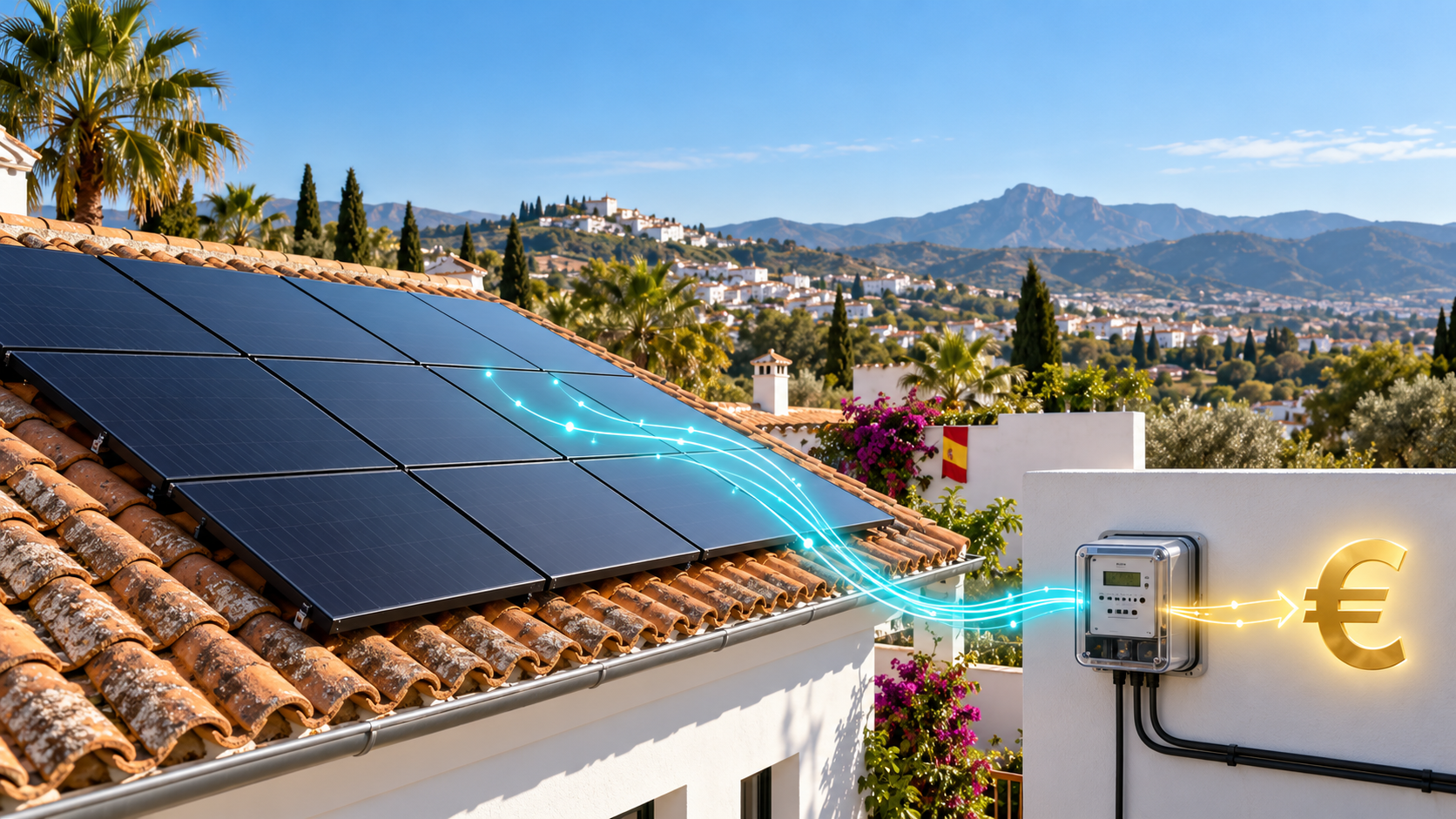
Quick answer
The best published fixed price we found was about €0.07/kWh. For comparison, the energy you buy costs roughly €0.12–0.22/kWh in the tariff tables we checked, so a kWh you use at home is worth about two to three times a kWh you export.
- €0.04–0.07Surplus paid by most retailers with a published fixed price
- ≈ €0.07Highest fixed price we found
- 2–3×A kWh used at home is worth this much more than a kWh exported
- MonthlySome prices are reviewed monthly, so confirm before signing
Ten retailers, what each pays and where to check
These are ranges, not offers. The exact price is in your own contract, so always confirm it with the company before you sign.
| Retailer | Tariff or option | Surplus (approx.) | Notes and source |
|---|---|---|---|
| TotalEnergies | A tu Aire, Luz Siempre | ≈ €0.07/kWh | 100% renewable energy, no virtual battery. Up to 100 kW. Source |
| Holaluz | Cloud | ≈ €0.07/kWh | Needs the Cloud simplified-compensation contract. The help page is undated (“as of today”), so check it is still offered. Source |
| Naturgy | Tarifa Solar | €0.06–0.07/kWh | Free virtual battery. The company says the price may be reviewed monthly. Source |
| Repsol | Tarifa Solar (fixed price) | €0.06–0.07/kWh | Price valid 12 months from signing. The page shows two figures (€0.06 and €0.07). Source |
| Endesa | Solar Plus | ≈ €0.06/kWh | Virtual battery available with a separate tariff. Source |
| Gana Energía | 24-hour tariff, self-consumption | ≈ €0.06/kWh | Free virtual wallet (Monedero Virtual). Figure from a comparison site. Source |
| Octopus Energy | Octopus Solar | €0.04–0.07/kWh | About €0.07 if the system was installed with Octopus, about €0.04 with other installers. Free Solar Wallet. Figures from a comparison site. Source |
| Iberdrola | Plan Solar | ≈ €0.04/kWh | Iberdrola does not publish a €/kWh figure on its page. The value comes from a third-party comparison (September 2026). Source |
| Plenitude | Fácil Plus | ≈ €0.04/kWh | The Solar Free plan gives no surplus compensation for the first two years. Figure from a comparison site. Source |
| Som Energia | Cooperative tariffs | not a single figure | No single fixed figure found. Check the current conditions with the cooperative. Source |
How to read these prices
- The prices above are mostly shown before VAT and taxes, as the retailers quote them.
- The deduction cannot exceed the cost of the energy you buy from the grid that month. Whatever is left over is lost unless your tariff has a virtual battery.
- A cheap surplus price can come with a cheap energy price, and the other way round. Compare the whole bill, not one number.
- Prices and promotions change, and some retailers review them monthly. Treat this table as a map, not a quote.
- If you installed with a company that is also a retailer, ask whether the price is better only for its own installations.
Illustration with round numbers: if your system exports 3,000 kWh a year at €0.06, the credit is about €180. If you use those same 3,000 kWh at home instead of buying them at about €0.15, you avoid about €450. This is an illustration, not a forecast.
Why the price matters less than the design
Because surplus is paid far below the price of the energy you buy, the biggest saving comes from using your own production.
In a Costa del Sol home, air conditioning, the pool pump, the water heater and an EV charger can run in sunny hours, and a battery moves part of the day into the evening. That lowers your dependence on any retailer’s surplus price.
We size every system from your bill and real habits, not from the roof area. See also what solar panels cost, the subsidies in Andalusia and our guide to how surplus compensation works.
How KiDi Solar helps
KiDi Solar is the installer, not your electricity retailer.
We size the system from your bill, handle the legalisation and certificates, and explain which kind of compensation tariff suits your consumption profile. We do not choose the retailer for you: the contract and the decision are yours.
Frequently asked questions about surplus prices
Is there a standard price for solar surplus in Spain?
No. Each retailer sets its own price, and it is written in your contract. On the regulated PVPC tariff it follows the hourly wholesale market. On the free market it is agreed with the retailer.
Which retailer pays the most for surplus?
Among the fixed prices we checked, TotalEnergies and Holaluz were at about €0.07/kWh, with Naturgy and Repsol close behind. Some indexed tariffs can pay more in some hours, but the price moves with the market.
Do I receive the money in my bank account?
Usually not. With simplified compensation the value is deducted from your electricity bill. A virtual battery or wallet can carry the balance to later months, but normally it does not pay out cash.
Can I change retailer after installing solar panels?
Yes. The compensation contract is with your retailer, not with the installer. You can change tariff or retailer, but check the surplus conditions of the new one first.
How often do these prices change?
They can change with each contract renewal, and some retailers review them monthly. This table reflects what we found in November 2026.
Find out what your surplus would be worth
Send us a recent bill and we will tell you which system size suits you and how much of your production you would use directly.
- Your town and property type
- A recent electricity bill
- Your daytime use: air conditioning, pool, EV
- Photos of the roof or available space
With this, KiDi Solar can determine:
- the realistic panel size
- whether adding a battery pays off
- how much of the production you would use directly
- the paperwork and timeline for legalisation
Prefer to talk first? Request a free site visit.
Sources and notes: prices checked on 1 November 2026 from the retailers’ own pages (linked in the table) and, where marked, from comparison sites: Roams (28 Oct 2026), Selectra (26 Oct 2026), Papernest (16 Sep 2026) and Alianza Energética (19 Oct 2026). Legal basis: Real Decreto 244/2019. Prices are approximate, change often and are not an offer. This guide is general information, not legal or tax advice.