
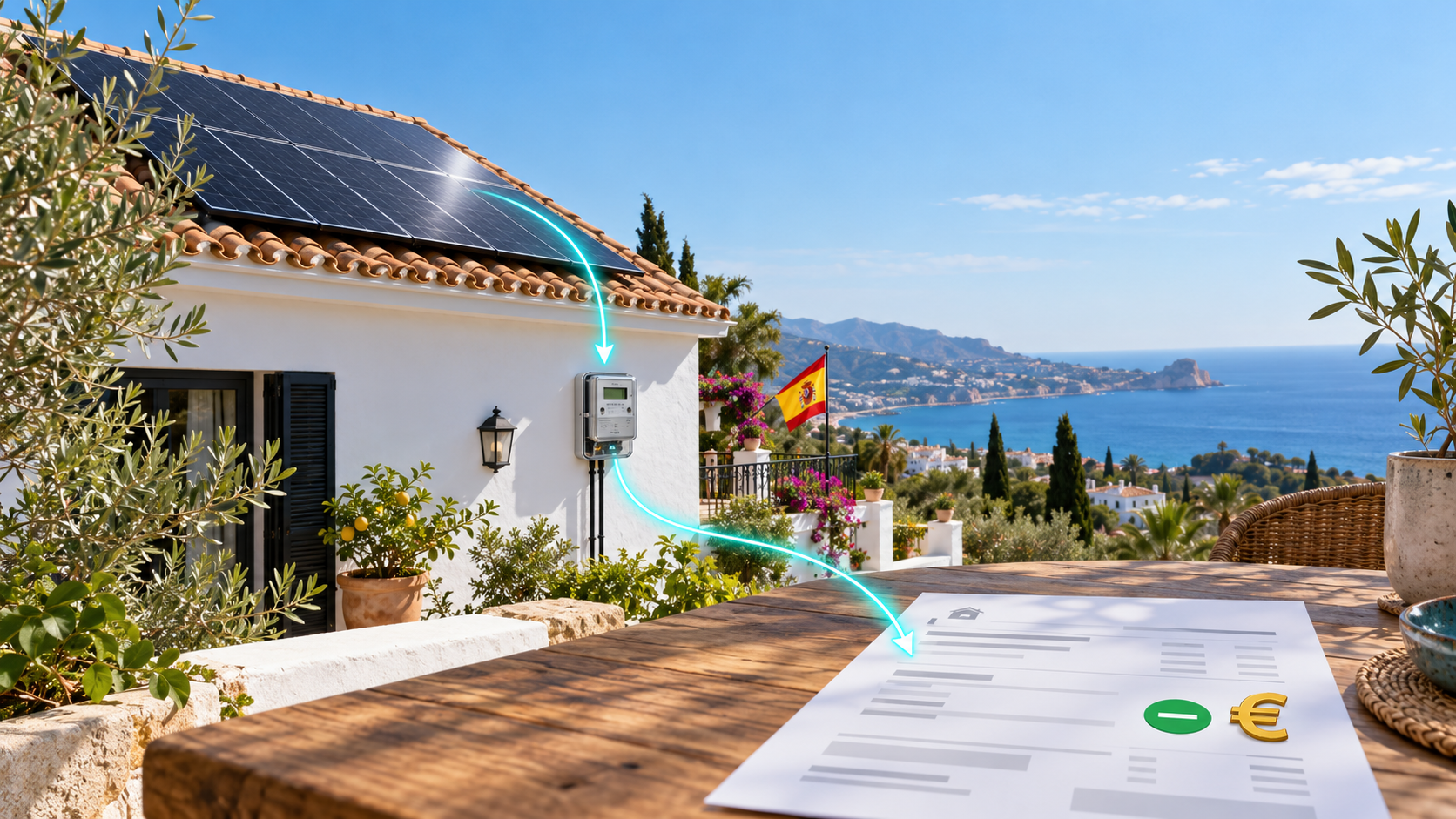
Surplus compensation is the mechanism by which the electricity your panels produce and you do not use at that moment is deducted from your bill. It is not a sale: your retailer values the kWh you export to the grid in euros and subtracts that amount from what you pay for the energy you take from it.
Simplified compensation is open to grid-connected installations of up to 100 kW. The price per kWh depends on your contract and varies widely between retailers. This guide explains how it is calculated, what to compare when choosing a tariff and how it affects the size of your system.
Quick answer
How much is surplus paid? It depends on the contract: on the regulated PVPC tariff it follows the average hourly wholesale price; on the free market you agree it with your retailer. In an OCU comparison of 28 tariffs, surplus was paid between €0.06 and €0.176 per kWh, always below the price of the energy you buy. The energy part of your bill cannot go negative.
- 100 kWMaximum power for simplified compensation
- Not a saleThe balance is deducted from your bill, not paid out
- €0.06–0.176/kWhRange paid across 28 tariffs in an OCU comparison
- No negative billThe deduction cannot exceed the cost of the energy consumed
How simplified compensation works
Each month your bill is worked out in four steps.
- Your system produces and you consume. During the day the panels feed the house first: fridge, air conditioning, pool pump.
- The surplus goes to the grid. What you do not use or store in a battery flows to the grid and your meter records it as surplus.
- The retailer values it in euros. It multiplies the exported kWh by the price in your contract.
- It is deducted from your bill. That amount is subtracted from the energy you bought from the grid that month. If it is larger, the excess is lost unless your tariff includes a virtual battery.
To qualify you need a legalised, registered, grid-connected installation and a compensation contract with your retailer.
Compensating is not selling
With simplified compensation you do not receive cash: you reduce your bill. Selling energy on the market is a different regime, with registration as a producer and its own obligations, and for a home it is usually not worth it.
What retailers pay for surplus and what to compare
Surplus is always paid below the electricity you buy, because purchased energy carries network charges and levies. That is why the tariff matters.
Before you sign, compare:
- The price of the energy you consume and the fixed charge.
- The value given to each kWh of surplus.
- Which part of the bill can be compensated: only the energy, or also network charges, levies and the fixed charge (the most favourable option is known as “zero bill”).
- Whether a virtual battery is offered, which stores the balance in euros for higher-consumption months.
- If the tariff is indexed, the formula and the price history.
- How the retailer treats the gas adjustment mechanism.
According to OCU, choosing the tariff well can save up to €505 a year on a household installation.
See also: what 10 Spanish retailers pay for solar surplus (November 2026).
What it means for the size of your system
Because surplus is paid less than the electricity you buy, the biggest saving comes from using your own production.
In a Costa del Sol home, air conditioning, the pool pump, the water heater or the EV charger can all run during sunny hours. The more of your production you use directly, or store in a battery for the evening, the less you depend on what you are paid for surplus.
That is why we size the system from your bill and real habits, not just the roof area. If you would export very little, a tighter system can be better than a large one. See also what solar panels cost and the subsidies available in Andalusia.
How KiDi Solar helps
KiDi Solar is the installer, not your electricity retailer.
We size the system from your bill, handle the legalisation and certificates, and explain which type of compensation tariff fits your consumption profile. We do not choose the retailer for you: the contract and the decision are yours.
Frequently asked questions about surplus compensation
What is surplus compensation?
It is the mechanism by which the energy your panels produce and you do not use at that moment is exported to the grid, valued in euros by your retailer and deducted from your bill. It is not a sale of energy.
How much is paid per kWh of surplus?
It depends on the contract. On PVPC it follows the average hourly market price; on the free market it is agreed with the retailer. In an OCU comparison of 28 tariffs the range was €0.06 to €0.176 per kWh, always below the price at which you buy energy.
Can my bill go negative?
No. The compensated amount cannot exceed the cost of the energy consumed from the grid in the period. The excess is lost unless your tariff includes a virtual battery.
What power qualifies?
Simplified compensation is for grid-connected installations of up to 100 kW, more than enough for a home.
Is it better to store energy in a battery or export it?
Because surplus is paid less than the electricity you buy, using your own production or storing it is usually worth more. We calculate it from your real bill before recommending anything.
Find out how much surplus your home would generate
Send us a recent bill and we will tell you which system size suits you and how much of your production you would use directly.
- Your town and property type
- A recent electricity bill
- Your daytime use: air conditioning, pool, EV
- Photos of the roof or available space
With this, KiDi Solar can determine:
- the realistic panel size
- whether adding a battery pays off
- how much of the production you would use directly
- the paperwork and timeline for legalisation
Prefer to start with a conversation? Request a free site visit.
Sources and notes: Real Decreto 244/2019 of 5 April regulating self-consumption; Repsol surplus compensation guide; OCU comparison of compensation tariffs. Prices per kWh change by retailer and date. This guide is general information, not legal or tax advice.