
When the wind turns southerly, the sky over the Costa del Sol can turn orange-grey and the cars outside end up covered in fine red dust. That dust comes from the Sahara, and it lands on your solar panels too. A layer you can barely see can quietly take a noticeable share of your output, mostly in the dry months, when your panels should be producing the most.
This guide explains what the dust does, what the research says about how much energy it costs in southern Spain, why rain does not always fix it, and the options for keeping panels clean, including the automatic rinse system KiDi Solar designs and installs.
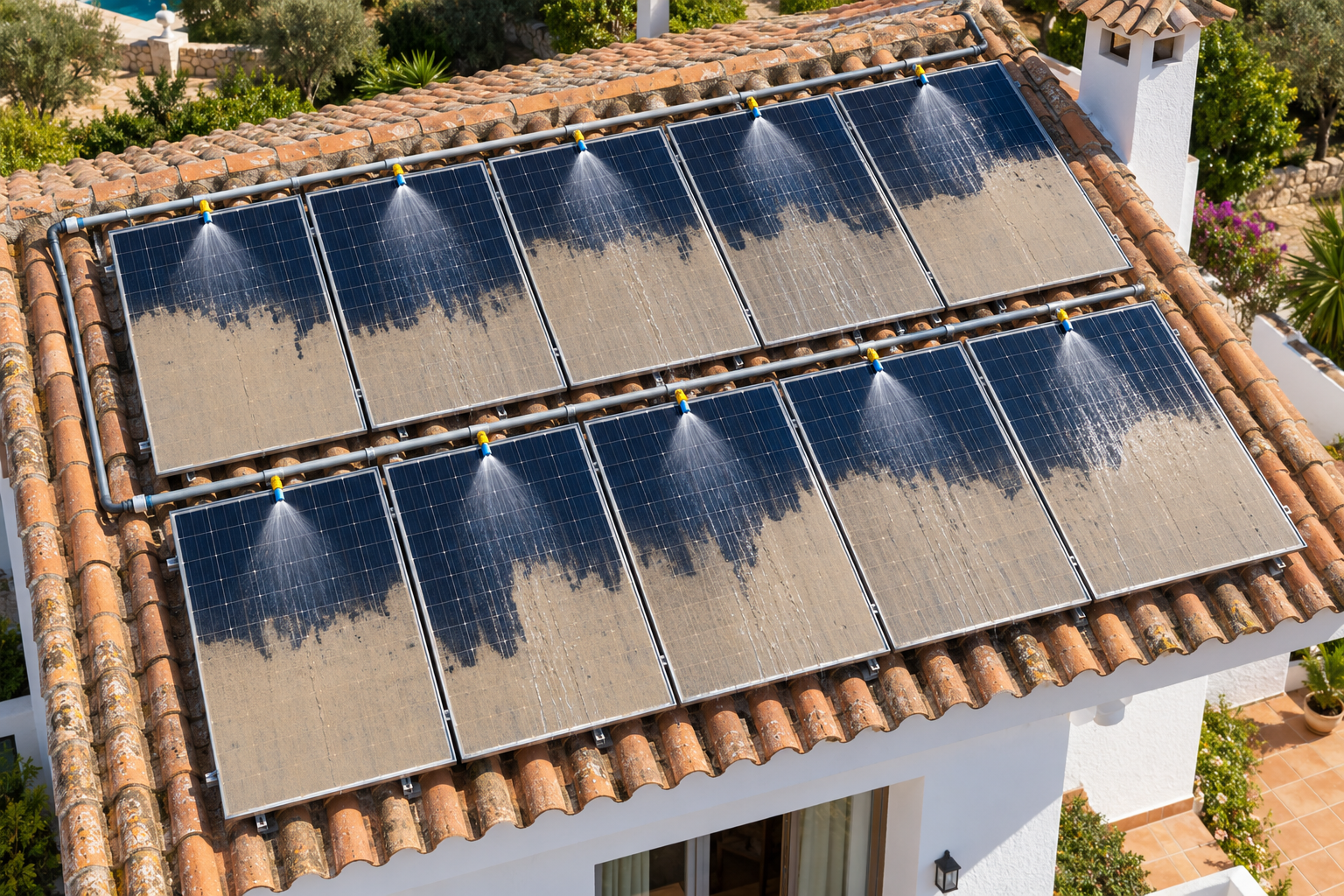
How much output do solar panels lose from Saharan dust?
Dust, including Saharan calima dust, typically costs solar panels in southern Spain a few percent of annual output: studies cited by OCU put the range at 1.5% to 6.2%. In Málaga, losses exceeded 20% during long dry spells without rain, when air conditioning and pool pumps demand the most energy.
The loss is largest in summer, when output is highest and rain is rare. Keeping the glass clean is cheap compared with the energy it protects, and a weekly automatic rinse plus one or two thorough cleans a year is the simplest way to do it.
- 1.5–6.2%Typical yearly loss from dust, per studies cited by OCU
- ≈ 4.4%Mean daily loss measured in a Málaga study
- > 20%Loss in the same study during long dry, dusty periods
- €5–10Typical professional price per panel, per OCU, plus a minimum call-out
Why the Costa del Sol gets so much dust
Southern Spain sits just across the Strait from Africa, so it is first in line when the wind blows from the south.
When southerly winds carry Saharan dust north, the episode is called a calima. The dust can hang in the air for days and then settle on everything outside. A European study of photovoltaic soiling notes that Spain and Portugal are particularly exposed to Saharan dust intrusions, and that dust left on the modules can cause significant losses even after the sky clears.
- Saharan dust from southerly calima episodes
- dry summers with little rain to rinse the glass
- pollen in spring
- salt and fine sand from the sea breeze near the coast
- bird droppings and leaves, especially under trees
- dust from nearby building work and unpaved roads
The same study found that losses in Spain are strongly seasonal, with most of the loss in August, after the dry months have let the dust accumulate.
Localised dirt matters too. Bird droppings can shade a single cell, and in some cases that shading causes local overheating, known as a hot spot. That is a reason to remove droppings promptly rather than wait for rain to shift them.
How much output dust really costs
Researchers call this effect photovoltaic (PV) soiling loss. The honest answer is a range, because it depends on how long it has been since the last rain and how dusty the season has been.
| Source | What it found |
|---|---|
| Málaga study (summarised in an IEA PVPS report) | Mean daily production loss of about 4.4%. Above 20% during long dry periods of dust accumulation. |
| OCU (citing California studies) | Loss of efficiency from dust between 1.5% and 6.2% a year. Example: a 5% drop on a 3.5 kWp system is about 260 kWh a year, about €42 at €0.16/kWh. |
| European soiling model (DLR) | Spain is among the countries with the largest average losses. In the model where rain removes only part of the dust, peak losses in Spain reach about 14%. |
What that means for a 10 kWp home system (illustration)
Illustration only: a 10 kWp system producing about 15,000 kWh a year, with each kWh valued at €0.15. The percentages are the low end of the OCU range, the Málaga mean and the top of the OCU range. Your own figure depends on your consumption, tariff and roof.
What the average hides
A yearly average of a few percent sounds small, but the loss is not spread evenly. In a long dry spell the glass keeps collecting dust day after day, and the Málaga study saw losses above 20% in those periods. That is the time of year when your panels would otherwise be producing the most and your air conditioning and pool pump are running.
Why rain does not always clean your panels
A proper downpour rinses the glass. A light shower or morning dew can do the opposite.
- Dust settles overnight. Most deposition happens at night, and dew makes the particles stick.
- Moisture binds it. Dust that dissolves a little in water can dry into a crust that cements the particles to the glass.
- Light rain smears it. A light shower can leave streaks instead of rinsing the surface.
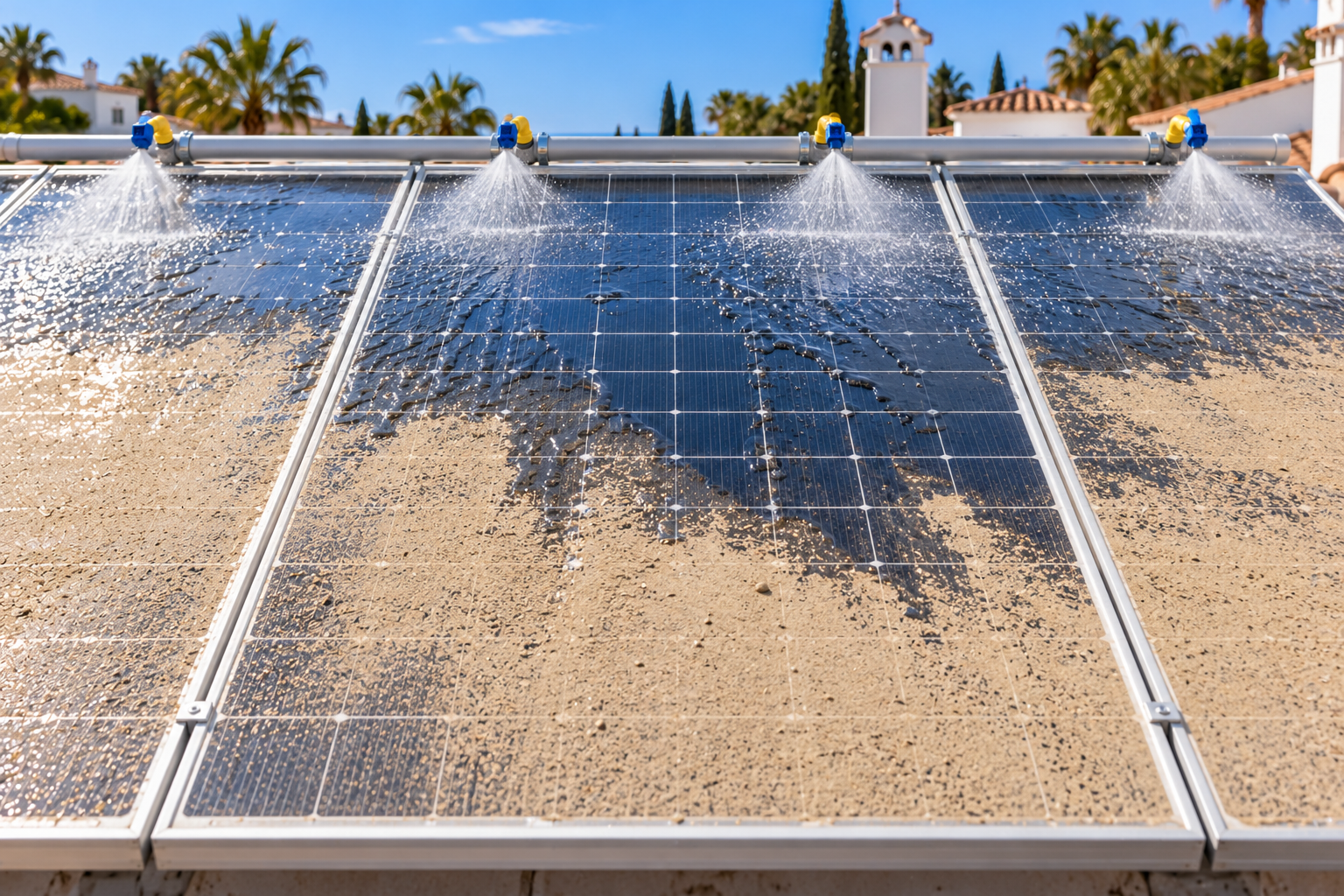
- Dirt collects at the bottom. On tilted panels the residue gathers along the lower edge, where it can shade the bottom row of cells.
Very fine particles are washed away easily by rain, but the coarser dust and the residue left by light rain are what stay behind. A European study concluded that rain cleans the panels only partially, somewhere between not at all and completely.
Four ways to keep panels clean
None is right for everyone. Here is how they compare.
| Method | Good for | Watch out for |
|---|---|---|
| Leave it to the rain | Costs nothing | Rain is rare in summer and often too light to clean properly. Dust builds up in the dry months. |
| Do it yourself | Panels at ground level or easy reach | Roof work is a fall risk. Use clean water, no detergents, no pressure washer. |
| Professional clean | A thorough result, including droppings and stuck-on residue | OCU quotes €5–10 per panel plus a minimum call-out, so a visit can pass €100. Dust returns after the next dry spell. |
| Automatic rinse system | Keeping dust from building up, with no roof visits | Needs a water connection and a design that suits your water. It does not replace a periodic hand clean. |
The automatic rinse system
A light rinse every week removes fresh dust before it can cake onto the glass.
KiDi Solar designs and installs automatic rinse systems for new installations and for panels you already have. New from KiDi Solar in 2026: we are bringing automatic panel cleaning to the Costa del Sol as a standard option, because a solar installation should do more than generate power and be inspected once a year.
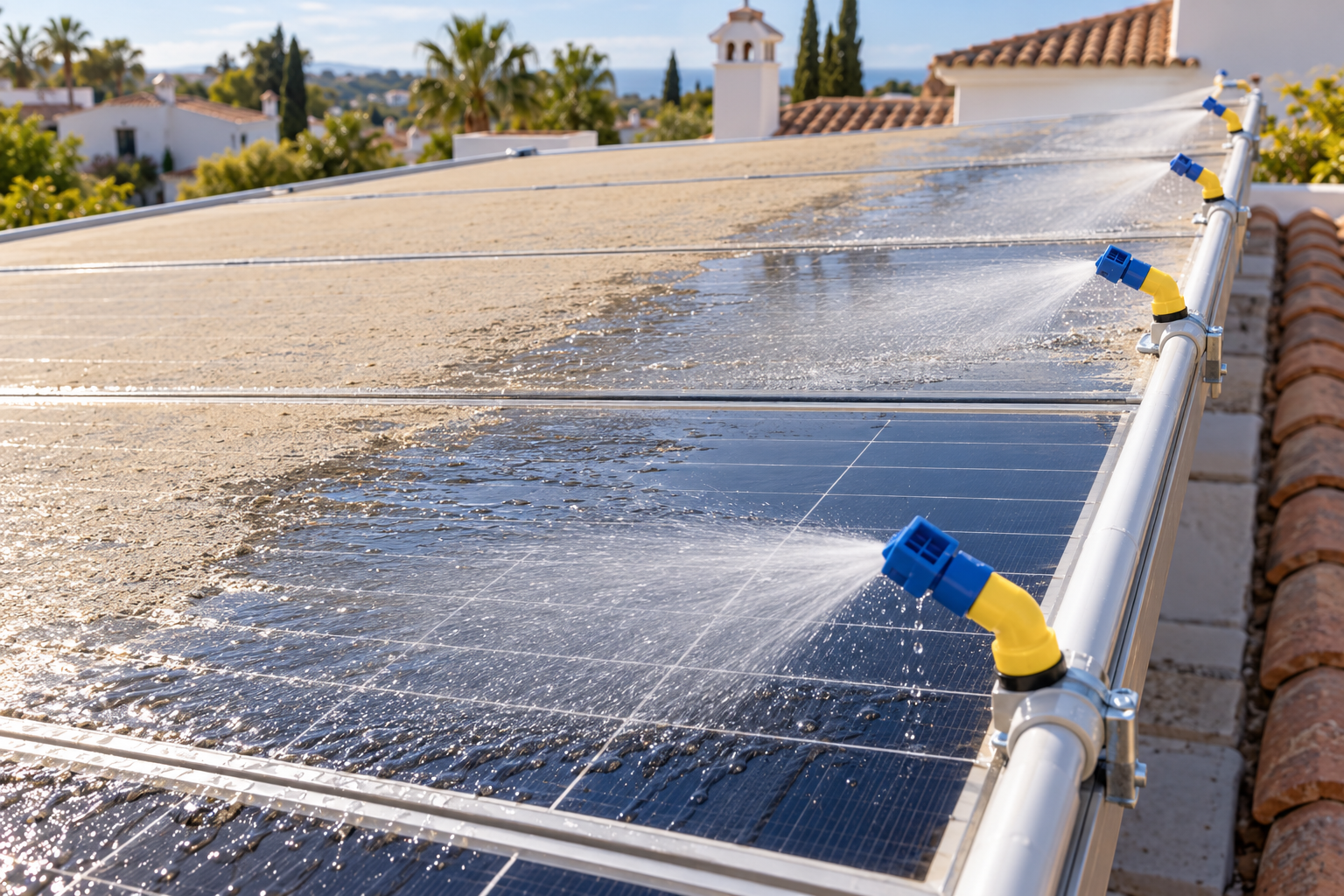
- Pipework along the panels. A thin line runs along each row of panels, fixed so it does not touch or shade the glass.
- Spray nozzles. Nozzles spaced along the line cover the whole surface with a fine, low-pressure spray.
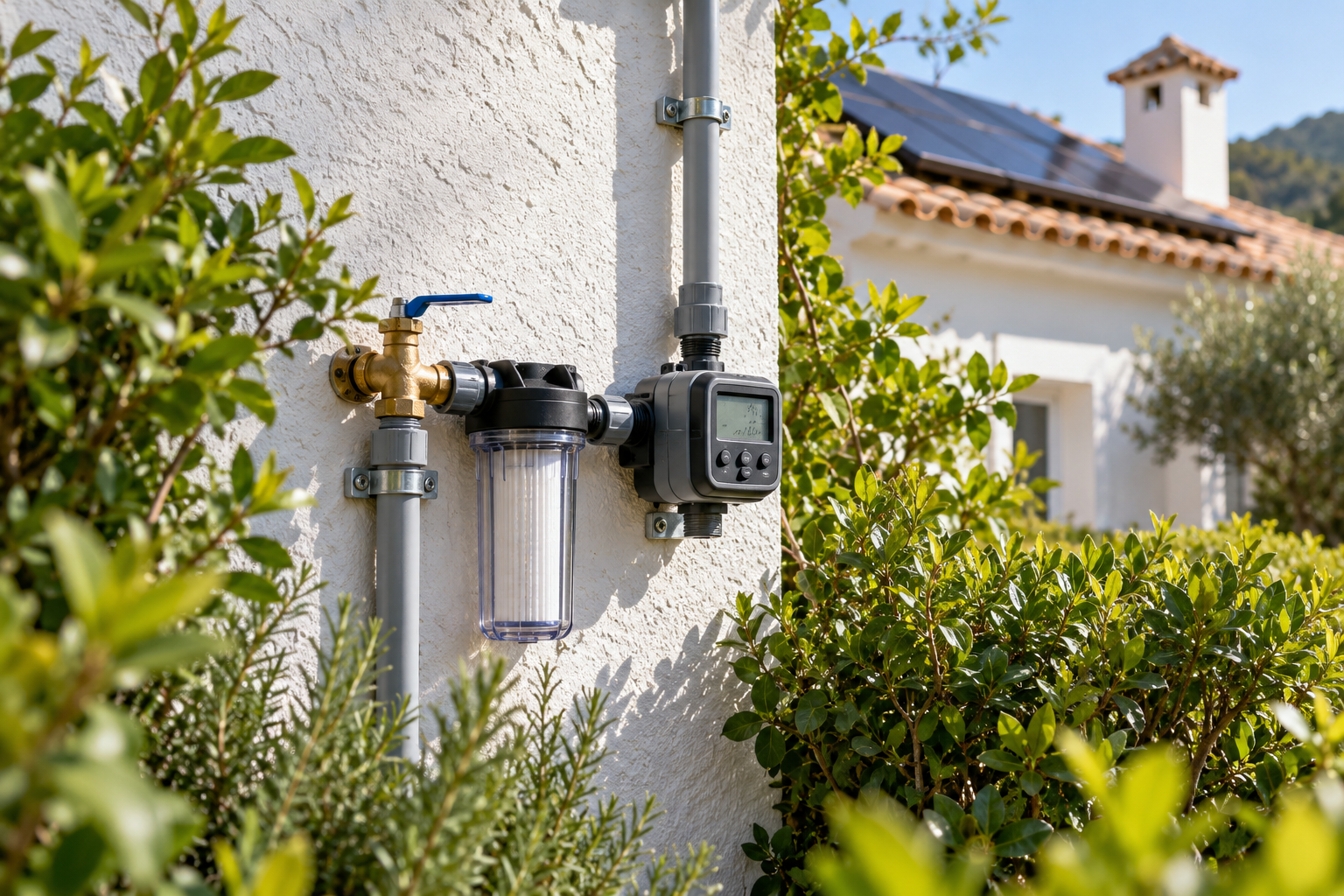
- Connection to the mains water. The line connects to your water supply, with a filter that reduces chlorine and calcium, so the water does not leave white spots.
- A timer. A controller opens the water on a schedule, for example once a week at night between 3 and 6 in the morning, when the panels have cooled, and shuts it off again.
- A thorough clean once or twice a year. We recommend a hand clean on top of the rinse to remove what water alone cannot.
- Fits: new installations and existing arrays
- Water use: depends on the number of panels, calculated for each system
- Schedule: weekly by default, adjusted to season and dust
- Price: individual quote after a survey
Water quality matters
In many places the tap water is hard. As hard water dries on glass it can leave mineral spots, so the system includes a filter that reduces chlorine and calcium. We also check the water at the survey and set the spray pattern and schedule from there. OCU also recommends clean water without detergents for manual cleaning, and rainwater or demineralised water where possible.
Eco-friendly and drought-aware
Andalusia has been through drought years in which the authorities and municipalities limited non-essential water use. The rules set by the Junta de Andalucía and your Ayuntamiento differ from place to place and change with reservoir levels, so we check what applies where you live.
The system is designed to use little water: a short, low-pressure rinse, at night between 3 and 6 in the morning, when the panels have cooled, rather than a hose-down. The timer can be adjusted or paused whenever restrictions apply. We calculate the water use for your panel count and put the figure in your quote, so you can compare it with cleaning by hose.
Is it worth it?
Compare what dust costs you each year with what keeping the panels clean costs.
For the 10 kWp example above, dust costs roughly €35–140 a year at typical averages, and more in a dry, dusty summer. A professional hand clean of 20 panels at OCU’s €5–10 per panel is about €100–200 a visit before any call-out fee, and the dust returns within weeks.
A weekly automatic rinse uses a small amount of water for a household array, and we calculate it for your panel count. The installation cost depends on the layout, so it is quoted individually.
Our honest take
The bigger the system and the dustier your location, the sooner a rinse system pays back. For a small array on a roof that gets regular rain, a yearly professional clean may be enough. We would rather tell you that after a survey than sell you something you do not need.
If you clean panels by hand
- Use only clean water. Avoid detergents and solvents.
- Do not use a pressure washer, and do not press hard on the panels.
- Use a soft cloth, sponge or soft brush on a telescopic pole, never abrasive materials.
- Clean early or late in the day, when the glass is cool, to avoid streaks.
- Leave roof work to a professional with safety equipment.
For more on keeping a system in good shape, see our solar panel maintenance and cleaning page, and how output changes through the year in our month-by-month production guide.
Frequently asked questions about dusty solar panels
How much output do dusty solar panels lose?
It depends on the season and on rain. Studies cited by OCU put the annual loss from dust at roughly 1.5% to 6.2%. A study of a system in Málaga found a mean daily loss of about 4.4%, with losses above 20% during long dry spells when dust builds up. A few weeks after a calima without rain is when the loss is largest.
Does rain clean solar panels?
Often only partly. A heavy shower can rinse the glass, but light rain or morning dew mixed with dust leaves mud streaks and can bind dust to the surface. On tilted panels the dirt tends to collect along the bottom edge, which can affect the lowest row of cells.
How often should solar panels be cleaned on the Costa del Sol?
There is no fixed rule. Dust builds up faster in the dry months and after calima episodes, so a rinse every week or two in summer keeps losses low, and a thorough hand clean once or twice a year removes what a rinse cannot, such as bird droppings and stuck-on residue.
Can I clean my panels myself?
If they are within safe reach and you can do it without climbing on the roof, use a garden hose or a soft brush on a telescopic pole with clean water, no detergents and no pressure washer, as OCU advises. Roof access is a fall risk, so leave rooftop work to a professional with safety equipment.
Will an automatic spray system damage my panels?
A low-pressure rinse does not scrub the glass, so there is no contact or pressure on the panels. What matters is water quality: hard tap water can leave mineral spots as it dries, so the system includes a filter that reduces chlorine and calcium, and we check the water at the survey.
Do you also install the system on panels I already have?
Yes. The rinse system is an add-on: it can be fitted along an existing array as well as designed together with a new installation. The price depends on the number of panels, the layout and the distance to the water supply, so it is quoted individually after a survey.
Don’t let calima steal your free electricity
Take our 2-minute quiz and we will come back to you with a quote for an automatic rinse system, within 2 hours in working hours. It works for new installations and for panels you already have, from Marbella and Málaga to Fuengirola, Estepona and the rest of the Costa del Sol.
- Your town and property type
- Number of panels and how they are laid out
- Where the water supply is
With this, KiDi Solar can determine:
- whether a rinse system suits your installation
- the design and the water it would use
- how much output it is likely to protect
- the price, quoted individually
Start the 2-minute quiz Message us on WhatsApp
Prefer to talk first? Request a free site visit or call +34 677 307 907.
KiDi Solar installs and services systems across the Costa del Sol. For local prices, completed projects and a free survey, see our page on solar panels in Marbella.
Sources and notes: IEA PVPS Task 13, Soiling Losses: Impact on the Performance of Photovoltaic Power Plants (2022) for the Málaga figures and the mechanisms of dust deposition; DLR, Photovoltaic soiling loss in Europe: geographical distribution and cleaning recommendations; OCU, how to clean solar panels for the yearly loss range, cleaning advice and professional prices. The cost illustration uses round numbers and is not a forecast. This guide is general information.