
Many homes on the Costa del Sol are townhouses, penthouses or villas inside an urbanización, and the first question is rarely about panels. It is who has to agree before anything goes on the roof. In Spain the answer is set by the Ley de Propiedad Horizontal, and it is more favourable to the owner who wants solar than most people expect.
This guide explains the vote you need, who pays, the difference between private and shared installations, how energy can be shared between neighbours, and the steps from the community meeting to switching the system on. It is general information, not legal advice.
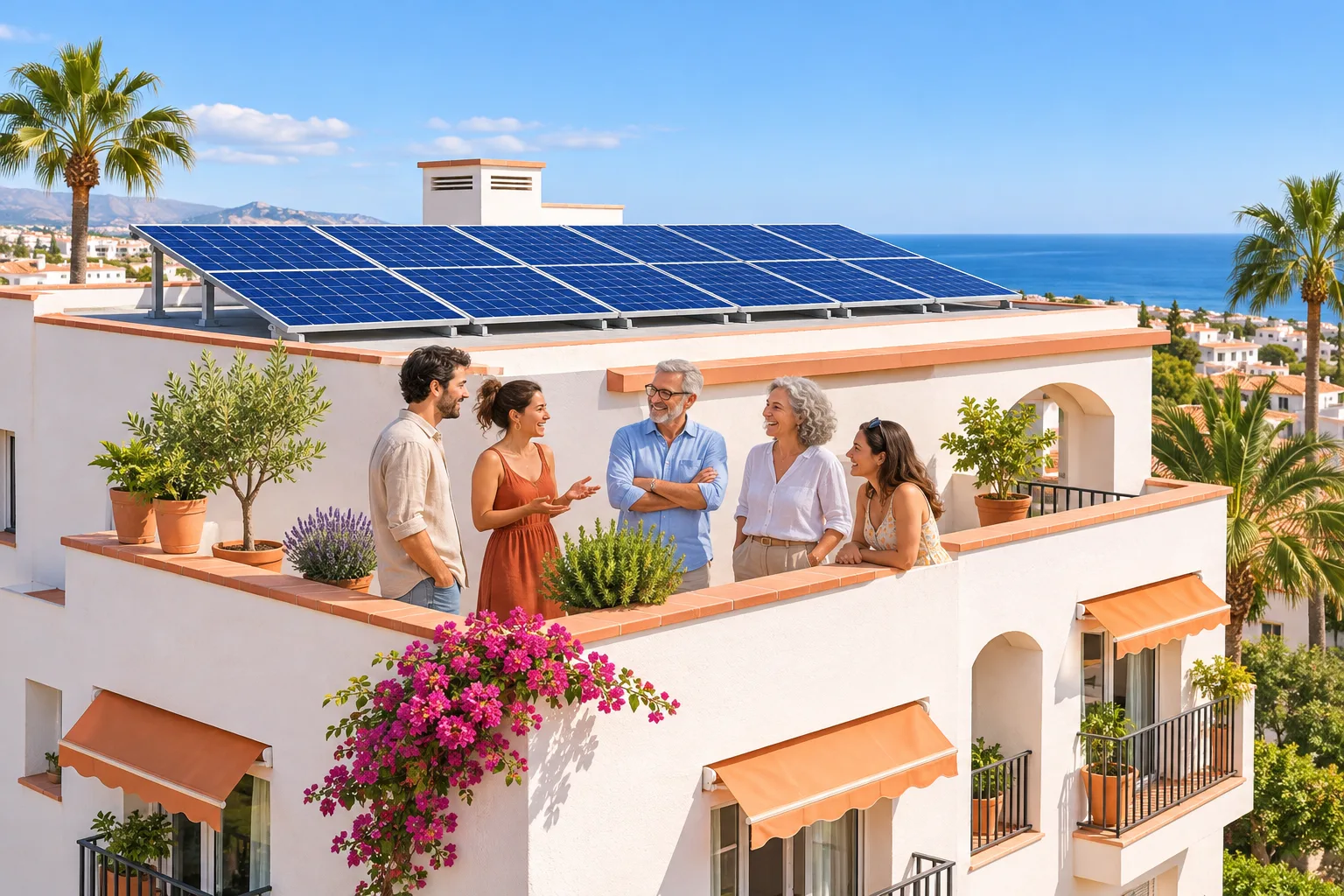
Do you need your neighbours’ permission to install solar panels in a community of owners in Spain?
Under article 17.1 of the Ley de Propiedad Horizontal, any owner can ask the community to approve a solar installation, for common or private use. Approval needs the support of one third of the owners who also represent one third of the participation quotas, not unanimity. Owners who did not vote in favour cannot be charged for the installation or its upkeep.
Different websites quote different majorities, so we follow the text as summarised in the IDAE guide for communities of owners and in a lawyer-reviewed Legálitas article, both listed at the end. Always check your own statutes and ask your administrador de fincas before you vote.
- 1/3Owners, representing 1/3 of the quotas, needed to approve under art. 17.1
- €0Cost for owners who voted against: they cannot be charged for installation or upkeep
- 5,000 mMaximum distance to share rooftop PV energy with nearby buildings, per the IDAE guide
- 2,000 mMaximum distance if panels must go on neighbouring roofs for lack of space
Individual or collective, common or private use
Before the vote, decide what you are asking the community to approve.
The IDAE guide separates two things. Individual or collective refers to the number of consumers linked to the installation (one supply point or several). Common or private use refers to who uses the energy.
| Set-up | Who uses the energy |
|---|---|
| Individual, common use | The community’s own supply: lift, stairwell lighting, pump. |
| Individual, private use | One owner’s home. |
| Collective, common use | Several supplies, all of them the community’s. |
| Collective, private use | Several owners’ homes share one installation. |
| Collective, common and private | A mix of community and individual supplies. |
A single owner who wants panels for their own flat on the shared roof is the second row. Several neighbours who want to split the output are the fourth.
What the law says about the vote and the cost
The rules sit in article 17 of the Ley de Propiedad Horizontal (LPH).
- Art. 17.1: any owner can request a common or private renewable-energy installation. It is approved by one third of the owners who also represent one third of the participation quotas.
- Art. 17.2: if the cost does not exceed twelve ordinary monthly community charges, a simple majority of owners representing a simple majority of quotas can approve a common-use installation, a request for aid or its financing.
- Who pays: the community cannot charge the installation, adaptation, maintenance or upkeep to owners who did not vote in favour.
- Joining later: an owner who joins afterwards can use the infrastructure by paying their share, updated, plus legal interest.
- Absent owners (art. 17.8): for agreements that need a qualified majority, an absent owner who was properly summoned and notified of the agreement is counted as in favour if they do not object in writing to the secretary within 30 natural days. Commentators describe this rule as applying to qualified majorities and unanimity, so ask your administrador de fincas whether it can be used for the one-third solar vote in your community.
- Minutes: the approval should be recorded concisely in the minutes of the meeting. A vote can be delegated if it is in writing.
Why you may read other numbers
Some news articles and energy-company pages describe stricter rules, such as unanimity for work that touches the facade or the structure. A change that alters the building envelope or structure is a separate matter from the self-consumption vote, and your community statutes can add conditions. That is why we suggest checking the exact wording with your administrador de fincas or a lawyer before the meeting.
Townhouses, penthouses and urbanizaciones
Whether you need a vote depends on who owns the roof, not on how the house looks.
Many Costa del Sol properties are pareados, adosados or penthouses. Two questions decide the route:
- Is the roof a common element? In a block, the roof usually belongs to the community, so the vote above applies even if only one owner will use the panels. If your title deed and your statutes make the roof or terrace yours alone, the community vote is not the gate, but you still need the municipal permit. Lawyers do not all agree on whether the roof of an adosado is private or common, and the answer depends on the title deed and statutes (El Derecho).
- Do the statutes or the urbanización rules add conditions? Some set rules for facades, visible installations or shared areas. Read them first.
The Repsol guide adds that panels must not shade another owner’s panels if that owner also has some. Plan the layout with that in mind.
How neighbours can share the energy and the surplus
A collective installation needs a written agreement, signed by every consumer.
- Distribution key: any fixed key is valid if all consumers sign it, for example equal shares, participation coefficients, contributions, energy needs or contracted power. The shares must add up to 100%.
- Surplus: it can be compensated on the bills with no negative bills, or sold on the market by the producer. For how this works in practice, see our guide to solar surplus compensation in Spain.
- Distance: energy can be shared with nearby buildings within 5,000 m when the panels are on rooftops. If your roof is too small, panels can be split across neighbouring roofs within 2,000 m (IDAE guide).
- Manager: the group can appoint a representative to manage the arrangement.
Agree up front how a new owner can join, because the guide recommends the same terms for everyone.
From the meeting to switching on
The IDAE guide sets out six stages.
- Decision. The meeting approves the idea and chooses the set-up: individual or collective, common or private use.
- Design and budget. A qualified installer designs the system from the building’s location and past bills. The guide suggests at least three quotes and checking guarantees and timing.
- Technical document and permits. Below 10 kW a technical memo is enough, above it a project is needed. You also need the building permit from the Ayuntamiento, the ICIO tax and fees, and the CAU self-consumption code. Above 15 kW an access and connection request to the distributor is needed, and with no surplus none is needed at any power.
- Legalisation. The installer obtains the CIE certificate from the autonomous community and gives you a copy.
- Collective paperwork. All consumers sign the distribution agreement, which goes to each energy retailer.
- Activation. The autonomous community sends the documents to the distributor, who notifies the retailer and updates the access contract, and then the retailer updates your supply contract.
For the general permit picture, see our legal framework guide and Andalucía subsidies and tax deductions.
What to bring to the meeting
Neighbours vote more easily on a clear proposal.
- A written quote that says who benefits and who pays.
- The set-up you propose (one of the five above) and the share each participant would get.
- The effect on the roof: layout, fixings, waterproofing and access for maintenance.
- What happens to an owner who joins later, and the proposed wording for the minutes.
If you want us to look at a roof first, our free estimate is the place to start.
Frequently asked questions about solar panels in a community of owners
Do I need unanimity to install solar panels in my community in Spain?
No. Under article 17.1 of the Ley de Propiedad Horizontal, an installation for common or private use is approved with the support of one third of the owners who also represent one third of the participation quotas. Statutes and works that affect the structure can add conditions, so check them first.
Who pays if some neighbours vote against?
The community cannot charge the installation, adaptation, maintenance or upkeep to owners who did not vote in favour. If they join later, they pay their updated share plus legal interest.
Can I install panels on my townhouse without asking anyone?
If the roof is yours alone under your title deed and statutes, the community vote does not apply, but the municipal permit does. If the roof is a common element, you need the community approval described above.
Can neighbours share one solar installation?
Yes, through a collective self-consumption set-up. All consumers sign a distribution key and the shares add up to 100%. The IDAE guide allows sharing with nearby buildings within 5,000 m for rooftop panels.
Does the community vote change if I add a battery?
It depends on where the battery goes. A battery installed inside your own property, such as a garage or storage room, is generally a private matter. A battery placed on a common element, such as the roof, a facade or a shared plant room, belongs in the community approval described above. Check your statutes and the municipal safety rules before you decide.
Planning solar in a community or urbanización?
Take our 2-minute quiz and we will come back to you with a quote, within 2 hours in working hours. It works for houses, townhouses and apartments across the Costa del Sol.
- Your town and property type
- Whether the roof is yours or shared
- Your yearly electricity use
With this, KiDi Solar can determine:
- what size and layout suit your roof
- whether you can go ahead alone or need a community vote
- the price, quoted individually
Start the 2-minute quiz Message us on WhatsApp
Prefer to talk first? Request a free site visit or call +34 677 307 907.
Sources and notes: IDAE, Guía de 5 pasos para el autoconsumo en comunidades de propietarios for the types of installation, article 17.1 and 17.2 summaries, distances and steps; Legálitas, placas solares en comunidades de vecinos for the one-third majority, cost allocation and late joiners; Repsol, normativa placas solares en comunidades for the shading point; El Derecho, adosado roofs and solar panels and Mundo Jurídico, absent owners’ votes for the 30-day rule and the roof debate. This guide is general information, not legal advice, and rules and their interpretation can change.