
Solar panels are the part of your system you will see every day for the next 30 years, so it pays to choose them carefully. On the Costa del Sol they have to handle intense sun, summer roof temperatures above 60 °C, salty sea air and the occasional calima dust storm.
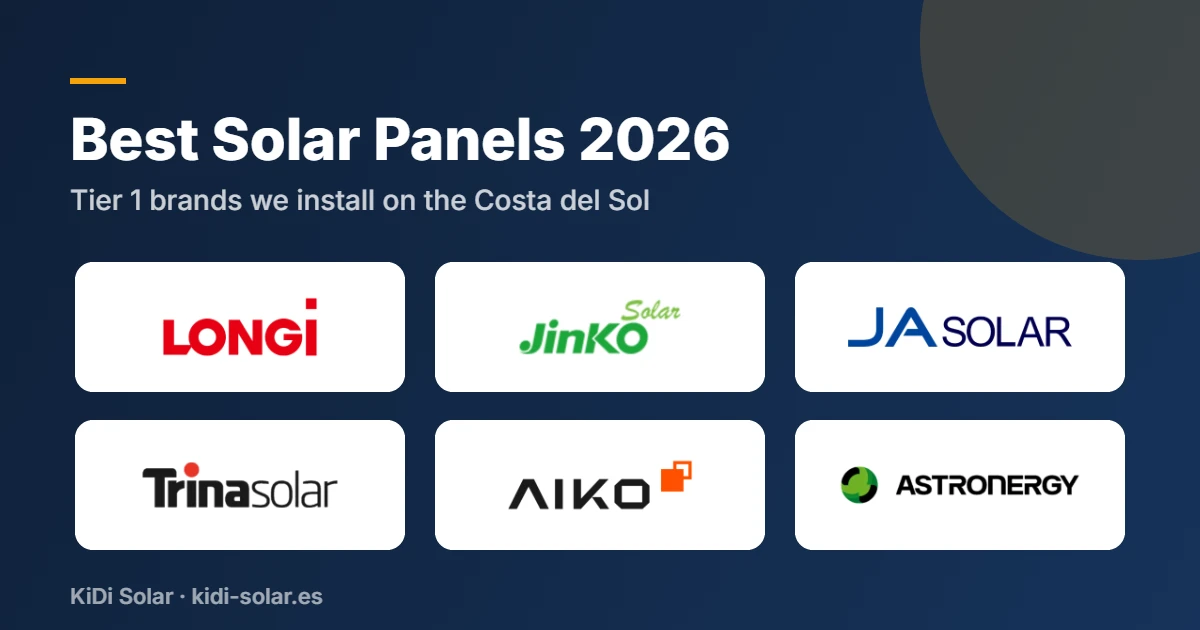
At KiDi Solar we install panels from six manufacturers: LONGi, JinkoSolar, JA Solar, Trina Solar, AIKO and Astronergy. All six are on the BloombergNEF Tier 1 list. In this guide we explain how they differ, which panel technologies matter, and how to choose the right panel for your roof.
Quick answer
- Limited roof space? Back-contact panels from LONGi (HPBC) or AIKO (ABC): the highest efficiency and a clean all-black look.
- Best value per watt? N-type TOPCon panels from JinkoSolar, JA Solar, Trina Solar or Astronergy.
- Flat roof, pergola or carport? Bifacial dual-glass panels capture extra light from below.
- Seafront home? Choose IEC 61701 salt-mist certified, dual-glass panels with corrosion-resistant mounting.
 Back-contact panels with top efficiency. Best when roof space is limited.
 N-type TOPCon at a strong price. Best value per watt.
 N-type TOPCon, bifacial options. Best for flat roofs and pergolas.
 N-type i-TOPCon, dual-glass options. A strong choice for coastal homes.
 All-black back-contact panels. Best for design and partial shade.
 N-type TOPCon at an entry price. Best for budget projects.
What matters in a solar panel on the Costa del Sol
Glossy brochures focus on peak power, but on the Costa del Sol four things decide how much energy, and how many years of savings, you actually get.
1. Efficiency and power
Efficiency tells you how much of the sunlight hitting a panel becomes electricity. Today’s residential panels reach roughly 22–24% module efficiency and 440–500 W per panel. Higher efficiency means more kilowatt-hours from the same roof, which matters most on smaller roofs, townhouses and roofs with chimneys, skylights or shading.
2. Performance in the heat
Panels produce slightly less as they get hotter. The temperature coefficient on the datasheet shows how much: modern N-type panels lose around 0.26–0.30% of their output for every degree above 25 °C. On a roof that reaches 60–65 °C in August, a lower coefficient gives you noticeably more energy every summer afternoon.
3. Salt air and humidity
Near the sea, salt mist can corrode frames, junction boxes and connectors. The international test for this is IEC 61701 (salt mist corrosion). For coastal homes we choose panels with this certification, prefer dual-glass construction and use corrosion-resistant mounting systems.
4. Warranties
Every panel has two warranties: a product warranty against manufacturing defects (typically 15–25 years) and a performance warranty that guarantees how much power the panel still delivers after 25–30 years (around 87–88% for the panels we install).
What “Tier 1” really means
BloombergNEF publishes a quarterly Tier 1 list of module manufacturers whose own-brand panels have been used in large, bank-financed projects. It measures bankability: financial strength and track record, not the quality of an individual panel. Still, it matters for homeowners: a Tier 1 manufacturer is much more likely to still exist in 25 years to honour your warranty.
All six brands we install appear on BloombergNEF’s Tier 1 list for Q2 2026, and they are among the largest manufacturers in the world, with annual capacities from about 35 GW (AIKO) to around 120 GW (JinkoSolar and LONGi).
Panel technologies explained
N-type TOPCon
TOPCon (Tunnel Oxide Passivated Contact) is the current mainstream technology. N-type TOPCon cells degrade very little, handle heat well and offer an excellent price per watt. JinkoSolar, JA Solar, Trina Solar and Astronergy build their main residential panels on TOPCon.
Back-contact (BC) panels
Back-contact cells move all electrical contacts to the rear of the cell, so the front surface has no metal lines and captures more light. LONGi calls its version HPBC and AIKO calls its version ABC (All Back Contact). The result is the highest efficiency in residential panels and a clean, uniform all-black look, at a slightly higher price.
Bifacial and dual-glass panels
Bifacial panels also generate power from light reflected onto their back side. They work best on flat roofs with a light surface, pergolas and carports. Dual-glass construction (glass on both sides) also makes panels more robust against humidity and salt air.
LONGi: back-contact efficiency from the world leader
Founded in 2000, LONGi is one of the two largest solar manufacturers in the world, with around 120 GW of annual production capacity, and it pioneered the move to monocrystalline silicon. Its latest residential panels use HPBC 2.0 back-contact cells.
Panels we install
- Hi-MO X10: back-contact (HPBC 2.0) N-type panels for homes, for example the Hi-MO X10 Explorer at 485 W and 23.8% module efficiency.
- Black-frame and full-black versions for a discreet look on villa roofs.
Strengths and what to consider
- Among the highest efficiencies available, ideal for limited roof space.
- Low temperature coefficient (-0.26%/°C on the Hi-MO X10 Explorer), good for hot summers.
- 15-year product and 30-year linear performance warranty on the Hi-MO X10 Explorer.
- Priced above standard TOPCon panels.
Best for
Villas and townhouses with limited or complex roof space, and owners who want maximum output and a premium look.
JinkoSolar: the world’s largest panel maker
Founded in 2006, JinkoSolar shares the top spot in global production capacity with LONGi (around 120 GW per year). Its Tiger Neo range is one of the best-selling N-type TOPCon panels in the world.
Panels we install
- Tiger Neo N-type TOPCon panels; JinkoSolar announced Tiger Neo 3.0 modules with up to 24.8% efficiency.
- Residential sizes around 440–500 W, including all-black versions.
Strengths and what to consider
- Excellent price per watt from the largest manufacturer.
- Low degradation: less than 1% in the first year and about 0.35% per year after that on the Tiger Neo 3.0 model we checked.
- 25-year product and 30-year power warranty on the Tiger Neo 3.0 455 W model.
- Very wide availability, so replacements and extensions are easy.
Best for
Homeowners who want proven, high-quality panels at the best value, and larger systems where cost per watt matters most.
JA Solar: reliable TOPCon with a strong track record
Founded in 2005, JA Solar is one of the four largest manufacturers in the world, with around 88 GW of capacity and a top AAA bankability rating. Its DeepBlue 4.0 Pro range uses N-type TOPCon cells.
Panels we install
- DeepBlue 4.0 Pro N-type TOPCon panels, for example the JAM54D40 bifacial dual-glass panel at around 460 W and 23% efficiency.
- Monofacial and bifacial, black-frame versions.
Strengths and what to consider
- Consistent quality and a long track record.
- Bifacial dual-glass versions suit flat roofs and pergolas.
- 15-year product and 30-year performance warranty (87% at year 30) on the JAM54D40 model we checked.
- Mid-range price.
Best for
Homeowners who want a dependable, well-priced TOPCon panel, and bifacial installations on flat roofs and pergolas.
Trina Solar: the pioneer with long warranties
Founded in 1997, Trina Solar is one of the oldest names in the industry and today the third-largest manufacturer, with around 100 GW of capacity and a AAA bankability rating. Its Vertex S+ range is designed for rooftops.
Panels we install
- Vertex S+ N-type i-TOPCon dual-glass panels, for example around 445 W and 22.3% efficiency.
- Compact, light dual-glass panels for residential roofs.
Strengths and what to consider
- Dual-glass construction: robust against humidity and salt air.
- Long 25-year product and 30-year performance warranty (87% at year 30) on the Vertex S+ model we checked.
- One of the longest-established manufacturers.
- Slightly lower efficiency than back-contact panels.
Best for
Coastal homes and owners who value durability and a long product warranty.
AIKO: record efficiency with ABC technology
Founded in 2009, AIKO specialises in ABC (All Back Contact) technology and states that its panels have topped the TaiyangNews ranking of mass-produced module efficiency since March 2023. Its annual capacity is around 35 GW.
Panels we install
- Neostar ABC N-type panels for homes, in all-black and black-frame versions.
- Designed for strong performance in partial shade.
Strengths and what to consider
- Very high efficiency and a sleek all-black look with no visible lines.
- Low degradation: at most 1% in the first year and 0.35% per year after, on the Neostar model we checked.
- 15-year product and 30-year performance warranty (88% at year 30) on that model.
- Premium price, similar to other back-contact panels.
Best for
Small or partly shaded roofs and design-conscious villas where looks matter as much as output.
Astronergy: TOPCon expertise from the CHINT Group
Founded in 2006 and part of the CHINT Group, Astronergy is one of the early private Chinese solar manufacturers and an N-type TOPCon pioneer, with around 56 GW of capacity and business in more than 140 countries.
Panels we install
- ASTRO N N-type TOPCon panels, including bifacial dual-glass versions around 445–450 W.
- Full-black and black-frame options.
Strengths and what to consider
- Strong value for money.
- Repeatedly named a PVEL “Top Performer” in independent reliability testing, according to the company.
- 15-year product and 30-year performance warranty (87% at year 30) on the ASTRO N model we checked.
- Less well known to homeowners than the biggest brands.
Best for
Budget-conscious projects and larger systems where you want Tier 1 quality at a lower price per watt.
Side-by-side comparison
| LONGi | JinkoSolar | JA Solar | Trina Solar | AIKO | Astronergy | |
|---|---|---|---|---|---|---|
| Founded | 2000 | 2006 | 2005 | 1997 | 2009 | 2006 |
| Capacity (GW/year) | ~120 | ~120 | ~88 | ~100 | ~35 | ~56 |
| Main residential tech | Back-contact (HPBC 2.0) | N-type TOPCon | N-type TOPCon | N-type i-TOPCon | Back-contact (ABC) | N-type TOPCon |
| Example module efficiency | 23.8% | up to 24.8% (Tiger Neo 3.0) | ~23% | ~22.3% | ~22.6–23.3% | ~22.3% |
| Product warranty* | 15 years | 25 years | 15 years | 25 years | 15 years | 15 years |
| Performance warranty* | 30 years | 30 years | 30 years (87%) | 30 years (87%) | 30 years (88%) | 30 years (87%) |
| Price level | Premium | Value | Mid-range | Mid-range | Premium | Value |
| Best for | Limited roof space | Best value | Bifacial / flat roofs | Coastal durability | Design & partial shade | Budget projects |
Want the right panels for your roof?
We check your roof, orientation, shading and budget, then recommend the panel that gives you the most energy for your money. The survey and quote are free.
How we choose panels for your roof
- On-site survey (1–2 days): roof size, orientation, tilt, shading, roof type and distance to the sea.
- Custom design and quote (1–3 days): we compare panel options for your roof and consumption, and match them to the right inverter.
- Permits and grid connection (1–5 days): we handle all the paperwork.
- Installation (4–10 days): our own team installs and commissions the system.
The panel is only half of the system: the inverter decides how much of that energy you actually use. Read our guide to the best solar inverters for Costa del Sol homes, or see our solar panel installation service and solar panel costs in Spain in 2026.
Warranty and service on the Costa del Sol
Your panels are covered by the manufacturer’s product and performance warranties, and KiDi Solar adds a 5-year installation warranty on our work. As a local installer based in Marbella, we handle any warranty claim with the manufacturer for you. We install across the coast, from Marbella to Málaga, Estepona and Sotogrande: see our Costa del Sol service area.
Solar Panels — FAQ
All six brands we install are BloombergNEF Tier 1 manufacturers, so the right choice depends on your roof and budget rather than on one “best” brand. For maximum output from a small or complex roof we often recommend back-contact panels from LONGi or AIKO. For the best price per watt, N-type TOPCon panels from JinkoSolar, JA Solar, Trina Solar or Astronergy are excellent. After a free survey we recommend the panel that gives you the most energy for your money.
Tier 1 is a list published by BloombergNEF of manufacturers whose own-brand panels have been used in large, bank-financed solar projects. It measures bankability, meaning the financial strength and track record of the manufacturer, not the quality of a specific panel. It is still a useful filter: a Tier 1 manufacturer is far more likely to be around in 25 years to honour your warranty. All brands we install are on the 2026 Tier 1 list.
N-type TOPCon panels are the current standard: high efficiency, low degradation and an excellent price per watt. Back-contact panels (LONGi HPBC and AIKO ABC) move all electrical contacts to the back of the cell, so more of the front surface captures sunlight. They are usually more efficient and look cleaner, but cost a little more. Back-contact makes most sense when roof space is limited; TOPCon is the best value when space is not an issue.
Often, yes. Bifacial dual-glass panels also capture light reflected onto their rear side, so on flat roofs with a light surface, pergolas and carports they can produce several percent more energy. On a standard tiled pitched roof the panel sits close to the tiles and the rear gain is small, so a monofacial panel is usually the better value there.
Yes, slightly. Every panel loses a small amount of output for each degree its cells heat up above 25 °C, which is the temperature coefficient on the datasheet (around -0.26 to -0.30% per °C for modern N-type panels). On a hot July afternoon that can mean a 5–10% dip. We reduce this by choosing panels with a low temperature coefficient and leaving ventilation space under the panels. The long sunny season more than compensates, which is why solar pays back so well here.
Yes, if you choose the right equipment. Close to the coast we use panels certified to IEC 61701 (the salt mist corrosion test), prefer dual-glass panels, and use corrosion-resistant aluminium and stainless steel mounting. We check the certificates on each datasheet before recommending a panel for a seafront property.
Quality panels typically produce electricity for 30 years or more. You get two manufacturer warranties: a product warranty against defects (typically 15–25 years, depending on the brand and model) and a performance warranty that guarantees around 87–88% of the original output after 30 years. On top of that, KiDi Solar gives a 5-year installation warranty.
It depends on your electricity use, roof space and whether you add a battery. Most homes we equip on the Costa del Sol use between 10 and 24 panels of 440–500 W, which means roughly 4.5 to 12 kW. During the free survey we size the system from your electricity bills, so you do not overpay for panels you do not need.
A light clean once or twice a year is usually enough, plus an extra one after a calima, when Saharan dust settles on everything. Rain removes most normal dust, but a heavy dust layer can cut production noticeably. Never use high-pressure water or abrasive products. We offer a maintenance and cleaning service.
You can usually add panels later if your inverter has spare capacity. It is best to match the new panels to the existing ones on the same string (similar power, voltage and current); otherwise we put them on a separate MPPT input or add a second inverter. We plan for future expansion from the start, so tell us if you expect an EV, a heat pump or a pool in the coming years.
Ready to start saving with solar?
Tell us about your home and we will design the right system for your roof. The survey and quote are free.
Related guides
- Best solar inverters: Huawei vs Growatt vs Deye vs Victron
- Solar panel installation on the Costa del Sol
- Home battery storage
Sources
- BloombergNEF Q2 2026 Tier 1 rankings (SolarQuarter)
- LONGi Hi-MO X10 Explorer (pv.de)
- JinkoSolar Tiger Neo 3.0 announcement (pv magazine)
- AIKO: About us (official website)
- Astronergy / CHINT company profile (Intersolar Europe)
- JA Solar JAM54D40 datasheet summary (Solartraders)
- Trina Solar Vertex S+ datasheet summary (Solartraders)