
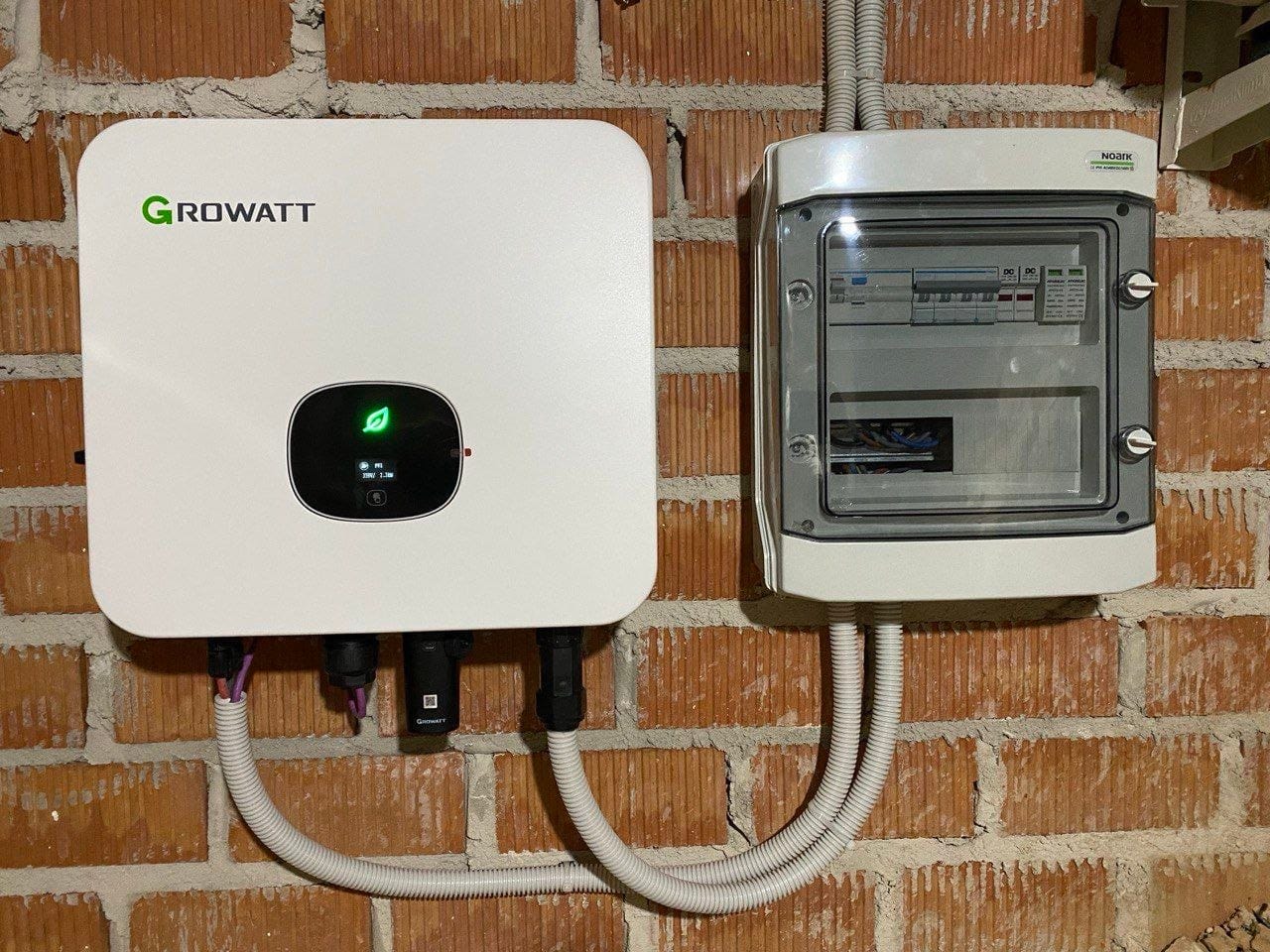
The inverter is the brain of every solar system. Your panels produce direct current (DC); the inverter turns it into the alternating current (AC) your home uses, decides when to charge or discharge your battery, when to export to the grid and, on the right models, keeps the lights on during a power cut. Choose the wrong one and even the best panels will underperform.
At KiDi Solar we have been installing solar systems on the Costa del Sol since 2022, and we work with four inverter brands: Huawei, Growatt, Deye and Victron Energy. In this guide we explain how they differ, which one suits which home, and what to check before you buy.
Quick answer
No single brand is best for every home. The right inverter depends on your electricity use, single- or three-phase supply, the size of your solar array, whether you want a battery or backup power, your roof and shading, the space available, your budget and future loads such as an EV charger, heat pump, pool or air conditioning. As a starting point:
 Premium all-in-one hybrid, excellent software and efficiency. Best for most villas that want a clean, smart system.
 Reliable and great value. Best when budget matters but you still want a quality hybrid with battery options.
 Strong backup and battery flexibility. Best for homes that want to keep running during power cuts.
 Modular and highly configurable. Best for off-grid fincas and homes that cannot afford outages.
What a solar inverter does, and why it is the brain of your system
Solar panels only produce DC electricity. The inverter converts it to 230 V AC for your home, tracks the best operating point of each panel string (MPPT) to squeeze out every watt, protects the system and reports everything to an app on your phone. Modern inverters reach a maximum efficiency of around 97–98%. The European weighted efficiency, which reflects real operating conditions, is slightly lower, and efficiency varies with load and temperature. In practice, good system design (array layout, MPPT configuration and shading) affects your annual yield far more than a fraction of a percent on a datasheet.
String vs hybrid inverters
A string (on-grid) inverter converts solar power and exports any surplus to the grid. A hybrid inverter does the same, but it can also charge and discharge a home battery and, with the right setup, power essential circuits during a blackout. Almost every system we install today uses a hybrid inverter, because adding a battery later is then simple and inexpensive.
Why a hybrid inverter makes sense in Spain
- Self-consumption pays more than export. The compensation you receive for surplus energy in Spain is lower than the price you pay for grid electricity, so storing your midday solar for the evening increases your savings.
- Evenings are when villas use the most power: air conditioning, pool pumps, cooking and lighting. A battery shifts solar energy into those hours.
- Power cuts happen, especially in rural areas and during summer storms. A hybrid inverter with a correctly installed backup system can keep your fridge, router, alarm and lights running.
Backup power: what a hybrid inverter can and cannot do
A hybrid inverter does not automatically keep your home powered during a blackout. Backup needs the whole chain to be in place:
- a compatible battery from the manufacturer’s approved list;
- the inverter’s backup (EPS) function, plus the approved backup switching equipment;
- a separate backup board for the circuits you want to keep running, or a suitable whole-home arrangement;
- correct configuration and commissioning.
It also helps to understand two numbers. Kilowatt-hours (kWh) are the energy stored in your battery; kilowatts (kW) are how much power the system can deliver at the same moment, which is limited by the inverter’s backup output. A 16 kWh battery behind an inverter with 5 kW of backup output can run up to 5 kW of appliances, for roughly three hours at full load, not 16 kW at once. Switching to backup also takes a short moment on most systems, so sensitive equipment may still need its own UPS.
Single-phase or three-phase? What Costa del Sol villas need
Your inverter must match your electricity supply. Spanish homes have either a single-phase (monofásica) or three-phase (trifásica) connection, and many larger villas on the Costa del Sol are three-phase.
How to know what your villa has
- Look at your electricity bill or contract: it states monofásica or trifásica.
- Your distribution board can give a clue, but it is not proof: some older properties have three-phase supplies without a neutral, and compatibility also depends on the meter, cabling and contracted power.
- The supply must be inspected by a qualified installer before choosing an inverter. We do this for free during the on-site survey.
When three-phase is the better choice
| Single-phase | Three-phase | |
|---|---|---|
| Typical home | Apartments, townhouses, smaller villas | Larger villas, fincas, homes with a pool or workshop |
| Typical inverter size | 3–6 kW | 5–15 kW and more |
| Heavy loads | Fine for normal household use | Pool pumps, heat pumps, several AC units, fast EV charging (11–22 kW) |
| Backup power | Backs up one phase | Can back up all three phases on suitable models |
Huawei: premium smart hybrid inverters
Huawei is one of the largest solar inverter manufacturers in the world: Wood Mackenzie ranked it number one in its global solar inverter manufacturer ranking for the first half of 2025. Its residential range, branded FusionSolar, is known for high efficiency, very good software and a clean, compact design.
Product lines we install
- SUN2000 hybrid inverters: single-phase and three-phase models for homes. The three-phase SUN2000-MAP0 series covers 5 to 12 kW and supports three-phase backup with Huawei’s backup box.
- LUNA2000 batteries: modular home batteries that you can expand step by step.
- Optional power optimizers for roofs with partial shading or panels facing different directions.
- FusionSolar app: production, consumption, battery and grid flows in real time.
Strengths and what to consider
- Top efficiency and very polished monitoring software.
- Typically a 10-year standard manufacturer warranty on SUN2000 inverters.
- Huawei batteries work with Huawei inverters, so the ecosystem is closed: great integration, less freedom to mix brands.
- Usually priced above Growatt and Deye.
Best for
Villa owners who want a premium, low-maintenance system with excellent app control, especially with a battery and optimizers on complex roofs.
Growatt: reliable quality at a smart price
Growatt was founded in 2010 in Shenzhen and has grown into one of the best-known inverter brands in Europe, with products in well over 100 countries. It is the brand we install most often: we have Growatt hybrid systems running in Estepona, Mijas and across the coast.
Product lines we install
- MIN TL-XH: single-phase, battery-ready hybrid inverters from 2.5 to 6 kW, up to 98.4% efficiency, IP65.
- MOD TL3-XH: three-phase, battery-ready inverters for larger villas.
- WIT series: higher-power three-phase hybrid inverters for large villas and small businesses.
- ARK and APX batteries: modular high-voltage batteries designed for Growatt inverters.
- ShinePhone app for monitoring.
Strengths and what to consider
- Excellent price-to-quality ratio and proven reliability.
- MIN TL-XH inverters typically come with a 10-year standard warranty.
- Battery-ready: you can start without a battery and add one later.
- The app is simpler than Huawei’s, but covers everything most homeowners need.
Best for
Homeowners who want a dependable hybrid system with a battery option at a sensible budget.
Growatt WIT hybrid inverters for large Costa del Sol villas
Large villas often need far more than a 5–10 kW system. A pool pump, several air-conditioning units, underfloor heating, a heat pump and an EV charger can easily push daytime demand beyond what a standard residential inverter can deliver. Growatt’s WIT series of three-phase hybrid inverters is designed for this range: higher output power to cover big daytime loads, connection to a substantial battery bank, backup options for essential circuits and monitoring of the whole system in one app.
For these homes the inverter, battery and electrical installation must be designed together: the three-phase supply, the contracted power, the backup board and room for future additions such as a second EV charger. You can see how this works in the engineering example below.
Good to know: Growatt also makes EV chargers, and we install 11 kW and 22 kW Growatt chargers. See our guide to EV charger installation.
Deye: backup power and battery flexibility
Deye inverters are made by Ningbo Deye Technology, founded in 2000 and listed on the Shanghai Stock Exchange since 2021. Its products are sold in more than 140 countries. Deye has built its reputation on hybrid inverters that keep a home running when the grid goes down.
Product lines we install
- SUN-SG hybrid inverters: single-phase and three-phase models, including versions for 48 V low-voltage batteries.
- Strong backup (EPS) capability and support for generator input on many models.
- Several inverters can work in parallel for bigger homes and fincas.
- Solarman app for monitoring.
Strengths and what to consider
- Flexible with batteries: works with a wide range of 48 V lithium batteries on Deye’s official compatibility list, not just one brand.
- Excellent for backup and weak-grid or off-grid situations.
- Warranty terms vary between 5 and 10 years depending on the model and distributor, so we confirm them in your quote.
- Many settings to configure: it needs an experienced installer to get the best from it.
Best for
Homes in areas with frequent power cuts, fincas with large batteries, and owners who want a lot of backup capacity for their budget.
Victron Energy: modular systems for maximum independence
Victron Energy is a Dutch company whose story goes back to the early 1970s. Today its equipment is used in more than 190 countries, from yachts and off-grid homes to telecom sites. Unlike the other three brands, Victron is not one all-in-one box but a modular system: an inverter/charger, separate solar charge controllers (or a grid-tie PV inverter) and a GX control unit work together.
Product lines we install
- MultiPlus-II and Quattro inverter/chargers: the core of the system, managing the battery, the grid connection and backup power.
- SmartSolar MPPT charge controllers for the solar panels.
- Cerbo GX control unit with the VRM online portal for monitoring and remote settings.
- ESS mode for grid-connected homes that want self-consumption plus backup.
Strengths and what to consider
- Outstanding backup performance and build quality.
- Very flexible: compatible with batteries on Victron’s published compatibility list and easy to expand.
- Victron gives a 5-year standard warranty on most products.
- More components, more design work and a higher price than all-in-one hybrids.
Best for
Off-grid and semi-off-grid fincas, homes that cannot afford a single power cut, and owners who want full control over their energy system.
Side-by-side comparison
| Huawei | Growatt | Deye | Victron Energy | |
|---|---|---|---|---|
| Type | All-in-one hybrid | All-in-one hybrid | All-in-one hybrid | Modular system |
| Price level | Premium | Mid-range | Mid-range | Premium |
| Single / three-phase | Both | Both | Both | Both (1 or 3 units) |
| Batteries | Huawei LUNA2000 | Growatt ARK / APX | Approved 48 V lithium batteries | Approved batteries from many brands |
| Backup in a power cut | Yes, with backup box | Yes, on selected models | Yes, strong | Yes, excellent |
| Monitoring app | FusionSolar | ShinePhone | Solarman | VRM |
| Typical standard warranty | 10 years | 10 years | 5–10 years | 5 years |
| Best for | Premium smart villas | Best value | Backup and large batteries | Off-grid and full control |
Not sure which inverter your villa needs?
We assess your electricity consumption, roof, battery requirements and backup needs, then recommend a suitable system for your Costa del Sol property.
Engineering example: a hybrid system for a high-consumption villa
To show how these choices work in practice, here is a system our engineers designed for a large villa on the Costa del Sol with a pool, air conditioning and high year-round consumption. The figures below are design estimates from our calculations, not measured results; the project is not yet installed.
| Design element | Estimate |
|---|---|
| Annual electricity demand | about 51,100 kWh |
| Solar array | about 25.5 kWp: 50 high-efficiency back-contact panels on a flat roof |
| Inverter | 25 kW three-phase hybrid inverter |
| Battery | 32 kWh nominal (two battery units) |
| Estimated annual solar production | about 44,200 kWh |
| Solar energy used directly | about 15,300 kWh per year |
| Energy supplied from the battery | about 10,700 kWh per year |
| Share of annual demand covered by solar | about 51% |
Why a 25 kW three-phase hybrid inverter here?
- High daytime loads: pool pumps and air conditioning run at the same time as peak solar production, so the inverter needs enough AC output to supply them directly.
- Three-phase supply: the house load is spread across three phases, and a three-phase inverter supplies all of them.
- Matched to the array: 25 kW of inverter output suits a 25.5 kWp array on a flat roof without wasting production.
- Evening use: the 32 kWh battery moves around 10,700 kWh of solar energy into the evening and night, when the villa still uses a lot of power.
- Honest limits: the panels produce about 86% of the villa’s annual demand, but because production and consumption do not always coincide, roughly half of the demand is covered by solar. The rest of the solar energy is exported, mostly at summer middays.
Most homes do not need this scale: many villas are well served by 5–12 kW of inverter power. The point is that the inverter is sized from the property’s real loads, not chosen from a brand list.
Planning a larger solar and battery system?
Three-phase villas with pools, air conditioning, heat pumps and EV charging need careful load, battery and backup design. Tell us about your property and we will look at the options.
Does a more expensive inverter actually save more money?
Not necessarily. An inverter’s price and its maximum efficiency do not decide your return on investment on their own. What matters is the whole system and how well it matches the way you use energy:
- Self-consumption: every kWh of solar you use yourself saves more than a kWh you export, because export compensation in Spain is lower than the price of grid electricity.
- Battery cost: a battery increases self-consumption, but it does not automatically give the shortest payback.
- Backup value: keeping the house running during an outage has real value, even if it does not appear on your bill.
- Lifetime: an inverter typically lasts 10–15 years, panels 30 or more, so plan for one inverter replacement.
- Warranty, monitoring and service: reliable support matters more than a small efficiency difference.
- Future expansion: an EV, heat pump or extra panels later may need more inverter capacity.
| Option | Makes sense when | Trade-off |
|---|---|---|
| Grid-connected inverter, no battery | You use most of your electricity during the day | Lowest upfront cost; evening use comes from the grid; no backup |
| Hybrid inverter, battery-ready | You want to start lean and add a battery later | Slightly higher cost now; easy battery upgrade later |
| Hybrid inverter with battery and backup | High evening use or frequent power cuts | Higher upfront cost; payback can be longer than solar alone |
| Modular backup system (e.g. Victron) | Outages are not acceptable, or the property is off-grid | Highest cost and design complexity |
We model each option with your consumption data and show you the numbers before you decide. We never promise guaranteed savings or payback, because they depend on your consumption and tariffs.
How KiDi Solar selects an inverter for your property
Our recommendation follows the same engineering steps for every property:
- Review your annual consumption and load profile from your bills.
- Analyse roof space, orientation and shading.
- Identify your grid connection: single or three-phase, contracted power and any limitations.
- Calculate a suitable solar array size.
- Choose the inverter output and MPPT configuration.
- Define your battery and backup needs.
- Check compatibility with your existing electrical installation.
- Find a cool, ventilated and accessible place for the inverter.
- Compare the lifetime economics of the realistic options.
- Give you a written, justified recommendation and an itemised quote.
Typical timeline:
- On-site survey (1–2 days): we check your roof, your electricity supply (single or three-phase), your consumption and where the inverter can be installed in a cool, shaded spot.
- Custom design and quote (1–3 days): we size the panels, inverter and battery, and recommend the brand that fits your needs and budget.
- Permits and grid connection (1–5 days): we handle the paperwork for you.
- Installation (4–10 days): our own team installs, configures and commissions the system, and sets up the app on your phone.
Want to see the bigger picture first? Read about our solar panel installation service, home battery storage or solar panel costs in Spain in 2026.
Warranty and service on the Costa del Sol
Every system comes with two layers of protection. The manufacturer warranty covers the inverter itself (see the table above). On top of that, KiDi Solar gives a 5-year installation warranty on our work. Because we are a local installer based in Marbella, if something goes wrong you call us, not a call centre abroad: we diagnose the problem, handle the warranty claim with the manufacturer and come to your home.
We install across the whole coast, from Marbella to Málaga, Estepona, Benahavís and Sotogrande. See our Costa del Sol service area.
Heat, salt air and where your inverter is installed
Every inverter reduces its output (derates) when it gets too hot, and Costa del Sol summers are hot. We follow each manufacturer’s minimum clearances, avoid direct afternoon sun and unventilated plant rooms or attics, and only use garages and utility rooms that are well ventilated. An IP65 or IP66 rating means the inverter is protected against dust and water jets; it does not by itself guarantee resistance to salty sea air. Near the coast we choose sheltered locations, use corrosion-resistant fixings and check connections during maintenance visits.
Solar Inverters — FAQ
No single brand is best for every home: it depends on your consumption, single- or three-phase supply, the size of your solar array, your battery and backup needs and your budget. As a guide, Huawei suits owners who want a premium, smart all-in-one system; Growatt offers excellent value and covers large three-phase villas with its WIT series; Deye is strong on backup power and battery flexibility; and Victron Energy suits off-grid fincas and homes that cannot afford outages. After a free survey we recommend the system that fits your property.
Battery capacity, in kilowatt-hours (kWh), is how much energy is stored. Backup power, in kilowatts (kW), is how much the system can deliver at the same moment, and it is limited by the inverter’s backup output. For example, a 16 kWh battery behind an inverter with 5 kW of backup output can run up to 5 kW of appliances for roughly three hours, not 16 kW at once. We size both to the circuits you want to keep running.
Your electricity bill or contract states whether your supply is monofásica (single-phase) or trifásica (three-phase). Many larger villas with pools, heat pumps or EV chargers are three-phase. The distribution board alone is not proof, as some older properties have unusual arrangements, so the supply should be inspected by a qualified installer. The inverter must match your grid configuration; we check this for free during the survey.
Yes, if you choose a hybrid or battery-ready inverter. Compatibility is specific: the battery must be on the manufacturer’s approved list, match the inverter’s voltage range, communicate with it through its battery management system and run compatible firmware, sometimes with an extra accessory. That is why we plan battery compatibility from day one, even if you install the battery a few years later.
Not automatically. A grid-connected system switches off during an outage for safety. To keep power during a blackout you need a hybrid inverter with its backup (EPS) function enabled, a compatible battery, approved backup switching equipment and usually a separate backup board for your essential circuits, all correctly configured. Only the circuits within the inverter’s backup output can run, and most systems take a short moment to switch over.
A quality inverter typically lasts 10 to 15 years. Manufacturer warranties depend on the product family, model and region, and some require product registration. As a guide, Huawei and Growatt residential hybrid inverters commonly come with around 10 years, Victron Energy products with 5 years, and Deye between 5 and 10 years depending on model and distributor. We confirm the exact terms in your quote. Separately, KiDi Solar gives a 5-year warranty on our installation work.
The location matters as much as the brand. Any inverter loses output when it overheats, so we install it out of direct sun with the manufacturer’s clearances, in a ventilated space. Near the sea we choose sheltered spots and corrosion-resistant fixings, because an IP65 or IP66 rating protects against dust and water, not specifically against salt. All four brands we install can work well on the coast when they are installed correctly.
Yes. Huawei uses the FusionSolar app, Growatt uses ShinePhone, Deye systems are usually monitored with Solarman, and Victron Energy uses the VRM portal. You can see solar production, home consumption, battery level and grid export in real time. With your permission we can also monitor the system remotely and spot problems early.
Usually, yes, if it is planned from the start. The inverter size, your contracted power and your supply (an 11 kW charger needs three-phase) all need to allow for it, and dynamic load balancing stops the charger from overloading your home. Some manufacturers, including Growatt, also make EV chargers that integrate with their monitoring app. Tell us if an electric car is in your plans and we will size the system accordingly.
Usually, yes, without replacing your panels. If your current inverter has failed, is out of warranty or you want to add a battery, we can replace it with a hybrid model sized to your existing array. First we check your panel strings, voltages and grid connection, and we handle the paperwork if the change affects your registered installation.
Get the right solar system for your home, not just the right brand
A tailored design and a transparent, itemised quote: we match the inverter, panels and battery to how you actually use energy. The survey and quote are free.
Related guides
Sources
- Huawei FusionSolar (official website)
- Growatt (official website)
- Deye: company information (official website)
- Victron Energy: This is Victron (official website)
- Wood Mackenzie global solar inverter ranking, H1 2025 (SolarQuarter)
How we compared: this guide is based on the manufacturers’ published specifications and warranty documents and on our own installation experience with these brands on the Costa del Sol. Specifications and warranty terms vary by model and region, so we confirm the exact terms in every quote. Last reviewed: 18 October 2026.