
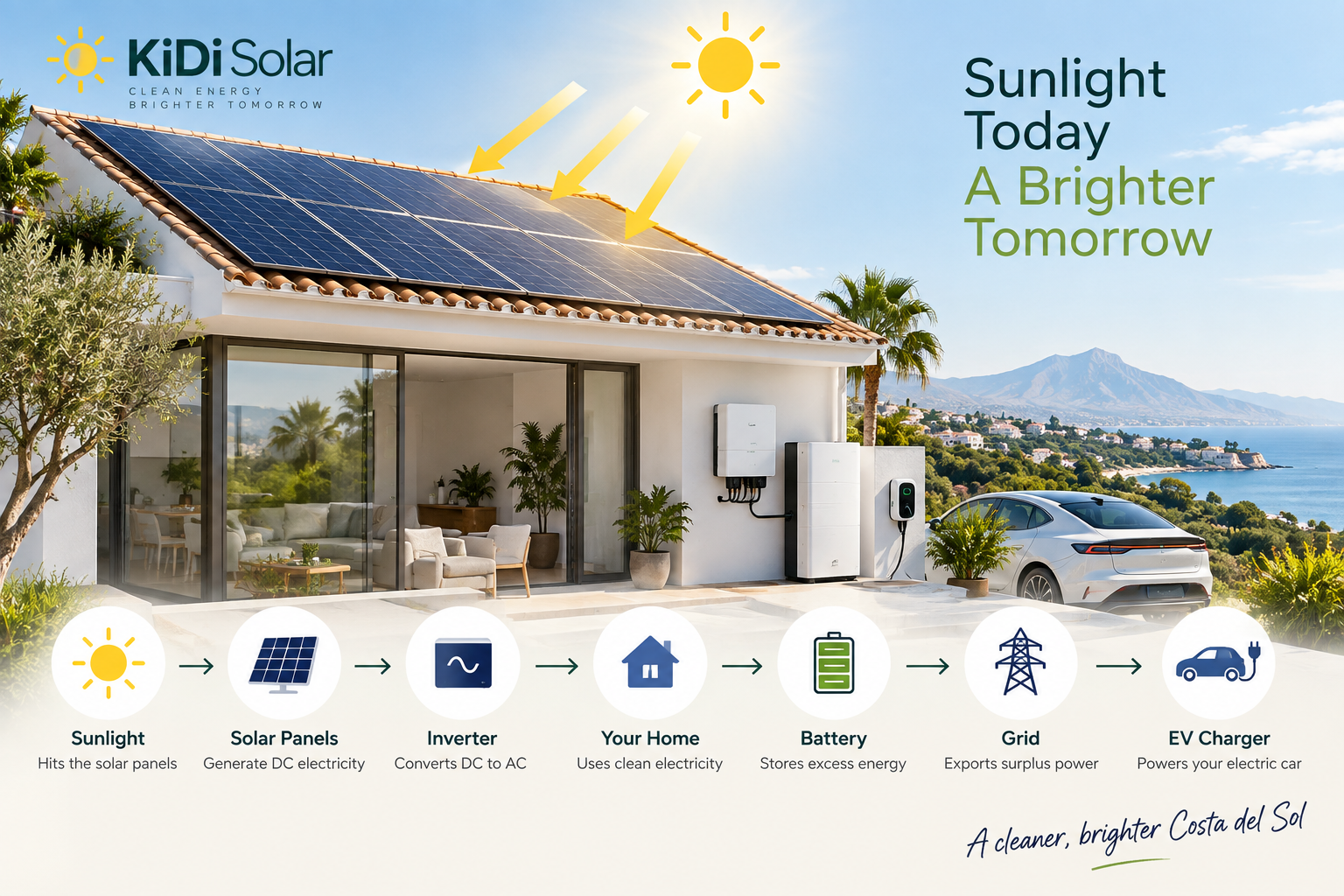
Solar panels convert sunlight directly into electricity through a physical process called the photovoltaic effect — no fuel, no combustion, no moving parts. For homeowners and villa owners across Marbella and the Costa del Sol, understanding how that process actually works, and what happens to the electricity once it’s generated, is the first real step toward deciding whether a photovoltaic system makes sense for a specific property.
This guide explains the science in plain language, walks through every component of a working home solar system, and answers the practical questions homeowners in southern Spain ask most often — from what happens on a cloudy day to how solar, batteries and EV chargers work together.
Quick answer
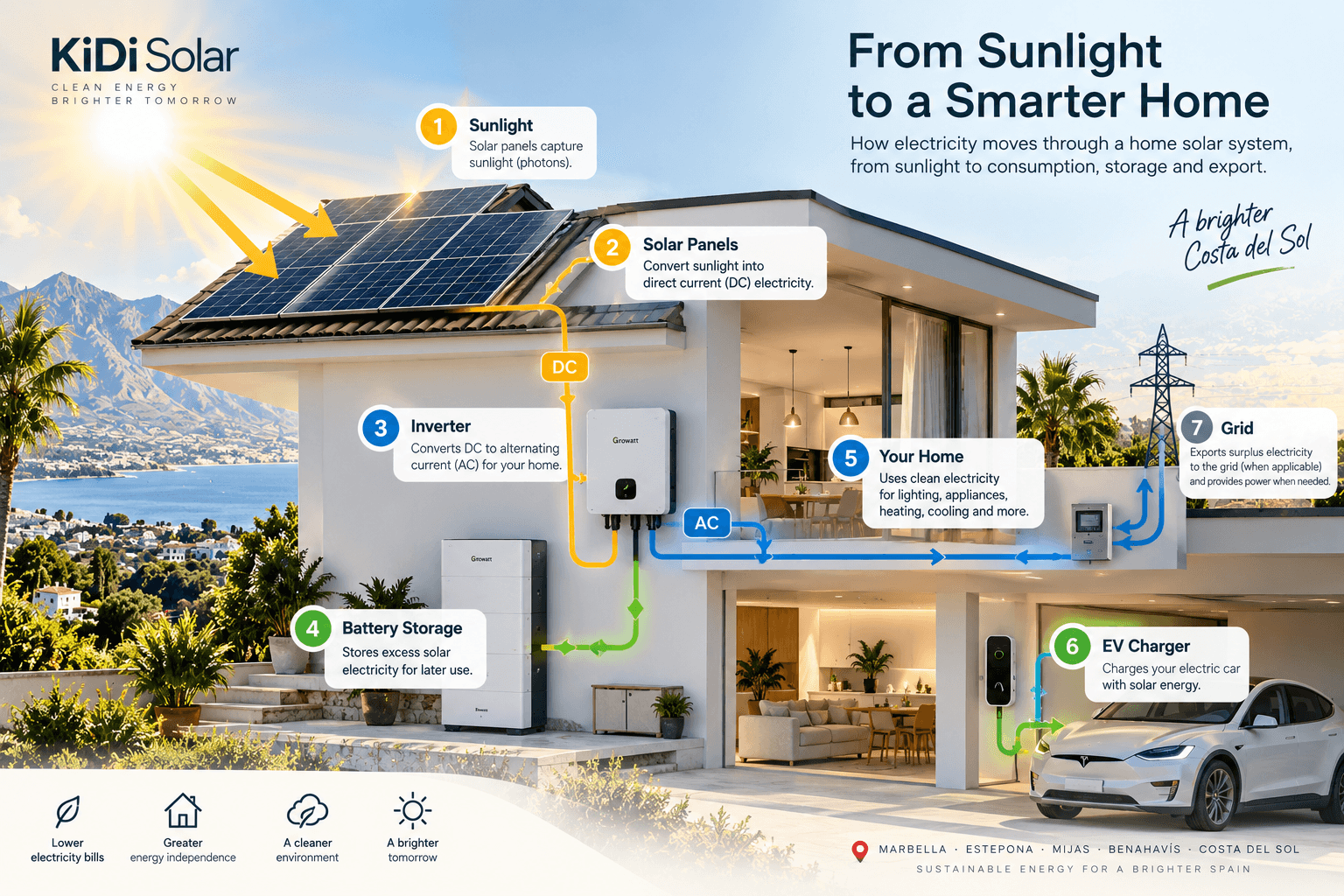
Solar panels contain photovoltaic cells that generate direct current (DC) electricity when sunlight strikes them. A solar inverter converts this DC electricity into alternating current (AC), the type of electricity used by household appliances. The property consumes this AC electricity first; any surplus can charge a battery, and any electricity beyond that can be exported to the grid. This entire process happens automatically, continuously, for as long as the sun is shining.
How Solar Panels Work in 30 Seconds
Before going into detail, here is the complete process from sunlight to a working electrical current inside the home.
Sunlight reaches the photovoltaic cells inside each solar panel.
The cells generate direct current (DC) electricity.
A solar inverter converts DC into usable AC electricity.
The property consumes solar electricity directly.
Surplus electricity can charge a battery, if one is installed.
Any remaining surplus can be exported to the electricity grid.
What Is the Photovoltaic Effect?
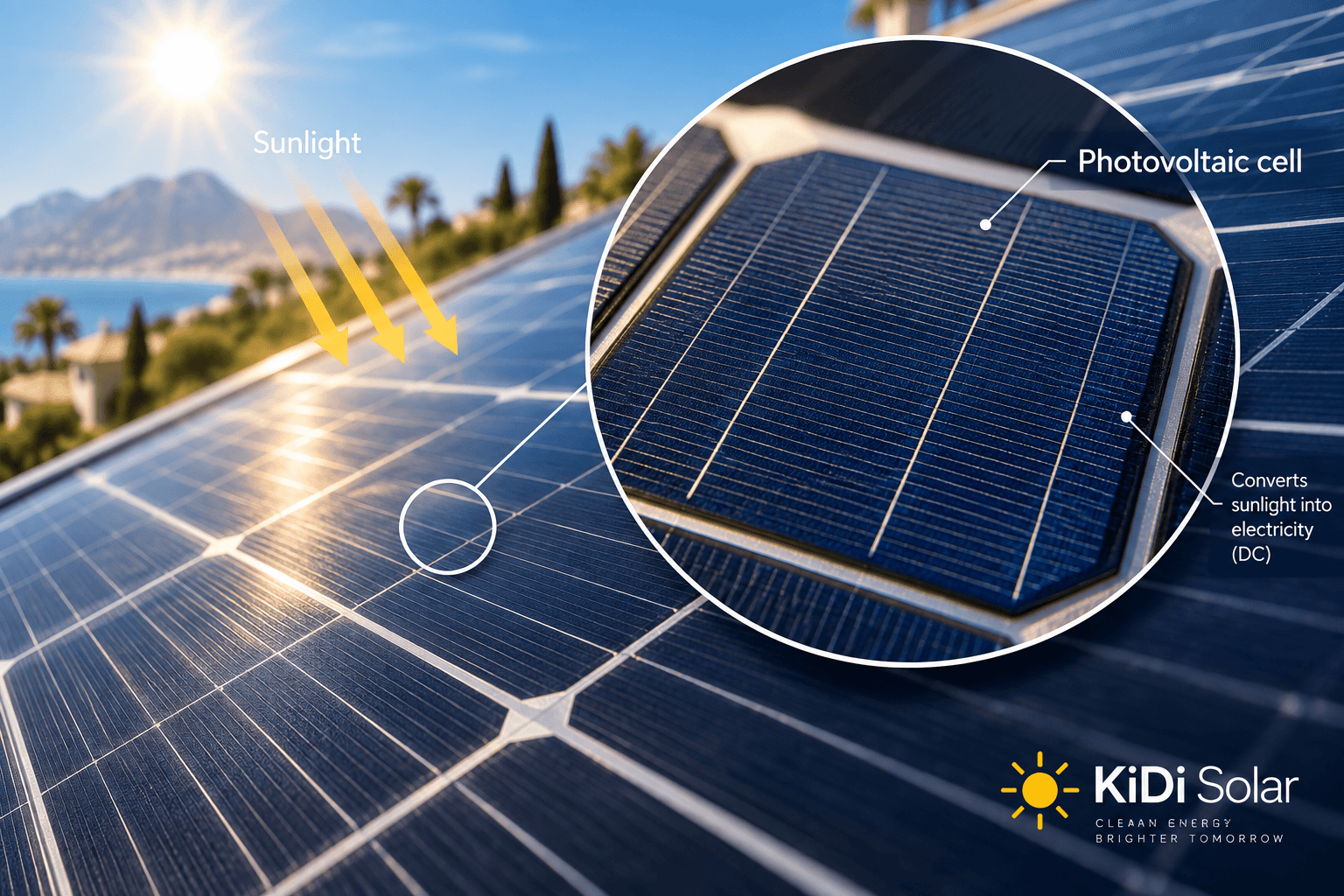
The photovoltaic effect is the physical reaction that allows a solar cell to generate electricity from light. Solar panels are built from cells made of silicon, a semiconductor material — meaning it conducts electricity better than an insulator like glass, but not as freely as a metal.
Each cell is manufactured with two layers of silicon that have been treated to behave differently: one layer has a surplus of free electrons, the other has a shortage of them. Where these two layers meet, an electric field forms.
Sunlight is made up of photons — small packets of energy. When a photon strikes the silicon with enough energy, it knocks an electron loose from its atom. The electric field at the junction between the two layers pushes that freed electron in a single direction. Metal conductors on the surface of the cell collect this directed flow of electrons, which is direct current (DC) electricity.
A single cell only produces a small amount of power on its own, which is why dozens of cells are wired together, sealed between glass and a protective backsheet, and framed into what is sold as a solar panel.
What Are Solar Panels Made Of?
A residential solar panel is a relatively simple physical object, built from a small number of components working together:
Photovoltaic cells
The individual silicon units that generate DC electricity from sunlight, wired together in a grid inside the panel.
Silicon
The semiconductor material at the core of most solar cells, chosen for its ability to release electrons when struck by light.
Glass
A tempered, low-iron glass front layer that protects the cells while allowing maximum light through.
Frame
Usually anodised aluminium, giving the panel structural rigidity and a fixing point for the mounting system.
Conductors
Thin metal ribbons and busbars that collect and carry the electrical current generated by each cell.
Bypass diodes
Small components in the panel’s junction box that reroute current around a shaded or underperforming section of cells, protecting overall output.
How a Complete Home Solar System Works
A solar panel on its own only generates DC electricity. Turning that into a usable, safe, monitored home energy system requires several additional components working together.
Solar panels
Convert sunlight into DC electricity. Usually installed on a south-facing or optimally oriented section of roof.
Solar inverter
Converts DC electricity into AC electricity that household appliances and the grid can use.
Electrical protection
Circuit breakers, surge protection and isolation switches that keep the installation safe and compliant.
Energy meter / smart meter
Measures electricity flowing to and from the grid, forming the basis for self-consumption accounting.
Battery storage
Optional. Stores surplus solar electricity generated during the day for use later.
Monitoring system
Displays real-time and historical data on generation, consumption, battery state and grid exchange.
Electrical grid
Supplies electricity when solar and battery are insufficient, and can receive exported surplus where applicable.
KiDi Solar designs each of these components around the property’s roof, electrical infrastructure and consumption pattern as part of every solar panel installation.
Not sure what size solar system your property needs?
A correctly sized system depends on your roof, your consumption and your goals — not a generic estimate.
Get a Free Solar AssessmentWhat Does a Solar Inverter Do?
A solar inverter converts the direct current (DC) electricity produced by photovoltaic panels into alternating current (AC) electricity, which is the type of electricity used by household appliances and supplied by the electricity grid. Without an inverter, the electricity generated by solar panels cannot be used inside a home.
There are several types of inverter used in residential installations:
- String inverter — a single central inverter connected to a “string” of panels wired together. A common, cost-effective choice for straightforward roof layouts.
- Microinverter — a small inverter fitted to each individual panel, allowing each one to operate independently. This can be useful on roofs with partial shading or multiple orientations.
- Hybrid inverter — manages both solar panels and battery storage from a single device, controlling how electricity moves between generation, consumption, battery and grid.
Hybrid inverters are particularly relevant for any property planning to install a battery, now or in the future, since they are built to manage battery charging and discharge as part of their core function rather than requiring a separate charge controller.
What Happens to Solar Electricity During the Day?
Solar generation follows the sun, while household electricity consumption follows daily habits — and the two rarely match perfectly. A simplified example for a villa on the Costa del Sol illustrates how this typically unfolds:
| Time of day | Typical solar generation | Typical household demand |
|---|---|---|
| Morning | Rising as the sun climbs | Moderate — kitchen, lighting, early appliance use |
| Midday | At or near peak output | Often lower if occupants are out, unless pool pumps or AC are running |
| Afternoon | Still strong, gradually declining | Rising — air conditioning, EV charging, general activity |
| Evening | Falling rapidly toward zero | Often the highest point of the day — cooking, lighting, entertainment |
| Night | None | Lower, but continuous — standby loads, occasionally AC or heating |
This mismatch between generation and consumption is the central reason system design matters: a property that uses most of its electricity in the evening will benefit from solar very differently than one with high daytime use.
What Happens to Excess Solar Electricity?
When solar panels generate more electricity than the property is using at that moment, the surplus has one of three possible destinations:
- Immediate consumption — used by other appliances or systems running elsewhere in the property at that moment.
- Battery storage — where a battery is installed, surplus electricity charges it for use later in the day or evening.
- Grid export — once consumption needs and any battery are covered, remaining surplus can be exported to the electricity grid.
This is the basic principle behind solar self-consumption: using as much of your own generated electricity as possible before drawing from, or exporting to, the wider grid. The proportion of solar electricity a property actually uses itself — rather than exporting — depends on its consumption pattern, system size and whether a battery is installed.
How Solar Batteries Work
A solar battery stores surplus DC electricity from the panels (or AC electricity converted back to DC, depending on system architecture) chemically, so it can be released again later when the property needs it rather than when the sun is generating it.
During the day, surplus solar electricity charges the battery. In the evening or at night, the battery discharges, supplying the property with stored solar electricity instead of drawing from the grid. This is the main reason batteries can increase a property’s self-consumption rate — they shift solar electricity generated at midday to when it’s actually needed.
Important distinction
Having a battery does not automatically mean a property will have electricity during a power cut. Backup power — sometimes called EPS (Emergency Power Supply) — requires a compatible inverter, correctly designed backup circuits, and system architecture built specifically to support it. A standard grid-connected solar-plus-battery system will typically shut down during a grid outage unless it has been specifically designed and equipped for backup operation.
Read more in our detailed guide on solar battery storage in Spain.
Considering solar panels with battery storage?
Battery sizing and backup capability depend on your inverter, your consumption pattern and your goals.
Ask KiDi SolarDo Solar Panels Work at Night?
No. Solar panels require light to generate electricity through the photovoltaic effect, so production stops once the sun sets. Any electricity used at night comes from a battery, if one is installed and charged, or from the electricity grid.
Do Solar Panels Work on Cloudy Days?
Yes, but generally at reduced output. Solar cells respond to daylight, not exclusively to direct sunlight, so panels continue to generate electricity when the sky is overcast. The exact reduction in output depends on cloud density and thickness, and varies considerably from one day to the next, so it should be understood as a real but variable effect rather than a fixed percentage.
Do Solar Panels Work in Winter?
Yes, solar panels continue generating electricity throughout the winter months. What changes seasonally is the number of daylight hours, the sun’s angle in the sky, and typically the intensity of solar radiation reaching the panels — all of which affect daily output. This is why annual production, rather than the output of any single day, is the meaningful figure when evaluating a solar system.
Southern Spain’s climate, with comparatively high solar irradiance across the year, is one of the reasons photovoltaic systems are widely considered for properties along the Costa del Sol — though actual year-round performance still depends on the specific roof, orientation and shading of each property.
How Solar Panels Work With the Electricity Grid in Spain
Most residential solar installations in Spain are grid-connected self-consumption systems, meaning the property remains connected to the public electricity grid alongside its solar system. Conceptually, these systems are designed to draw on each source of electricity in a specific order:
- Solar first — electricity generated by the panels is used before any other source.
- Battery second — where installed, stored solar electricity is used once direct solar generation isn’t sufficient.
- Grid when required — the grid supplies any remaining electricity needs once solar and battery (if present) have been used.
- Surplus export where applicable — electricity beyond the property’s needs and any battery capacity can be exported to the grid.
The specific rules, registration requirements and compensation mechanisms for self-consumption and grid export in Spain are governed by national and regional regulation. For guidance on how these rules apply to a specific property, a qualified installer or an official source should always be consulted directly.
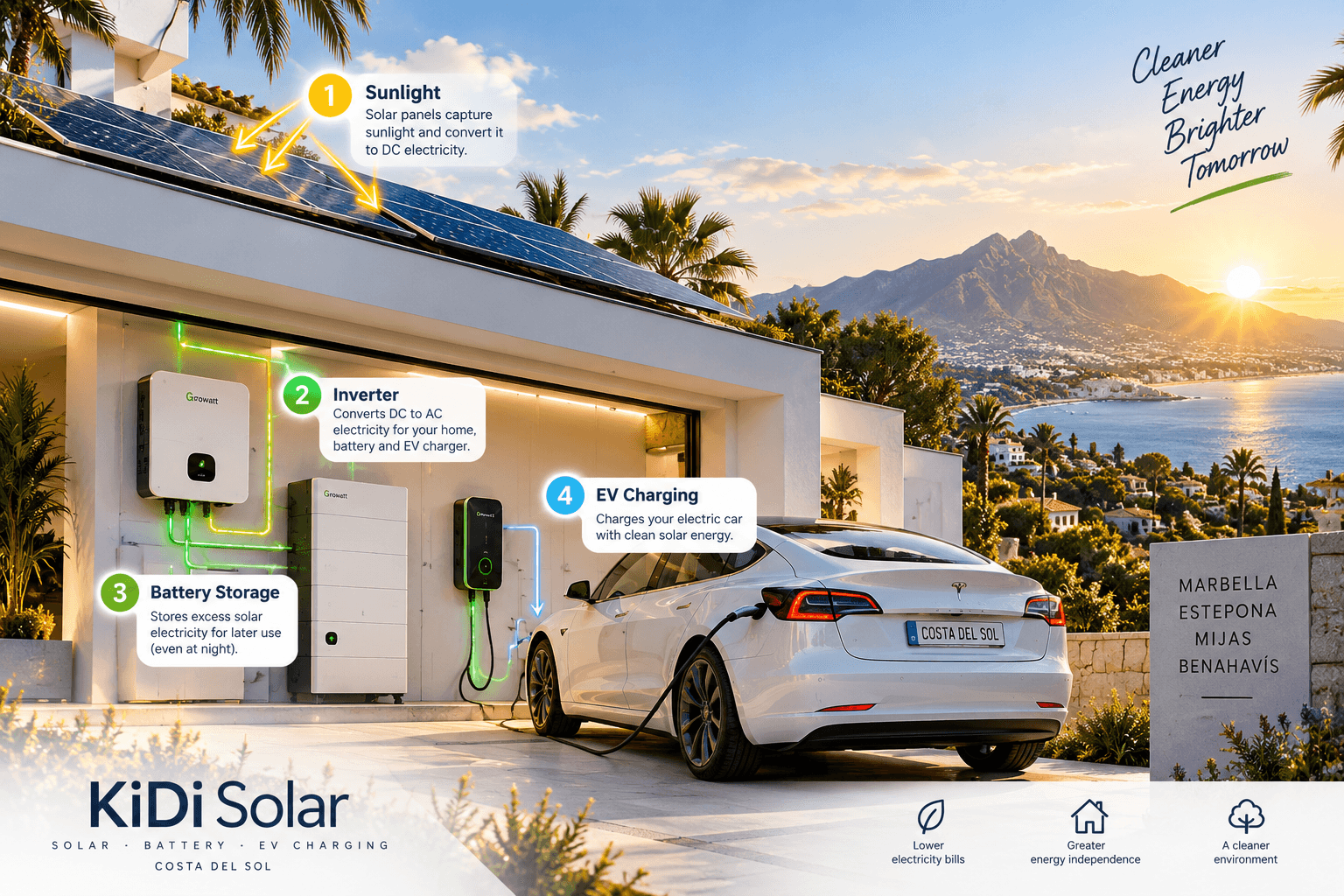
Solar Panels + Battery + EV Charger
An increasing number of properties on the Costa del Sol are combining solar panels, battery storage and an EV charger into a single coordinated system, rather than treating each as a separate installation:
Solar panels generate electricity.
The house consumes what it needs directly.
Surplus charges the battery.
The EV charger draws from solar or battery where available.
Any remaining need is met by the grid.
Coordinated system design matters most for villas with multiple significant electrical loads — swimming pools, air conditioning, heat pumps, EV charging — because these loads compete for the same solar surplus and battery capacity. Sizing the inverter, battery and charger together, rather than adding each one independently over time, tends to produce a more efficient result. KiDi Solar also provides EV charger installation designed to integrate with an existing or new solar system.
How Many Solar Panels Does a House Need?
There is no single correct number of panels that applies to every home — the right answer depends on a combination of property-specific factors:
- Annual electricity consumption
- How much of that consumption happens during daylight hours
- Roof orientation and usable area
- Shading from trees, neighbouring buildings or roof features
- The wattage of the panels being used
- Whether an EV is planned or already owned
- Swimming pool pumps and filtration schedules
- Air conditioning and heat pump usage
- Whether a battery is part of the system, and how it will be used
Because of this, generic sizing rules or online calculators based on square metres of roof alone can be misleading. KiDi Solar designs each system based on the property’s actual energy profile — reviewing consumption data, roof conditions and future plans — rather than a one-size-fits-all estimate.
Example: How Solar Could Work in a Costa del Sol Villa
Illustrative example
Property: A villa in the Marbella area with a swimming pool, air conditioning, an electric vehicle, and generally high daytime electricity use from pool filtration and family activity.
On a sunny day, solar panels begin generating electricity in the morning as pool pumps and early appliances draw power. Through midday, generation typically peaks — potentially covering pool filtration, background loads and part of any daytime air conditioning directly from solar. Surplus generation during these hours could charge a battery, if installed, or be exported to the grid.
In the afternoon and evening, as air conditioning, EV charging and household activity increase while solar generation declines, the property would draw on any charged battery first, then on the grid for anything beyond that.
This is a simplified, illustrative example only. Actual solar production, self-consumption and savings depend on the specific property’s roof, shading, consumption pattern, system design and equipment — and should be assessed individually.
Solar Panels With Battery vs Without Battery
| Without battery | With battery | |
|---|---|---|
| Initial complexity | Simpler system, fewer components | More components; inverter and battery compatibility must be considered |
| Daytime self-consumption | Limited to what’s used as it’s generated | Same as without battery — battery affects storage, not generation |
| Night-time solar energy availability | None — grid supplies the property overnight | Stored solar electricity can supply the property overnight, within battery capacity |
| Grid dependence | Higher outside daylight hours | Reduced, depending on battery size and consumption |
| Backup potential | None — grid-tied systems shut down in a power cut | Possible, but only with a compatible inverter and backup-specific design |
| Best suited for | Properties with high daytime consumption relative to solar generation | Properties with significant evening or night-time consumption, or a wish for partial backup |
Neither configuration is universally better — the right choice depends on when a property actually consumes electricity, its budget, and whether backup power is a priority.
Grid-Tied vs Hybrid vs Off-Grid Solar
| System type | How it works | Typical relevance |
|---|---|---|
| Grid-tied | Connected to the public grid; exports surplus and imports when solar is insufficient; no battery | Common for properties prioritising daytime self-consumption and a simpler, lower-cost system |
| Hybrid | Connected to the grid, but includes battery storage managed by a hybrid inverter, with optional backup capability | Common for properties wanting higher self-consumption, evening solar use, and potentially partial backup |
| Off-grid | Not connected to the public grid; relies entirely on solar generation and battery storage, often with a backup generator | Relevant mainly for remote properties without a practical grid connection |
The great majority of residential properties on the Costa del Sol use grid-tied or hybrid systems, since these are already connected to the electricity grid. The choice between them depends on the property’s objectives — cost, self-consumption, and whether backup power matters.
How Long Do Solar Panels Last?
Solar panels don’t fail outright after a fixed number of years — they degrade gradually, producing slightly less electricity year by year as the materials inside age. Manufacturers commonly provide two types of warranty: a product warranty covering material and workmanship defects, and a longer performance warranty guaranteeing a minimum output level after a set number of years. These figures vary by manufacturer and panel range, so they should be confirmed against the specific product being installed rather than assumed as an industry standard.
In practical terms, a well-installed system using quality equipment can remain productive for several decades, which is why equipment selection and installation quality have a meaningful long-term impact on a system’s value.
How Is Solar Production Monitored?
Modern solar inverters typically include monitoring functionality, usually accessible through a smartphone app or web dashboard. This generally allows a homeowner to track:
- Real-time and historical solar production
- Household electricity consumption
- Battery state of charge, where a battery is installed
- Electricity imported from the grid
- Electricity exported to the grid
Monitoring shifts maintenance from reactive to proactive — a performance issue can often be identified through the monitoring platform rather than discovered months later through an unexpectedly high electricity bill. KiDi Solar’s maintenance and cleaning service also covers the physical side of upkeep, which matters particularly on coastal properties exposed to dust, pollen and sea-salt residue.
Are Solar Panels Worth It on the Costa del Sol?
This depends on several variables specific to each property, rather than a single yes-or-no answer:
- Current and future electricity consumption
- How much of that consumption happens during daylight hours (the self-consumption ratio)
- System price and available equipment options
- Roof conditions — orientation, shading, structural suitability
- The property’s electricity tariff
- Whether battery storage is included, and its cost
- Whether an EV is owned or planned
- Expected changes in future electricity consumption
What does make the Costa del Sol particularly relevant for evaluating solar is its consistently high solar availability across most of the year, which supports strong potential generation — provided the system itself is correctly sized and designed for the property. Evaluating these factors together, rather than focusing on price per panel alone, is what determines whether a specific installation makes financial and practical sense.
Solar Panel Installation in Marbella and the Costa del Sol
KiDi Solar designs and installs photovoltaic systems for homeowners, villa owners and businesses across the Costa del Sol, including Marbella, Estepona, Benahavís and Mijas, as well as Fuengirola, Benalmádena, Torremolinos, Málaga, Ojén and Sotogrande.
Every installation begins with an assessment of the property’s roof, electrical infrastructure and actual consumption pattern, followed by system design, professional installation and the registration steps required for grid-connected self-consumption in Spain.
Expert note from KiDi Solar
Two properties with similar annual electricity consumption can still require very different solar system designs. Their hourly consumption profiles, roof conditions and future energy needs — a planned pool, an EV, an extension — are rarely identical, and each of these factors changes how a system should be sized and configured. This is why KiDi Solar starts every project with an assessment of the property itself, rather than a standard package.
Frequently Asked Questions
How do solar panels work?
Solar panels work by using photovoltaic cells, usually made of silicon, to convert sunlight into direct current (DC) electricity. A solar inverter then converts this DC electricity into alternating current (AC), which is what household appliances and the electricity grid use. The property consumes this electricity directly, with any surplus available for battery storage or grid export.
Do solar panels work at night?
No, solar panels do not generate electricity at night, because they require light to produce a current through the photovoltaic effect. During night-time hours, a property draws electricity from a battery, if one is installed and charged, or from the electricity grid.
Do solar panels work when it is cloudy?
Yes, solar panels continue to generate electricity on cloudy days, since they respond to daylight rather than only direct sunlight. Output is generally reduced compared with clear-sky conditions, and the exact reduction varies depending on cloud thickness and density.
Do solar panels work in winter in Spain?
Yes, solar panels continue generating electricity throughout winter. Daily output tends to be lower than in summer due to fewer daylight hours and a lower sun angle, which is why annual production, rather than a single day’s output, is the more meaningful measure of system performance.
What happens to excess solar electricity?
Excess solar electricity can be used immediately by other appliances in the property, stored in a battery if one is installed, or exported to the electricity grid once consumption and any battery capacity have been covered. Which of these applies depends on the system’s design and what’s installed at the property.
Can solar panels charge a home battery?
Yes. Surplus DC electricity from the solar panels, or AC electricity via a hybrid inverter depending on system architecture, can charge a compatible home battery. The battery then discharges that stored electricity later, typically in the evening or at night, reducing how much electricity the property needs to import from the grid.
Can solar panels charge an electric car?
Yes. A solar system can supply part or all of the electricity used to charge an EV, particularly when charging takes place during daylight hours or from a battery charged by solar earlier in the day. Coordinated system design helps ensure the EV charger, battery and household consumption don’t compete unnecessarily for the same solar electricity.
Will solar panels work during a power cut?
Not automatically. Standard grid-connected solar systems, including many with a battery, are designed to shut down during a grid outage for safety reasons. Backup power during a blackout requires a compatible inverter, correctly designed backup circuits, and a system specifically configured for that purpose.
How many solar panels do I need for a villa in Marbella?
There is no fixed number that applies to every villa — it depends on the property’s annual and daytime electricity consumption, roof orientation and shading, panel wattage, and factors like a pool, EV or air conditioning. A proper assessment of the property’s actual energy profile is needed to determine an appropriate system size.
What does a solar inverter do?
A solar inverter converts the direct current (DC) electricity produced by photovoltaic panels into alternating current (AC) electricity, which household appliances and the electricity grid use. Hybrid inverters also manage battery charging and discharge as part of the same device.
Can I add a battery to an existing solar system?
Often yes, though this depends on the existing inverter’s compatibility with battery storage, its firmware, and the overall electrical configuration of the installation. A qualified installer needs to assess the existing system before confirming whether — and how — a battery can be added.
Are solar panels worth installing on the Costa del Sol?
This depends on the specific property — its electricity consumption, roof conditions, tariff, and whether a battery or EV charging is part of the plan. The Costa del Sol’s consistently high solar availability supports strong potential generation, but whether a system is worthwhile still depends on correctly matching its design to the property’s actual energy needs.
Find out how solar could work for your property.
Every property uses energy differently. KiDi Solar can analyse your electricity consumption, roof and future energy requirements to design a photovoltaic system for your property.
Request a Personalised Solar Quote